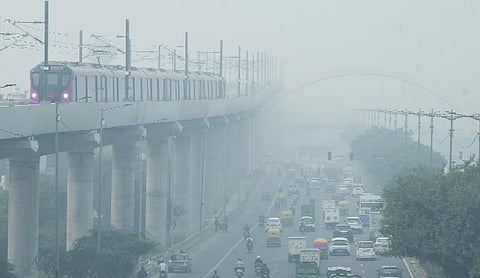

The national Capital replaced Lahore on Friday as the world’s most polluted city in the morning, with the Air Quality Index (AQI) reaching ‘severe’ levels and visibility dropping as smog blanketed the city, prompting residents to report breathing difficulties and respiratory discomfort. In the evening, Tehran and Bishkek (Kyrgyzstan) overtook it.
A thick layer of grey smog hung over the city through the day, shrouding buildings and reducing visibility across several stretches. A hazy sky obscured the skyline, while the sun appeared as a faint disc behind a blanket of pollution. The haze was particularly pronounced in the morning, when several parts of the city were enveloped in dense smog. Unfavourable weather conditions and weak winds contributed to the persistence of pollutants close to the ground.
In a recent analysis by Dalberg Advisors and the Clean Air Fund, air pollution cost the Indian economy around $260 billion in 2024-roughly 6 per cent of GDP. The analysis suggests that cutting PM2.5 pollution by around 20 per cent could help avert $85 billion in economic losses by 2030.
A 2021 report by Dalberg and the Clean Air Fund, which estimated the annual cost of air pollution to Indian businesses at $95 billion, had already highlighted the productivity problem.
It estimated that presenteeism reduced employee productivity by 8-10 per cent on high-pollution days in 2019, translating into losses of around $24 billion that year. The report also estimated that absenteeism cost businesses $6 billion.
The findings are significant amid the recurring political debate over the sources of Delhi’s pollution, particularly stubble burning in Punjab and Haryana, and the contribution of vehicles, industrial emissions and other local sources.
Delhi’s air quality remained toxic and in the “very poor” category, with the AQI settling at 373 at 4 pm. The national capital woke up to another morning of hazardous air quality on Friday, with the instantaneous AQI touching 403 at 6:05 am and remaining at the same level at 8 am and 9 am, according to the Central Pollution Control Board’s (CPCB) Sameer app.
According to the Decision Support System (DSS) data, transport was the largest contributor to Delhi’s pollution at 18.5 per cent, followed by residential sources at 4.6 per cent, peripheral industries at 3.7 per cent, construction at 2.5 per cent, road dust at 1.3 per cent and other sectors at 1.2 per cent.
Among the National Capital Region (NCR) districts, Jhajjar in Haryana recorded the highest contribution at 7.2 per cent, followed by Gurugram (Haryana) at 5.4 per cent, Gautam Buddh Nagar (Uttar Pradesh) at 4.8 per cent, Bulandshahr (Uttar Pradesh) at 4.4 per cent, Faridabad (Haryana) at 3.3 per cent, Ghaziabad (Uttar Pradesh) at 3.1 per cent, Bhiwani (Haryana) at 2.2 per cent, Rohtak (Haryana) at 1.9 per cent, Alwar (Rajasthan) at 1.8 per cent and Sonipat (Haryana) at 1.2 per cent. The other districts accounted for 18.1 per cent.