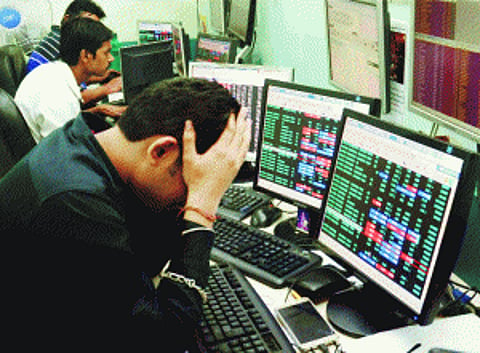

Britain’s shocking exit from the European Union (EU) on ‘Black Friday’ shook global financial markets and the tremors rocked Dalal Street also eroding nearly Rs 4-lakh crore from the investors’ wealth.
Following the unprecedented development, the Government, Reserve Bank of India (RBI) and other financial regulators, including the Securities and Exchange Board of India (SEBI), sought to allay fears saying the fall in Indian stock markets and currency trade was relatively moderate in comparison to many other currencies globally.
The Finance Ministry rushed to calm jangled nerves, saying that India’s sound macro-economic fundamentals, backed by planned structural reforms and firewalls, would help it weather any major Brexit fallout.
“It offers a silver lining to the Indian economy in terms of decline in oil prices and likelihood of a rate hike delay in the US,” the Finance Ministry said.
Earlier, in the first half of trading hours, the volatile market saw a huge sell-off due to uncertainty over the future prospects of Indian-run companies in the UK and other European countries, but a late buying spree by domestic financial institutions, reform talks and the Government’s assurances helped the market recoup and recover some losses. In early trade the BSE Sensex crashed nearly 1,100 points before regaining some ground and closing at 26,397.71, down 605 points. Similarly, the NSE 50-share Nifty was also trading down by 310.30 points or 3.75 per cent to quote at 7,960.15, and later settled at 181 points at close, while the rupee, which took a big hit by almost 96 paise, fell below the Rs 68-mark against the US dollar.
However, gold, considered a safe-haven investment, soared to a 26-month high in the bullion market.
The Brexit hit major domestic companies with Tata Motors crashing by 11.40 per cent and Tata Steel by about 9 per cent. Besides, ICICI Bank, Axis Bank, SBI, Adani Ports, larsen, ONGC and Reliance Industries were also down significantly. Apart from Indian stocks, all stocks on European, Asian and US bourses were trading in the red zone.
In order to allay fears among investors, both Finance Minister Arun Jaitley and RBI Governor Raghuram Rajan assured that there was no cause for panic as India’s economic fundamentals remained strong along with other macro indicators.
Rajan promised to provide liquidity and correct any disorderly market behaviour following UK’s exit, saying that after initial investor worries over Brexit, funds should return to India.
On the other hand, worried over the currency situation, the RBI chief said he was concerned about currency intervention by nations to create a competitive advantage and asked Central banks around the world not to cause currency devaluations.
“The RBI is watching all markets, both internationally and domestically, and will provide domestic or foreign liquidity in appropriate amounts. As of now, all the markets seem to be working and if there are disruptions in the markets and liquidity is not available from certain quarters, we are fully ready to provide whatever liquidity is needed. India should not see any major foreign selling given its relatively better fundamentals relative to other economies,” Rajan said.
Chief Economic Adviser Arvind Subramanian said the Government has enough ‘ammunition’ to deal with volatility in the currency market and India is going to be a haven of stability and opportunity in these uncertain times.
“let’s not see this as unremittingly gloomy. There are a couple of silver linings. Oil prices have come down. That’s good for India’s macro situation,” Subramanian added. In line with Subramanian’s view, Economic Affairs Secretary Shaktikanta Das also asserted that India has the firepower to withstand the impact of Britain’s exit from the EU and did not expect foreign trade to suffer.
With Britain’s decision, India Inc also feels that Indian companies will re-work their business strategy in the region.
“European markets are one of the key drivers for Indian companies investing in the UK. With the UK voting to leave the EU, Indian companies will re-engineer their European strategy. This should not be an issue. India will not be affected due to Brexit if we look at a mid to long-term perspective,” CII president Naushad Forbes said, adding that the India-UK relationship is an important one, within or without the EU.