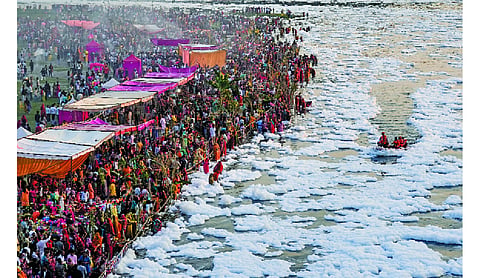

Flagging repeated failures to clean the Yamuna River despite spending huge sums, the Supreme Court has come down hard on the authorities, warning they will be penalised for deteriorating water quality. It also said compensation or a fine should be deposited with the court’s registry.
Directing the Central Pollution Control Board (CPCB) to monitor water quality at the points where the Yamuna and 520 drains enter and exit States, Union territories and districts, a bench of Justices Manoj Misra and Manmohan said pollution has only increased despite huge sums being spent on cleaning the river, reflecting the failure of civic administration across towns and cities along its banks.
During the presentation, the bench pointed out a few contradictions in the draft Yamuna Action Plan submitted to this SC. For instance, the plan does not propose the removal of encroachments on water bodies and wetlands alongside Zone ‘O’, on the ground that they are free of encroachments.
However, Annexure-9 to the Draft Yamuna Action Plan, prepared by the NCT of Delhi, marks all 35 water bodies and wetlands in Zone ‘O’ as “Yes” for encroachment. Further, although the Plan states that 28 of the 37 existing Sewage Treatment Plants in Delhi meet the standards stipulated by the Central Pollution Control Board in its report at Annexure V, the report states that none of these Plants meets all the prescribed standards and that only five meet the bacteriological limit.
“This court thinks that everything that is wrong with the civic administration in towns, cities and villages situated along the banks of the river is reflected in the poor health of the river and in the 520 drains that discharge wastewater into the Yamuna. This is why, despite huge sums being spent on cleaning the river, pollution in the Yamuna has only increased,” the bench said while hearing a plea related to cleaning of the river.
“If the water quality deteriorates on any parametre while flowing through, or exiting a State/Union Territory or a District therein, then that State/Union Territory or District within the State/Union Territory shall be held accountable and penalised. The said compensation/ fine shall be deposited with the Registry of this Court. The Central Pollution Control Board to suggest a formula for computation of fine/compensation,” it said.
The top court said industrial pollution and untreated sewage must be curtailed, if not stopped altogether, at the source. “Where that is not possible, the sewage must first be tapped and then treated. However, tapping will remain a challenge in the absence of a robust sewage system and due to the joining of stormwater and sewage drains.
“This court is further of the opinion that it would be difficult, if not impossible, for civic authorities to tap sewage in most illegal and unauthorised colonies built on encroached land, since they have not been built on a grid layout and have hardly any space for laying a sewage system,” it said.
The top court said that unless illegal and unauthorised colonies and ‘jhuggi-jhopdi’ (slum) clusters on the drains and on the riverbed are removed, with rehabilitation of their occupants, their sewage will continue to pollute the river. The court directed that if water quality deteriorates while passing through a particular state, Union territory or district, the concerned authorities would be held accountable and penalised.
The top court also directed the CPCB to investigate and submit a detailed report with respect to any incident of pollution in the Yamuna, such as fish deaths, floating of white foam on the surface, eutrophication or algal bloom, or increase in Biochemical Oxygen Demand (BOD), Chemical Oxygen Demand (COD), or Total Suspended Solids (TSS) levels.
“The Chief Secretaries of each of the Yamuna Basin States and Union Territories, as well as the Secretaries of the concerned Central Ministries, shall, within two weeks from today, nominate a senior officer not below the rank of Special Secretary to act as the Nodal Officer,” the bench said. The matter has been listed for hearing on January 13, 2027.