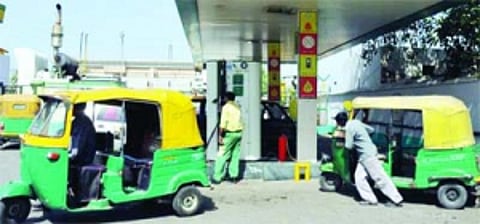

In an outright politically motivated move, the Government on Monday cut CNG prices by a steep Rs 15 per kg and piped cooking gas (PNG) by Rs 5/unit. The Government re-scheduled domestic gas supplies from fields operated by ONGC and Oil India ltd (OIl) to CNG (transport sector) and PNG sector from the existing 80 per cent to 100 per cent.
The decision will provide instant relief to consumers in cities like Delhi, Ahmedabad, Sonepat, Meerut, Bareli, Indore, Surat and Hyderabad. Explaining about the rationale behind the decision, the Ministry said retailers like Indraprastha Gas ltd (IGl, which supplies CNG and PNG) were being forced to import a part of their gas supplies. After the CNG price was hiked in Delhi by Rs 4.50 per kg last month, the AAP Government and auto-rickshaw drivers had proposed to hold a Maha Panchayat this week to decide their future course of action.
Meanwhile, coinciding with its decision to slash gas price, the Centre on Monday withdrew its petition from Supreme Court where it challenged the order by Bombay High Court staying the Guidelines on Supply of Natural Gas. The Centre’s surprise move came with an explanation that it had revised the earlier policy after it met with severe criticism from State Government, including AAP-led Delhi Government.
Ironically, three days ago the Centre had requested a bench headed by Justice Hl Dattu to resolve all disputes relating to the guidelines at the earliest. On Monday, the same bench was informed that the guidelines have been revised. The proposal in this respect was cleared by the Ministry of Petroleum and Natural Gas earlier in the day. Petroleum Minister M Veerappa Moily told the media that the price reduction would come into effect immediately.
As per the decision taken by the Government, it has now been decided to meet the requirements of all CNG and PNG retailers in the country from domestic fields, sparing them the need to buy costlier lNG (liquefied natural gas). This has been done by upwardly revising the existing 80 per cent supply quota from gas fields for CNG and PNG sectors to 100 per cent. “The price of CNG in Delhi will be reduced by about Rs 15 per kg (about 30 per cent). There will also be a reduction of about Rs 5 per cubic metre (about 20 per cent) in the price of PNG,” Moily said.
Supplies to CNG retailers have been increased by cutting about 1.9 million standard cubic metres per day or one-third of the domestic gas allocated to non-core users in the steel, oil refineries and petrochemical sectors. CNG retailers, or city gas distributors, will get 8.32 mmscmd of gas from fields given to ONGC and Oil India, as compared to 6.4 mmscmd presently.
The political lollypop though may not taste too sweet for long as from April 1, 2014 onwards gas prices are likely to almost double when the C Rangarajan panel suggested formula comes into effect. According to this formula, gas prices are likely to double from $4 per mmBtu to $8 per mmBtu.
While strongly denying that the move was aimed at wooing voters, Moily said that it was being planned for quite some time and the principal motive was to promote greater usage of eco-friendly fuel.
To bolster his claims, Moily, while citing data given by Central Pollution Control Board (CPCB), said that in his constituency Bengaluru the emission level was 41 per cent compared to highly populated metros like Delhi and Mumbai where these were recorded at 7 per cent and 6 per cent respectively. At the same time he added that “our target is always to benefit the common man. If it helps the common man, we are happy. If some political party also stands to benefit, it is incidental”.
However, there will be no cut in rates in Mumbai, which gets all its gas requirements from domestic fields. “All city gas entities in the country will get natural gas at uniform price. Rates of CNG and piped gas will however vary from city to city depending on transportation charges and local sales tax or VAT,” Moily said. There is no value added tax (VAT) on CNG in the national capital, he said, asking other State Governments to waive local levies on the environment friendly fuel. The decision had a major effect on IGl’s share price on BSE which surged by 7.74 per cent to Rs 266.70 per share.