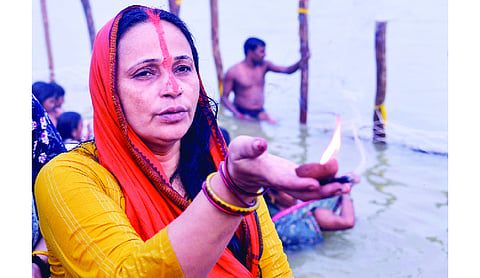

For thousands of devotees preparing to approach Delhi’s water bodies this Chhath, the familiar sounds of home may come not just from folk songs and family conversations, but also from loudspeakers. Along the newly developed 11 km-long Munak Canal ghat, safety announcements in Maithili and Bhojpuri will guide devotees through the rituals, precautions, and instructions.
The Delhi Police has prepared voice messages in Maithili and Bhojpuri to communicate safety guidelines. The messages will be played at all the ghats to make devotees aware of dos and don’ts in their familiar languages and help prevent any untoward incident during the festival.
Delhi Chief Minister Rekha Gupta has directed officials to ensure adequate arrangements for Chhath Puja, so devotees are not inconvenienced. The chief minister held a meeting with officials from several departments and issued necessary directions, her office said in a statement. “It is the Government’s responsibility to ensure that every devotee and person observing the fast has access to a safe, clean and convenient environment for offering prayers. Clear responsibilities have been assigned to all the departments concerned,” the statement said. As directed by the chief minister, all necessary arrangements and personnel deployment at the ghats have been ensured by November 16, it added.
The police have made elaborate security arrangements along the 11-km stretch, including deployment of additional personnel on both sides of the canal. CCTV cameras have also been installed at key junctions and traffic choke points to monitor the movement of people and vehicles closely. Around 10 watchtowers have also been constructed along the canal to facilitate surveillance, particularly at night, a senior police officer said.
Medical camps, first-aid teams, ambulances and paramedical personnel are also being arranged at major locations, with nearby hospitals connected to respond to emergencies.
The scale of the preparations reflects how deeply Chhath has become part of Delhi’s cultural landscape. For families who migrated from Bihar, Jharkhand and eastern Uttar Pradesh, the festival is an annual reaffirmation of ties with their native places. Its rituals, songs and traditional offerings travel with them, transforming neighbourhood ponds, riverbanks and temporary ghats into extensions of the villages they left behind.
Unlike many festivals centered on temples, Chhath brings worship into the open, placing water and the Sun at the heart of its observance. The four-day ritual begins with Nahay Khay, when devotees observe ritual purification and prepare a simple meal. Kharna follows, with a day-long fast broken after sunset through offerings of jaggery-based kheer and chapatis. Thekua, bananas, coconuts and sugarcane are among the traditional offerings carefully arranged in bamboo baskets.
The most significant moments come on November 15 and 16, when devotees will offer Sandhya Arghya to the setting Sun and Usha Arghya to the rising Sun. Standing in water, often after observing a rigorous fast without food or water, devotees offer prayers to Surya, expressing gratitude for the life-sustaining force of nature. The worship of the setting Sun alongside the rising one gives the festival its distinctive symbolism: reverence not only for beginnings, but also for endings.
At Shalimar Bagh, where VIP movement is expected around the new ghat, police have planned additional security and traffic management measures. Diversions will also operate across parts of East, North-East and Shahdara districts on November 15 and 16. Civic agencies have been assigned responsibilities ranging from sanitation and drinking water to electricity, mobile toilets and post-festival cleanliness.