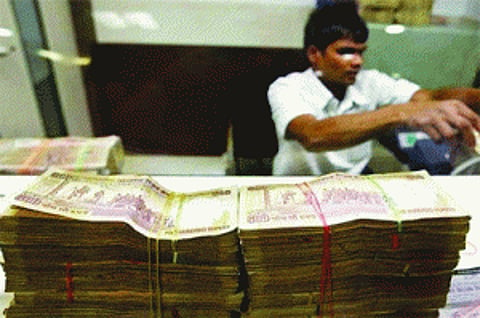

In what could be a bonanza for the States, the CAG has estimated that the Centre owes nearly Rs82,000 crore to them towards sharing of net proceeds of taxes and duties collected over two decades. This whopping figure is the due from Direct Taxes collections starting from 2005-06, Indirect Taxes from 1999-2000 and Customs duties from 1996-97 financial years.
Net proceeds means total of taxes and duties minus the cost of collection. Article 270 of the Constitution mandates the Centre to share the net proceeds of taxes and duties in the Union list with the States.
The CAG’s estimation known as Certification of Rs81,647.7 crore was submitted to the Finance Ministry on February 19. In a meeting last week the Public Accounts Committee (PAC) also decided to take up this issue to ensure speedy disbursement to the States.
“As desired, I forward here a statement showing the difference between net proceeds of the taxes and duties assignable to the States under Article 270 of the Constitution of India, based on the recommendations of the successive Finance Commissions, as worked out by us and actually assigned to States as per respective Finance Accounts of the Union Government for the period 1996-07 to 2014-15. The total amount, to be further devolved to the States comes out to rupees eighty one thousand six hundred forty seven crore and seventy lakh,” said the CAG’s covering letter of Certification to the Finance Ministry.
The CAG also asked the Ministry of Finance to revert back about the implementation of sharing with States.
Bhartruhari Mahtab, BJD MP, who raised the matter in last week’s PAC meeting demanded that there should be a prompt mechanism to hand over the Centre’s share to States. It is learned that several MPs raised concerns on the Centre’s slow action and demanded speedy disposal of money owed to States.
The issue of sharing of taxes mentioned in the Union list got clarity after the 80th amendment to the Constitution in 2000.
But still there were doubts on the status of Customs Duties and the Ministry of Finance never clarified to the CAG about it for the past 15 years.
“In the course of certification process, it was however felt that in respect of non-shareable segment of the Union excise duties clarifications should be sought from the Ministry of Finance as to whether the duties collected under the sub major head…….In case of Customs Duties, there was a doubt on surcharge. Accordingly, a reference was made to the Ministry of Finance for clarifications. Though the matter was semi-officially reminded at the DAI level several times, no response/ clarifications received. As a result there was inordinate delay in issue of the certificates.
“In late 2004, it was felt that since no clarification was forthcoming from the Ministry of Finance and there was no likelihood of immediate solution, this office should proceed with the issuance of the certificates in case of other direct/indirect taxes at least,” said the CAG’s office detailing the long -standing tussle and ambiguity in sharing of Centre and States.
Till 2000, there were lot of ambiguity in sharing of taxes and duties between Centre and States. After the passage of 80th amendment of the Constitution in June 2000, a radical shift in the devolution of the financial resources from the Union to the States took place. The amended Article 270 of the Constitution provided that all taxes and duties referred to the Union list, except those mentioned in Articles 268 and 269, surcharge on the taxes and duties as well as any cess levied for specific purpose under any law made by the Parliament, were to be shared with the States.
Prior to the 80th amendment, taxes on income other than agricultural income and a part of Union Excise duties were required to be shared by the Union Government with the States. As a result of the 80th amendment, net proceeds of other taxes and duties like Corporate Tax, Customs, Service Tax and non-shareable segment of the Union excise duties also become shareable with the States.