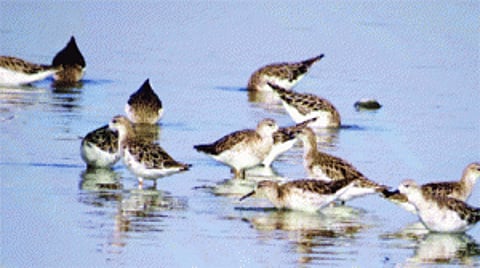

There is a big reason for birdwatchers to rejoice as the national Capital has witnessed a substantial increase in the population of birds, both domestic and migratory. In just a span of two years, the population of winged visitors in the city has swollen by almost 300 per cent, from 134 in 2013 to 513 in 2015 till now.
Moreover, several migratory birds have been spotted after several years. Interestingly, while their numbers have significantly declined in the “traditional” habitats like Okhla Bird Sanctuary, birds now find their abode in crematoriums, drains and scantly explored riverbanks.
According to the Asian Waterbirds Census (AWC), the population of waterbirds in the capital stands at 513 in 2015, an increase of 17 per cent from the last year figures. “It is an intriguing phenomenon we have come across this time. In 2013, the population of waterbirds in Delhi was only 134, which increased to 439 in 2014, and this year it is 513. Migratory birds like Ruff, Whiskered Tern and Bar-headed Geese have been sighted after ages,” said TK Roy, AWC Delhi co-coordinator.
Astonishingly, a large number of birds were found in crematoriums and filthy areas this year. Explaining the reason, Roy said that the birds have found alternate habitats as the old ones like Okhla Bird Sanctuary, National Zoological Park, Bhalswa lake in north Delhi, Hauz Khas lake and Sanjay lake in East Delhi are open to excessive human interference.
“The fact that birds are now being spotted in the most polluted or dirtiest points of Delhi means they are changing their habits as per the situation for survival. They now feed on decomposed garbage and food particles,” he added.
Even as most of the natural wetlands in Delhi are shrinking due to rapid urbanisation, over 19 species of waterbirds were sighted which is a substantial increase from the year 2013 when the figures stood at just seven. With 23 species, the year 2014, however, saw the maximum diversity in waterbirds.
Among the “resident bird” species in Delhi are little Cormorant and Black-winged Stilt. Other “migratory birds” include Black-headed Gull, Common Redshank, little Stint, Common Sandpiper and three species of Wagtails, most of which fly from Central Asia, north Asia and Siberia.
The AWC is a volunteer largest waterbird census which is conducted simultaneously throughout Asia in 27 countries once in a year in the month of January. “The aim of the census is to record the status of important wetlands and noting the diversity of waterbirds for global conservation. In Delhi, the AWC covers four important wetlands — Okhla Bird Sanctuary, River Yamuna, Najafgarh Drain and Jheel and the Delhi Zoo,” said another member of AWC.