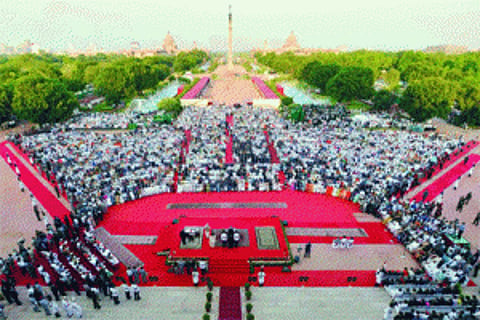

Ushering in an era of BJP’s dominance in national governance, Narendra Modi on Monday assumed the office of Prime Minister at the head of a 45-member Council of Ministers.
After a hard-fought victory, Modi sought to balance factors of caste, religion, region and gender with those of talent, experience, youth and national aspirations unleashed by him during his nationwide campaigning. That the task has been far from easy was amply reflected in under-representation or absence of any Minister from several States whereas a few States got the lion’s share of ministries.
In a clear power statement, Modi, 63, took oath as the Prime Minister in the magnificent forecourt of the Rashtrapati Bhavan before a 4,000-strong gathering clapping for him.
Many heads of SAARC states, including Pakistani Prime Minister Nawaz Sharif, watched Modi take the oath of office and secrecy in Hindi.The who’s who of Indian politics, business and cine world were also present in good numbers.
Along with Modi, 23 Cabinet Ministers, ten Ministers of State with Independent charge and 12 Ministers of State were sworn in by President Pranab Mukherjee.
The top of the line BJP leadership, including Rajnath Singh, Sushma Swaraj, Arun Jaitley, M Venkaiah Naidu, Nitin Gadkari, Uma Bharti, Maneka Gandhi, Ananth Kumar, Ravi Shankar Prasad, Harsh Vardhan, were among those who were sworn in as Cabinet Ministers.
Television actress-turned BJP leader Smriti Irani, 38, was the youngest BJP leader inducted by Modi as Cabinet Minister.Besides Irani, the other five women Cabinet Ministers were Swaraj, Bharti, Najma Heptullah, Gandhi, and Harsimrat Kaur Badal. Najma, the lone
Muslim face of the Modi Ministry is likely to be the Minority Affairs Minister.In getting that Cabinet berth, she has sidelined a powerful claimant like Mukhtar Abbas Naqvi.
The fiery sanyasin Uma Bharti could get the onerous task of cleaning up the Ganga and linking rivers as Minister of Water Resources and Ganga Cleaning, the latter being a newly-created Ministry.
By the looks of it, Rajnath who took oath of office after Modi has emerged as the number two man in the Cabinet as he is expected to land the Home Portfolio. However, party strategist Arun Jaitley with possible Finance and Defence portfolios could turn out to be more powerful as two of these heavy-ticket Ministries are included in the Cabinet Committee on Security (CCS).
Swaraj would be in the CCS and thus in the core team of the Modi-Govenrment if she were to bag the External Affairs Ministry. Expected to be awarded Road and Shipping Ministry or a restructured Infrastructure Ministry, Gadkari would be likely to play a decisive role in transforming key sectors which could generate jobs, a key poll plank of Modi.
Former Karnataka Chief Minister Sadanand Gowda is expected to run the Railways as a Cabinet Minister. Another senior Karnataka BJP leader Ananth Kumar is likely to be entrusted with the Ministry of Parliamentary Affairs.
With massive reforms required in the law and justice sector, Ravi Shankar Prasad with his legal background could give the Government the required support as law Minister. He could also have the additional charge of the coveted Telecom Portfolio.
Naidu, with his previous experience in the Vajpayee Government, will need to lift the Urban Development Ministry which is needed to provide cheap housing to millions of city dwellers.
Irani who may be entrusted with the HRD Ministry will have to transcend her inexperience to bring about long-pending changes in the education sector that decisively impacts children and thus the future of the youth.
Child and Women Welfare Ministry that plays a crucial role in the development of quality human resource could be handed over to Maneka who had a stint in the Vajpayee Government. The sector is much neglected and need to be given a new high if those who hold half-of-the sky are to be cared for and nurtured.
Prakash Javadekar is expected to be given charge of Information and Broadcasting Ministry that has to creatively interface with the fourth estate and generate innovative ideas in terms of giving information and publicity to the Government’s programmes in rural and neglected areas. Javadekar who has a journalistic background and has been a spokesperson, expressed confidence that he could serve it in the best possible way if given the responsibility. He also may get additional charge of the Environment Ministry.
Among the NDA allies, Ram Vilas Paswan (lJP), Harsimrat Kaur Badal (Akali Dal),
Anant Geete (Shiv Sena) and Ashok Gajapathi Raju (TDP) were administered oath of Cabinet Minsters. Paswan is likely to get Food and Civil Supply Ministry.
While Uttar Pradesh, Maharasthra and Bihar got high representation, States like West Bengal, Kerala, Nagaland, Mizoram, Meghalaya, Manipur, Himachal Pradesh, Uttarakhand, Sikkim and Tripura did not have any representation. P Radhakrishnan (BJP) was the lone representative from Tamil Nadu as Minister of State.
UP has got the lion’s share of nine members in the 45-member Council of Ministers which was sworn in on Monday in the light of bagging astounding 71 seats all by itself and with the NDA getting 73 seats out of 80.
Apart from the Prime Minister, the Cabinet has four more party heavyweights, BJP president Rajnath Singh who won from lucknow, Uma Bharti from Jhansi, Kalraj Mishra from Deoria and Maneka Gandhi from Pilibhit.
The State has also got representation in the form of two Ministers of State (Independent charge) former Army Chief VK Singh (Ghaziabad) and Santosh Gangwar from Bareilly.
The Cabinet also got representation from western UP where riots had hit Muzaffarnagar last year. Muzaffarnagar MP Sanjiv Kumar Baliyan has been inducted as a Minister of State.
Maharashtra took the second place with six inclusions- three Cabinet Ministers and three Ministers of State. Former party chief Gadkari, senior leaders Gopinath Munde and Anant Geete were inducted as Cabinet Ministers, Javadekar and Piyush Goel got sworn-in as Ministers of State (Independent charge) and Rao Saheb Danve as a Minister of State.
Bihar has got the spotlight back on it by getting five Ministers in Modi’s Ministry, against none in UPA-II regime under Manmohan Singh.
With Assembly polls due next year, Bihar has been allotted three Cabinet berths, one Minister of State Independent charge and one Minister of State. The BJP-led NDA walked away with 31 of the 40 lok Sabha seats in the State.
The leaders from Bihar sworn into Modi’s Council of Ministers are Ravi Shankar Prasad, Radha Mohan Singh and lJP chief Ram Vilas Paswan (all three Cabinet Ministers), Dharmendra Pradhan as MoS-Independent and Rashtriya lok Samta Party (RlSP) chief Upendra Kushwaha as a Minister of State.
Madhya Pradesh has an equal number of Ministers with Swaraj, Najma Heptullah, Narendra Singh Tomar and Gehlot being made Cabinet Ministers.
Karnataka has M Venkaiah Naidu (originally from Andhra Pradesh but RS from State) Ananth Kumar, DV Sadananda Gowda were inducted as Cabinet Ministers while GM Siddheshwara was sworn-in as a Minister of State.
From the Prime Minister’s Home State of Gujarat, Jaitley and Smriti Irani have been made Cabinet Ministers while Mansukhbhai Vasawa has been given Minister of State rank.
Haryana has got two members in the Council of Ministers with Rao Inderjit Singh taking over as Minister of State (Independent charge) with Faridabad MP Kishanpal taking oath as a Minister of State.
From Odisha, the lone MP of BJP Jual Oram has been made a Cabinet Minister. Oram was also in the Cabinet of Atal Bihari Vajpayee.
Harsimrat Kaur Badal is the lone representative from Punjab while Shri Ganganagar MP Nihalchand is the only representative from Rajasthan where all 25 seats in lok Sabha were won by BJP.
Harsh Vardhan from Delhi, Sarbanand Sonowal from Assam, Jitendra Singh from Jammu and Kashmir, Pon Radhkrishnan from Tamil Nadu, Ashok Gajapthi Raju (TDP) from Andhra Pradesh, Shripad Nayak from Goa, Kiran Rijiju from Arunachal Pradesh and Vishnu Deo Sai from Chhattisgarh are also lone representatives from there respective States.