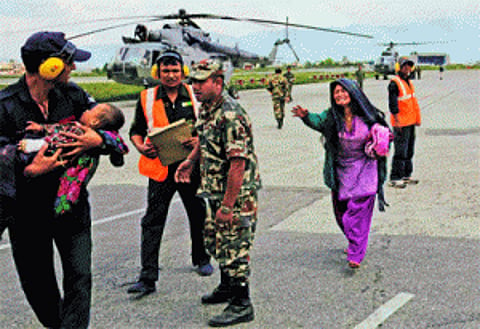

Two days after a devastating earthquake reduced a large part of Nepal into rubble, Indian rescue teams made inroads into the interiors of the country and reached Barpak village on Monday, the epicentre of Saturday’s earthquake, where more than 150 bodies were spotted during an aerial survey by Indian Air Force (IAF) helicopters.
In another major development, India has begun using the road route to pull out stranded people. On Monday, IAF aircraft and helicopters of Indian Army stepped up their operations by carrying massive amounts of material and bringing back as many people as possible. But the congestion at Kathmandu airport is posing a serious problem as the airport is choked due to piled up relief material and arrival of commercial flights. This has prompted India to start using the road route to pull out stranded people.
So far 5,400 people have been evacuated from Nepal, including 30 foreign nationals. Out of these 600 got out by road in the last 24 hours. “A big change in this operation has been movement on the ground. Buses and trucks have started reaching,” Foreign Secretary S Jaishankar said as buses crossed over into India from Sunauli (Uttar Pradesh), Raxaul and Janakpur (Bihar). Indian Foreign Office has deputed officers at Raxaul and Sunauli check points to help foreign nationals with immigration.
So far, 72 deaths have been reported from various Indian States, with the highest being in Bihar (56) followed by UP (12). But despite being struck by tragedy, on Monday, 132 buses from Bihar, Uttarakhand and Uttar Pradesh left for Kathmandu to bring back people. Besides, 21 trucks carrying food and other relief material also left for Nepal. India is also getting requests from several countries to help their nationals out, besides, Jaishankar said, there have also been requests by several countries for “overflight.”
However, Ministry of Home Affairs officials said, rescue by road is slow due to landslides. So far the Army has managed to restore damaged road links from Gorakhpur in UP to Kathmandu due to which India could send more than 5,000 blankets and 500 tents, besides truckloads of medicine. Officials said that if need be India may use road routes via Siliguri in West Bengal and Uttarakhand to reach out to victims in Nepal.
Meanwhile, Indian rescue teams reached inaccessible Barpak Village, which was the epicenter of Saturday’s massive earthquake. The area was so far inaccessible. But on Monday, medical and engineering units of the Indian Army and National Disaster Response Force (NDRF) reached the village where more than 150 bodies were spotted during an aerial survey by IAF helicopters.
In fact, the aviation teams, which conducted aerial surveys of the surrounding areas, have found several dead bodies spread across the hilly State. Home Secretary lC Goyal said Army and NDRF teams with guidance from Nepali Army have started moving out to far-flung areas to save lives.
located about 70 kms from Kathmandu, Barpak so far was cut off from the rest of the country due to damaged roads and no helicopters could also land there. A medical team of the Army has now started treating injured people besides clearing up dead bodies while the engineers are repairing roads to enable relief material to come through in the next few days. On Monday the IAF brought out 87 victims, including a traumatised child paralysed due to the injuries suffered in the earthquake, from remote areas in Nepal.
The Army has also set up a base headquarter in the village led by Brigadier J Gamlin to oversee rescue efforts. In addition, the Indian Army Engineer Task Force, responsible for repairing damaged infrastructure, including roads and restoring power supply, has established satellite telephone link with the Nepalese Army Headquarters for smooth operations.
With a strong network of more than 1,25,000 retired Indian Army Gorkha soldiers settled in Nepal, the Army is also getting a feedback about the extent of damage in the villages. Medical teams with doctors and fully-equipped field hospitals including operation theatres were directed to cover a radius of 70 to 80 km by sending small teams to far-flung villages. The Army has flown in three field hospitals to Nepal having 60 beds capacity, besides building equipment like bulldozers, communication systems like satellite phones.
Meanwhile, a team of Army and Power Ministry engineers has managed to restore electricity in Kathmandu, while Indian Oil Corporation is making assessment of fuel requirement in the country. Ministry of Information Technology has also set up a unit to locate missing people in Nepal.