
- HOME
- INDIA
- WORLD
- BUSINESS
- STATES
- LAW & JUSTICE
- ENTERTAINMENT
- SPORTS
- VIEWPOINT
- LIFESTYLE
- TECH
The Election Commission of India (ECI) on Monday defended its functioning and the conduct of the Special Intensive Revision (SIR) of electoral rolls in the Supreme Court. The poll body also questioned the basis of a petition challenging its decision-making process. The Supreme Court is expected to hear the batch of petitions on Tuesday.
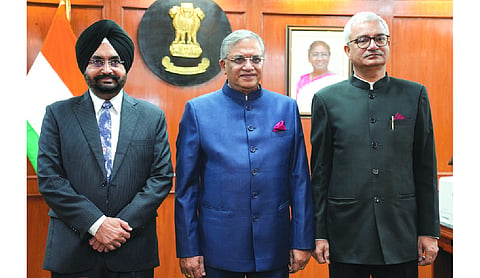
The counter affidavit, filed by Deputy Election Commissioner Bhanu Prakash Yeturu in response to a writ petition by Rakesh Kumar Singh alias Rakesh Singh, stated that it has been approved unanimously by the Chief Election Commissioner Gyanesh Kumar and Election Commissioners Sukhbir Singh Sandhu and Vivek Joshi. It addresses concerns over the poll body's internal decision-making process, alleged changes to voter enrolment forms, deletion of names from the electoral rolls and the functioning of its databases. The poll body also said Form 6 has not been amended and that only the Union Government can amend it. The SIR declaration is a separate document, it said.
In its reply, the ECI has denied allegations that the CEC unilaterally took SIR-related decisions despite objections from the other two Election Commissioners. The poll body explained its decision-making process after reports that two of the three Commissioners were not on board with the process adopted for SIR of voter list and inclusion of new voters. Asserting that all decisions were unanimous, the ECI said the petitions on the matter filed in the SC are based solely on newspaper reports and should be dismissed.
The commission said the SIR exercise was undertaken in the discharge of its constitutional mandate under Article 324 of the Constitution, read with the Representation of the People Act, 1950, and the applicable rules.
Refuting allegations, the ECI stated that all three orders concerning the SIR, dated June 24, 2025, October 27, 2025, and May 14, 2026, were unanimous decisions of the poll body. The poll body clarified that notes, queries, suggestions or observations recorded by the CEC or Election Commissioners during the processing of a file do not, by themselves, constitute decisions of the poll body. "The files put up by the respective divisions are sent first to one Election Commissioner and thereafter to the other Election Commissioner and then finally to the Chief Election Commissioner... Such approved decisions of the Commission are duly noted in the concerned files of the Election Commission and bear the signature of the ECs and CEC. Thereafter, the decision is notified and implemented by the ECI," the affidavit read.
"In any decision-making process, any suggestion, observation or query by the Chief Election Commissioner or the Election Commissioners either to other Election Commissioner/Chief Election Commissioner or to any officer of the Commission - does not constitute a decision of the Election Commission under Section 18 of the 2023 Act," the Commission said.
Rejecting the allegations regarding changes to 'Form 6, the Commission clarified that none of the three SIR orders have resulted in any changes to the statutory 'Form 6' used for voter registration.
The poll body said the declaration prescribed for the exercise was a separate document and not part of the statutory form for inclusion in the electoral roll. It said the declaration was intended to facilitate the verification of applicants' eligibility and the linking of their details with electoral rolls prepared during previous intensive revisions.
The commission said the declaration format introduced for the subsequent phases of SIR was a modification of the earlier format, intended to make the process easier for applicants by allowing them to provide details of themselves or their relatives appearing in previous electoral rolls. According to the affidavit, applicants whose details could be linked with earlier electoral rolls could submit the declaration along with Form 6 without additional documents. Those unable to provide such details or whose records could not be linked would be required to submit supporting documents as prescribed.
The affidavit further stated that the Commission had decided to facilitate the process for electors who could not be mapped to previous electoral rolls or whose records contained discrepancies. Booth-level officers would visit their homes to collect documents, which would be uploaded for consideration by electoral registration officers. The Commission said the exercise did not prevent eligible persons from applying for enrolment after the completion of SIR, adding that the regular process of updating electoral rolls would continue under the applicable rules.
On ECINet, it said no name is added or deleted except by order of the Electoral Registration Officer (ERO). A committee with experts from IIT and IISc has been set up to check compliance.
Citing the situation in Goa, the Commission said that of the 97 voters described as having been "left out", 88 had already been enrolled, six were abroad and three held Portuguese passports.
On appeals against the inclusion of voters in West Bengal, the EC said the cases had been filed by officers from the office of the Chief Electoral Officer (CEO), West Bengal, in compliance with Supreme Court orders. "These matters were not brought to the Commission," it said.
The Commission argued that the petition was founded entirely on a newspaper report and that the petitioner had not independently verified the factual claims with the respondents. Hence, the petition is not maintainable. It further stated that the Commission had never released or authorised the release of any internal note or file to the media.
The Commission has been caught in a huge controversy after a recent report said Election Commissioners Sukhbir Singh Sandhu and Vivek Joshi were kept in the dark about various decisions taken by the poll body.