
- HOME
- INDIA
- WORLD
- BUSINESS
- STATES
- LAW & JUSTICE
- ENTERTAINMENT
- SPORTS
- VIEWPOINT
- LIFESTYLE
- TECH
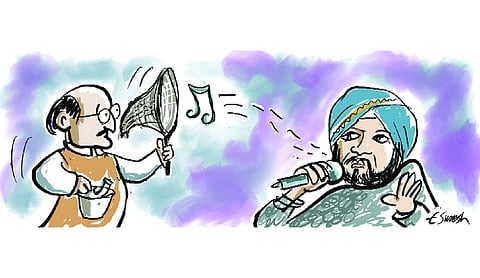
The Daler Mehndi controversy at Uttarakhand’s Kunjapuri fair raises a larger question about the exercise of public authority: where does accountability end and public humiliation begin? While religious occasions demand decorum and artistes must honour their professional commitments, allegations made before the facts are established risk turning legitimate scrutiny into a public spectacle
The controversy surrounding Punjabi singer Daler Mehndi’s performance at the Siddhpeeth Maa Kunjapuri Fair in Uttarakhand has raised a question far more consequential than whether a concert met its audience’s expectations: does the authority to demand accountability also confer the licence to publicly humiliate?
When a lawmaker and minister walked onto the stage, interrupted Mehndi’s performance and questioned whether he was singing live or lip-syncing, the disagreement ceased to be merely about entertainment. The minister alleged that the singer was intoxicated and unable to perform adequately. The allegations, however, were not independently established. The subsequent revelation that Mehndi was reportedly unwell added another dimension to an already unfortunate episode.
There is little dispute that a religious gathering deserves decorum. The Kunjapuri fair is rooted in faith and tradition, and a performance during Navratri must respect the sensibilities of the occasion. Equally, an artiste engaged for a public event has obligations to the organisers and the audience. Professional commitments cannot be divorced from contractual terms, agreed standards of performance and the circumstances in which an event is organised.
But acknowledging these responsibilities does not mean that every perceived shortcoming warrants a public dressing-down. A minister is entitled to question the quality of a performance, seek explanations from the organisers, examine contractual obligations and, if circumstances demand, insist that a concert be stopped. If there were legitimate concerns about the artiste’s condition or the authenticity of the performance, they deserved prompt investigation. What was difficult to justify was the manner in which suspicion was converted into public accusation before the facts had been conclusively established.
Accountability is a principle; public humiliation is a choice. The distinction matters particularly when the person making the accusation occupies constitutional office. A lawmaker’s words carry a weight that ordinary heckling does not. A remark delivered from the stage by a powerful public representative, before an assembled audience and rolling cameras, can rapidly become a verdict in the court of public opinion. Social media then amplifies the spectacle, leaving the person accused to contend with reputational injury that may endure long after the original facts have been clarified.
Questions about intoxication are not trivial observations. Nor is an allegation of lip-syncing necessarily inconsequential when an artiste has been contracted to deliver a live performance. Both can legitimately be investigated. But there is a world of difference between asking whether contractual obligations were fulfilled and publicly implying dishonesty or misconduct without conclusive evidence. The former is scrutiny. The latter risks becoming character assassination.
An artiste’s reputation is not beyond question, but neither is it disposable. A person’s inability to sing or speak as expected on a particular evening may have several explanations, including illness. A responsible response would begin with an enquiry, not an assumption. Indeed, the minister subsequently acknowledged that he had learnt Mehndi was unwell, while maintaining that the singer should have informed the organisers beforehand. That is a legitimate concern to raise, but one that could have been addressed without turning the stage into a courtroom.
Nor was this an instance in which the public was confronted with an obvious breach of decorum through lewd lyrics, suggestive insinuations or manifestly inappropriate conduct. The controversy centred on the quality of the performance and suspicions about the singer’s condition. Those concerns deserved proportionate scrutiny, not a spectacle that risked eclipsing the occasion itself.
One must also guard against a culture in which conspicuous reprimand is mistaken for decisive leadership. The urge to appear uncompromising can sometimes become an exercise in performative puritanism, where the display of moral authority matters more than the patient establishment of facts. The sanctity of a religious festival is best protected by dignity, not indignation.
The episode also carries implications for Uttarakhand’s cultural standing. The state has long drawn strength from its spiritual heritage, natural grandeur and traditions of welcoming visitors. Its identity as Devbhoomi should be reflected not merely in the invocation of religious sanctity but in the grace with which it treats those who arrive as guests. In this context, Chief Minister Dhami’s subsequent intervention was welcome. His outreach and his emphasis on dialogue, mutual respect and Uttarakhand’s tradition of hospitality offered a constructive counterpoint to the confrontation. His appeal to move beyond the controversy was a reminder that the state’s reputation must not be reduced to an unfortunate moment on a stage.
The larger lesson is straightforward. Public office demands not only the courage to question but also the wisdom to pause; not merely the authority to intervene but the judgement to do so proportionately. An artiste may owe a client a performance, but a public representative owes citizens something more enduring: fairness, restraint and respect for due process.
Uttarakhand need not choose between the sanctity of faith and the dignity of an artiste. Both can coexist, provided neither becomes an excuse to disregard the other. Ultimately, the measure of authority is not how forcefully it can rebuke someone in public, but how judiciously it can resolve a dispute without diminishing human dignity. That is the distinction between muscular posturing and mature leadership, and the standard by which this episode deserves to be remembered.
An artiste’s reputation is not beyond question, but neither is it disposable. A person’s inability to sing or speak as expected on a particular evening may have several explanations, including illness. A responsible response would begin with an enquiry, not an assumption
The writer is a former Lieutenant Governor of the Andaman and Nicobar Islands and Puducherry and a military veteran; Views presented are personal.