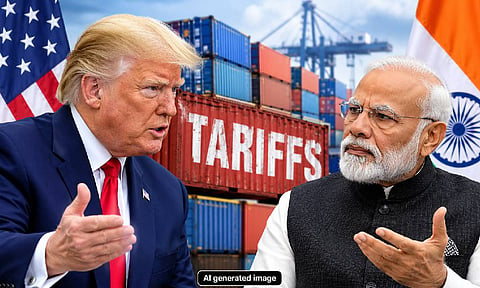

Trump has done it again, something he is good at – disrupting and bullying! Once again, he is back with his tariffs to disrupt and arm-twist. This time it has another dimension to it – a bargaining chip to tilt the bilateral agreement in his favour. The United States has proposed a 25 per cent tariff on Indian goods, capped at 17 per cent if New Delhi signs a bilateral trade deal. The proposal covers 14 economies. At 17 per cent, India would have an edge over Vietnam, Bangladesh, Cambodia, Indonesia, Malaysia and Thailand, yet still trail Japan, Korea and the European Union at 15 per cent. This is both good and bad news.
The US takes about a fifth of India’s goods exports, and a demand-led economy can absorb a measured shock. Yet the deal rate is no gift: India already faces a 10 per cent Section 301 levy, so the proposal is a top-up of seven points with an agreement, fifteen without. No matter what anyone says, it will hurt, and Indian industry will bear the brunt.
The labour-intensive clusters such as textiles, gems and jewellery, shrimp, leather and engineering goods, where margins are thin, would really hit hard.Is Washington arm-twisting India into junior partnership? Partly.
Its worry about Chinese-driven overcapacity is legitimate, yet the notice faults India for failing to police imports and investment from non-market economies and for relying on such inputs in pharmaceuticals, steel, solar and IT.
The lower rate hinges on a “responsive” agreement, building on a February framework in which India signalled intent to buy $500 billion of American goods over five years. India rightly denies structural excess capacity; it consumes most of what it makes.
Punishing it for gaps in its industrial base would push supply chains towards Beijing, not away. The additional tariff, in a way, would be counterproductive for the US as well, as it would lead India to tilt away from it and eventually reduce its dependency on the US, but in the short term it would be India and not the US to feel the pain.
How should India respond? India has already yielded a lot at the cost of its industry. It must contest the finding on evidence: comments are due on January 5; New Delhi should arrive at the hearing with data. Second, conclude the interim agreement only within red lines, namely farm and dairy livelihoods and room to industrialise, and press for exclusions and a rate at or below peers rather than celebrate 17 per cent as a favour. Third and most important, it must diversify with urgency. At home, cheaper logistics, credit and inputs would cushion exporters whatever Washington decides.
Will Trump succeed? As leverage, partly: the 15-to-20 per cent rates largely echo deals struck since 2025. India should treat 17 and 25 as an opening bid, not a verdict: bargain hard, diversify faster, reform at home. As for Trump, still reeling from the midterm loss, he may have to rethink his tactics, as he has done several times in the past.
