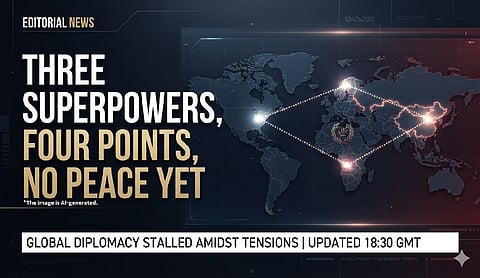

The unprecedented meeting of Trump, Xi and Putin has revived great-power diplomacy but delivered few concrete commitments on pressing global challenges
For the first time, the leaders of the world’s three largest nuclear powers sat at one round table. On November 19, at Shenzhen’s Kylin Villa, on the APEC sidelines, Xi Jinping hosted Donald Trump and Vladimir Putin for just over an hour. The imagery was extraordinary. The substance was not. The agenda was heavy. Washington wanted to discuss nuclear arms control, urgent since New START lapsed in February, and the Iran war, with oil through the Strait of Hormuz at stake.
Ukraine, officially off the table, crept in, as did trade and AI. Each leader played to type. Trump declared “We are really making history”, argued the three nations were “uniquely positioned” to shrink nuclear stockpiles, and hailed a “Highly Consequential” trip. Xi, the gracious host, called nuclear weapons a “sword of Damocles hanging over humanity” and the talks “fruitful”, though a China with roughly 600 warheads, against more than 5,000 each for America and Russia, gave no hint of accepting limits. Putin, attending APEC for the first time since 2017, cast the trio as Second World War victors jointly responsible for peace, called the talks “open and candid”, and blamed Kyiv and Europe for the war. There was a joint declaration: a roughly 250-word “Statement on Peace” with four points.
The three pledged to reform the United Nations, raise production and supply of refined petroleum, insist the International Criminal Court “must not abuse” its jurisdiction, and reaffirm that “a nuclear war cannot be won and must never be fought”, promising dialogue on nuclear risks and proliferation. The document is notable for its silences. Ukraine and Iran are absent. There are no arms cuts, no timelines, no oil volumes, no date for the promised nuclear dialogue. The ICC clause is self-serving: Putin faces its arrest warrant and Washington has sanctioned its officials. “Reform” of the UN by three veto-holders may mean less accountability, not more representation.
Did Shenzhen usher in peace? Not yet. Guns in Ukraine and the Gulf have not fallen silent. Zelensky called Trump’s separate meeting with Putin a mistake; Ukraine’s foreign minister warned against a return to spheres of influence. Yet the summit did something real: it opened a channel the three had never used, and restated the Reagan-Gorbachev formula at a moment when no treaty caps the two largest arsenals. Three takeaways stand out. First, great-power diplomacy is back, conducted over the heads of allies. Second, Xi emerged as convenor and Putin as the clear winner, rehabilitated without concessions. Third, Trump, a lame duck after his midterm drubbing, is chasing legacy abroad. For India, the stakes are concrete: a steadier oil market helps, but a three-power condominium on UN reform could shut the door on New Delhi’s Security Council ambitions. The way forward lies in converting words into mechanisms: a dated, staffed nuclear dialogue; a ceasefire track for Ukraine with Kyiv at the table; and de-escalation in the Gulf. The G20 in Miami next month is the first test. Declarations do not make peace. Diplomats do.
