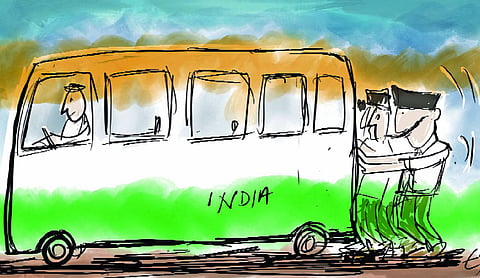

India's long-term national story will be shaped not merely by economic growth, technological advancement or geopolitical influence, but by its civilisational identity, social cohesion and institutional strength. In this context, the Rashtriya Swayamsevak Sangh (RSS) occupies an important position in India's political, cultural and social landscape. The RSS has evolved from a voluntary cultural organisation into one of the most influential social movements in modern India. .
India is a civilisation as much as it is a modern nation-state. Its diversity of languages, traditions, philosophies and religious practices creates extraordinary cultural richness, but presents challenges in developing a shared national consciousness, the single most important factor that China enjoys over India, wherein eighty per cent of the Chinese population is from the Han tribe and speaks one language.
The RSS argues that India's civilisational heritage, broadly understood through the concept of Hindu cultural identity, provides a common foundation for national unity. Its emphasis on cultural continuity, indigenous traditions and national consciousness has contributed significantly to debates about how India should understand itself in the twenty-first century.
For a country seeking greater global influence, confidence in its historical and cultural identity can become an important source of soft power. India's traditions of yoga, philosophy, spirituality, literature and intellectual exchange already contribute to its international image.
One of the RSS's most significant contributions is its decentralised organisational structure. Through its shakhas, training programmes and volunteer networks, it has established a presence across numerous towns, cities and villages. Unlike organisations that primarily mobilise people during elections, the RSS emphasises continuous engagement, discipline, collective activities and character-building.
This grassroots approach has important implications for India's long-term development. It encourages community participation, creates opportunities for leadership development, facilitates social mobilisation and provides institutional continuity beyond electoral cycles.
India's development challenges are too extensive for governments alone to address. Civil society organisations capable of mobilising citizens can therefore play an important complementary role in nation-building.
The RSS and organisations associated with the broader Sangh Parivar have developed activities in education, healthcare, rural development, disaster relief and community welfare. Their service initiatives seek to reach communities that may have limited access to public institutions.
The organisation's centenary year in 2025 brought renewed attention to its extensive network of shakhas and its continued grassroots expansion. For India, where inequalities in education, healthcare and economic opportunity remain significant, voluntary organisations can contribute to last-mile development.
Their long-term credibility, however, depends on ensuring that social services are delivered impartially, irrespective of religion, caste or political affiliation.
The RSS has a role in shaping India's geopolitical and strategic imagination given the influence it is having over the current government. India's emergence as a global power will depend on more than military capabilities and economic indicators.
National cohesion, cultural confidence and social stability will also influence its international standing. The RSS contributes to discussions about India's civilisational identity, indigenous approaches to development and self-reliance.
These ideas resonate with wider debates about strategic autonomy and India's position in an increasingly multipolar world. Nevertheless, India's greatest international advantage is its democratic diversity.
A globally influential India must demonstrate that different religious, linguistic and cultural communities can prosper within a shared constitutional framework. The RSS's long-term relevance will therefore depend partly on how effectively it reconciles cultural nationalism with inclusive citizenship.
However, the organisation faces several challenges, including its male-dominated structure, perceived ideological rigidity, questions about transparency and accountability, and concerns about inclusion of minorities. Its association with Hindu majoritarian politics has also raised questions about whether its concept of national identity adequately reflects India's religious diversity and constitutional values.
Another emerging concern is the growing proximity of middle- and lower-level Sangh cadres to political power in BJP-ruled governments, creating perceptions of easy access to money and influence. Visible lifestyle changes among large number of individuals associated with the Sangh have further fuelled public scrutiny. If left unaddressed, such perceptions could undermine the organisation's long-standing credibility, moral authority and the public respect it has commanded over decades.
Ultimately, the RSS is crucial to understanding India's long-term story because it represents an influential force in the country's social, cultural and political evolution. Its century-long existence, grassroots networks, volunteer mobilisation and ideological influence make it an important stakeholder in debates about India's future. However, its importance should not be confused with unquestionable correctness. India's success cannot be measured solely through the expansion of one ideology or organisation.
It must be measured through economic prosperity, institutional strength, scientific advancement, social justice, national security and equal citizenship. The RSS has an opportunity to contribute positively to this national transformation by strengthening social service, encouraging constructive patriotism and building bridges across communities. Equally, it must address legitimate concerns about inclusiveness, transparency and majoritarianism. India's long-term success requires both civilisational confidence and constitutional commitment.
The author is a public policy expert and columnist
