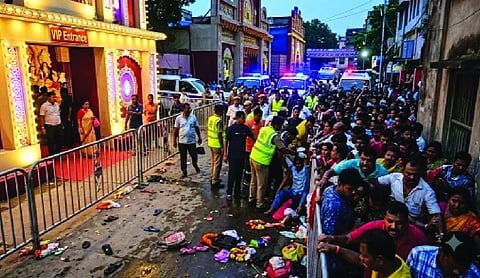

From shoddy planning and crumbling infrastructure to VIP privilege and the tyranny of jugaad, India’s recurring crowd disasters expose a deeper civic and administrative failure. Until rules apply equally and public safety takes precedence over spectacle, preventable tragedies will continue to claim lives
From shoddy planning and creaking infrastructure to queue-jumping, VIP privilege and the tyranny of jugaad, our public tragedies expose a deeper failure: the inability to respect rules, space and fellow citizens.
The stampede at Kolkata’s Chorbagan Sarbojanin Durga Puja pandal is a grim reminder that disasters in India rarely result from a single failure. They are often the culmination of inadequate planning, overstretched infrastructure, poor coordination and societal indiscipline.
As investigations establish the precise sequence of events and responsibility for the tragedy, larger questions demand attention: Why do we repeatedly fail to make public spaces safe? And why is elementary civic discipline treated as optional?
A crowd crush occurs when density becomes so high that individuals lose control over their movement and face potentially fatal pressure. Rain, a rumour, a sudden announcement or someone falling can trigger disaster. The trigger may be unpredictable; the underlying vulnerability usually is not. From Nashik in 2003 to Mandhardevi in 2005, India’s crowd disasters have exposed familiar weaknesses: bottlenecks, poor crowd estimates, inadequate infrastructure and poor policing. These are foreseeable risks requiring competent administration, robust infrastructure and consistent enforcement.
Yet we persist with last-minute arrangements, improvised barricades and ceremonial assurances. We plan for the spectacle and publicity, while safety becomes an afterthought.
Narrow approaches, inadequate exits and insufficient medical facilities are tolerated until tragedy exposes their consequences. This administrative failure reflects a wider national problem: our peculiar relationship with rules. For too many citizens, a queue is an obstacle to be negotiated, a barricade a challenge to be overcome, and an instruction to wait an inconvenience meant for somebody else. People push forward, fearing they will otherwise lose out; others follow because everyone appears to be advancing. In a densely packed crowd, such behaviour can prove lethal.
This is not to blame stampede victims, who may have virtually no control over their movements.
Responsibility must be established through evidence, including the adequacy of planning, capacity controls and emergency response. But compassion must not prevent us from examining the social habits that make public spaces dangerous. Civic sense is not a decorative virtue. It is essential to public safety. Respecting queues, obeying entry restrictions and following safety instructions are acts of collective self-preservation. In a crowd, discipline can mean the difference between life and death.
The problem becomes more corrosive when indiscipline acquires legitimacy through privilege. India has normalised VIP (even something called VVIP!) culture to an extraordinary degree. Political functionaries, powerful bureaucrats/administrators and influential individuals may expect special access, cleared routes and exemption from ordinary inconveniences. The uniquely VVIP mindset takes this further: rules are for the public, queues for the commoner, and instructions for those without connections.
Such privilege is not harmless theatre. Unauthorised entry and exceptional movements can disrupt carefully designed crowd-management plans. When enforcement authorities are expected to accommodate the powerful, they undermine their own credibility. The message is unmistakable: compliance is for the powerless; influence confers exemption.
The same instinct animates our celebrated talent for ‘jugaad’.
Resourcefulness is valuable, but dangerous when it substitutes for engineering, preparation and accountability. Improvised arrangements cannot indefinitely compensate for inadequate exits, unreliable barriers or insufficient staffing. Administrative ingenuity is no substitute for sound infrastructure.
Our reputation as tourists abroad also warrants introspection. Stereotypes about Indian travellers in international destinations are increasingly dominating the narrative. Wherever our fellow citizens disregard queues, litter, insist on our own song-and-dance rituals or ignore local rules, we must acknowledge the problem. Travel does not create civic sense; it reveals whether we have cultivated it at home. Demanding orderly services overseas while tolerating disorder at home is a contradiction.
What must change?
First, crowd management must become a professional discipline. Organisers and authorities need realistic attendance estimates, enforceable capacity limits, separate entry and exit routes, holding areas, real-time monitoring and clear thresholds for suspending admissions. Responsibilities across police, civic agencies, organisers and emergency services must be explicit.
Second, accountability must extend beyond the immediate trigger. Investigations must establish whether foreseeable risks were ignored and safety standards breached. Findings must lead to corrective action, not merely suspensions, compensation and promises of vigilance.
Finally, civic discipline must become a shared expectation. Organisers cannot demand orderly conduct while tolerating privileged exceptions. Authorities cannot enforce rules selectively. Citizens cannot insist on their rights while treating obligations as optional. Consistent enforcement and visible compliance by influential people must reinforce the same message.
India can organise immense gatherings.
The challenge is to translate that capacity into safe, equitable and accountable systems. A civilised society is measured not by the size of its celebrations or its talent for improvisation, but by whether ordinary people can participate without avoidable danger. A stampede may begin with a sudden surge. The conditions that make it fatal are often built over time through negligence, entitlement and everyday indiscipline.
Until we confront all three, each tragedy will invite familiar expressions of grief, followed by a return to business as usual. The real tribute to those who died in Kolkata is to ensure that the next crowd is managed before it becomes a catastrophe.
Civic discipline must become a shared expectation. Organisers cannot demand orderly conduct while tolerating privileged exceptions. Authorities cannot enforce rules selectively. Citizens cannot insist on their rights while treating obligations as optional. Consistent enforcement and visible compliance by influential people must reinforce the same message
The writer is a former Lieutenant Governor of the Andaman and Nicobar Islands and Puducherry, and a military veteran; Views presented are personal.