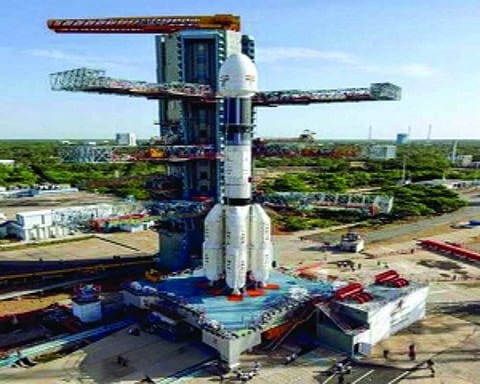

The GSLV-F10 debacle notwithstanding, ISRO must focus on improving the cryogenic engine
The non-success of the Indian Space Research Organisation’s August 12 launch of the GSLV-F10 (GeoSynchronous Satellite Launch Vehicle) with an Earth Observation Satellite (EOS-03) as its payload comes as a setback to the country’s space dreams. The launcher was powered by an indigenous cryogenic engine capable of deploying heavy satellites into the geosynchronous orbit of 36,000 km above Earth. The ISRO said the first two stages of the three-stage launch went as scripted but the engine, which would have lobbed the satellite into the pre-destined orbit, failed to function due to technical anomaly. An investigation is on to find out the reasons for the malfunctioning. Though India is a force to reckon with in the global launch market of small and medium spacecraft, the country is still far from perfecting a launch vehicle to send heavy communication and remote sensing satellites weighing 2,500 kg or more to the geo synchronous orbit, which is synchronous with the Earth’s orbit. India has so far launched 14 GSLV missions, some of them powered by cryogenic engines purchased from the erstwhile Soviet Union. The ISRO claims that eight missions were successes, four failed and two were partial failures.
In space missions, there are no partial successes or failures and hence the country’s track record in GSLV missions reads eight successes and six failures. ISRO’s priority should be to perfect the cryogenic technology, a crucial element in deploying heavy satellites into the GSO. Our PSLVs are trusted workhorses and have earned international reputation and credibility as a dependable player in launching small and medium satellites. Many countries, including the US, Israel and France, have made use of the PSLV to launch their sensitive space missions. The ISRO should focus on making the cryogenic engine a foolproof mechanism because the ‘moolah’ in space exploration lies in the GSO. It should be noted that even the so-called “friends of India” tried their best to prevent it from acquiring the cryogenic technology for fear that ISRO would emerge as a competitor in the global launch vehicle market. The country is also going ahead with its manned mission to space, for which the minimum requirement is 100 per cent success rate in man-rating (the capability of the launch vehicle to deploy astronauts into space and bring them safely back). One cannot tell the world that the manned mission was a partial failure!