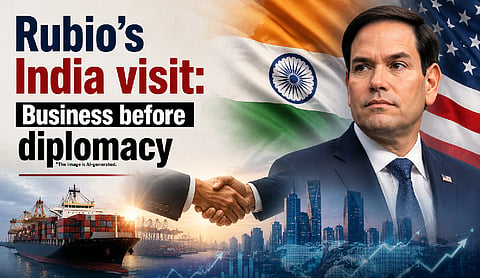

Marco Rubio’s Mumbai itinerary puts trade ahead of diplomatic repair, but India must not mistake business optics for strategic reassurance
When America’s Secretary of State lands in Mumbai rather than New Delhi, holds no meeting with the Prime Minister and heads to a refinery, the message is hard to miss. Marco Rubio’s second India visit this year is a business trip dressed in diplomatic clothing. The itinerary tells the story. Rubio meets External Affairs Minister S Jaishankar and billionaire Mukesh Ambani, whose Reliance runs the world’s largest refining complex at Jamnagar. He also lays a wreath at the Taj memorial for the 26/11 victims.
Washington wants to spotlight Reliance’s plans for a new Texas refinery as American diesel prices climb ahead of the midterms. Why now? Three pressures converge. First, trade. A February framework cut tariffs on Indian goods from 50 to 18 per cent, but talks slowed after the US Supreme Court struck down Trump’s tariffs. Trump has just delayed tariffs, and Rubio says the push for a deal was a factor. Second, energy. The West Asia crisis has disrupted Gulf supplies and deepened India’s reliance on Russian crude. Rubio now concedes India cannot pivot overnight, while Washington itself has signed a deal to import Russian diesel.
Sanctions rhetoric has quietly given way to pump prices. Third, Trump’s planned India trip early next year, which Rubio is to prepare for.
Is it business or mending ties? Business, with repair as a by-product. The damage is real: high tariffs, Washington’s closeness to Pakistan, and the killing of three Indian sailors in attacks by the US Navy in the Gulf, plus Trump’s Beijing summit. The promise of an India-hosted Quad leaders’ summit has also vanished from the joint statements. Rubio’s May visit was meant to mend things; the sailors’ deaths roiled relations again soon after. Real repair needs a leader-level gesture, not a refinery tour.
The likely outcome is modest. A trade announcement is possible, though AFP reports that the prospects of a deal during this visit appear slim. Expect warm words, an energy-and-investment showcase and talk of Trump’s visit. Jamnagar is symbolism with a price tag: Washington wants Indian capital in Texas and Indian diesel for American pumps. Expect little movement on Russian oil, where Washington has lost the moral high ground, and little on the Quad.
India’s response should be calm and unhurried. Sign a trade deal only if it is worth signing: protect farm and dairy, demand tariff certainty after the court ruling, and refuse commitments that one executive order can reverse.
Keep buying oil where it is cheapest and safest; energy security is not a bargaining chip while West Asia burns, though buying American crude and gas as a commercial choice makes sense. Press Washington for a firm date for Trump’s visit and the Quad summit, and ask for answers on the sailors.
Use Jamnagar’s optics to extract commitments, not photographs. Above all, treat courtesy as courtesy, not commitment. This administration’s positions shift with the oil price and the electoral calendar. India’s should not.