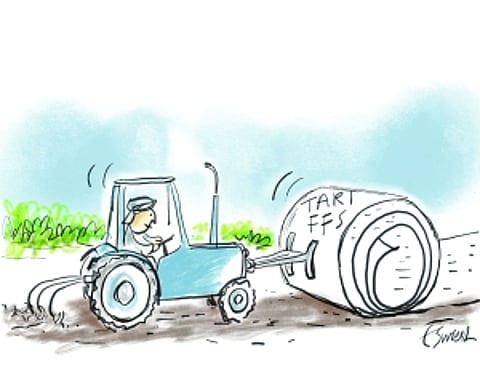

For India, the challenge is not merely to expand GDP, but to build an economy agile enough to absorb shocks, diverse enough to spread risk, and robust enough to convert disruptions into opportunities
The popular slogan, “Tariffs Are Obstacles, Trade is the Solution!” is the talk in every nook and corner of India. The US criticised India’s relatively high tariffs and non-tariff barriers, particularly in agriculture, pharmaceuticals, and electronics, compared to US levels, which pulled the trigger on the contradictory tariff policy. India’s growing dependence on discounted Russian crude oil led to additional punitive tariffs, given US sensitivities to sanctions.
When a key trading partner slaps a heavy tariff on your goods, the effects are instant, causing exporters worry, TV panels debate, and markets question the growth story. However, moments like this reveal something deeper: how much a nation relies on forces it cannot control.
For India, the lesson is clear.In a world shaped by trade disputes, currency swings, energy price hikes, and shifting demand, growth alone is not enough. The economy must be built to absorb shocks and keep moving forward. India’s ability to withstand shocks and maintain growth is tied to its resilience through diversity in trade, robust infrastructure investments, and adaptive policies. Stability in India draws investment, protects jobs, and maintains India’s position in the world economy.
Resilience means more than protecting export markets. It is about creating a multi-channel economy — where goods, services, experiences, and ideas flow freely, so no single disruption can halt progress. Campaigns like Visit Bharat, India’s tourism and soft-power drive, are part of this vision. At this juncture, India needs to rethink and recalibrate its approach amid the tariff shock:
Diversify Export Markets
Relying too much on a few big markets leaves us exposed to their politics. For an instance, Vietnam eased US trade tensions by deepening ties with the EU and ASEAN. Chile, dependent on copper sales to China, spread risk with trade deals in 60+ countries.
In this context, India should target under-served regions: Africa’s growing cities, Latin America’s expanding middle class, Eastern Europe’s pharma needs. It should fast-track trade pacts with GCC, UK, African Union; explore deals with MERCOSUR, Central Asia. India should send dairy exporters to West Asia, renewable energy firms to East Africa, food processors to Southeast Asia.
Strengthen Domestic Value Chains
Heavy import dependence in key components can stall production. For instance, China boosted self-reliance in steel and electronics, while South Korea did the same in shipbuilding and electronics. In this situation, India needs to localise high-value inputs such as semiconductors, speciality chemicals, textiles, and APIs. It must build industrial clusters for MSMEs with shared R&D, laboratories, and logistics. Additionally, it should upgrade infrastructure covering freight corridors, digital customs, and cold chains.
Build Macro Resilience
Tariffs are not the only threat; commodity shocks, currency swings, and capital flight can be equally damaging. Norway’s $1.6 trillion sovereign fund cushions downturns, while Singapore relies on large reserves and targeted fiscal boosts.
At this crucial time, India needs to maintain forex reserves covering 12–18 months of imports. It should also create a stabilisation fund from windfall revenues.
Drive Innovation
Competing on cost alone renders a nation replaceable. For instance, Israel leads in cyber security, medical devices, and water technology, while Finland has transitioned from timber to high-tech industries. In this context, India must invest in AI, biotechnology, clean energy, and advanced materials.
It should amplify patent filings, expedite approvals, and develop climate-friendly industrial hubs to meet global green standards.
Inclusive Growth & Tourism
Over-focusing on goods exports can neglect stable earners such as tourism and services. For instance, Thailand and Spain treat tourism as a strategic sector for jobs and foreign exchange. India needs to connect tourism to local economies, encompassing heritage, eco, and food circuits. It should also enhance e-visas, airports, and multilingual services.
An Amalgamated Approach
Resilience is not built in a single move. Vietnam’s pivot succeeded because its manufacturing was ready. Norway’s fund works due to fiscal discipline. Israel’s innovation thrives thanks to integration between education and defence. India’s six pillars — diversified exports, stronger value chains, macroeconomic buffers, innovation, fast governance, and inclusive growth — reinforce each other. A shock in one area is cushioned by strength in the others.
The Decade of Resilience
India’s advantages — comprising a young workforce, rising domestic demand, and growing infrastructure — can only shine if volatility is treated as part of the plan, not as a surprise. By adapting global lessons to our scale and diversity, and linking them to initiatives such as Visit Bharat, India can shift from merely reacting to setting the pace. When the next tariff or currency jolt occurs, the objective is simple: Respond not with alarm, but with confidence.
The writer is an Associate Professor, TA Pai Management Institute, Manipal Academy of Higher Education, Manipal
