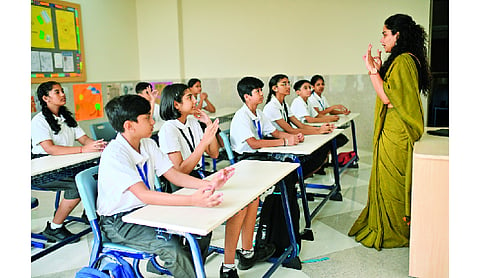

There is a disturbing trend in classrooms of today. Teachers are not only expected to teach but also obliged to be counsellors, disciplinarians, emotional caregivers and sometimes even surrogate parents. There is no denying that schools play a part in the formation of character, but the increasing trend to leave the responsibility of parenting to schools needs to be seriously considered. Look at the paradox here.
A youngster spends much of the day outside school, learning attitudes, habits and behaviours via family interactions, internet platforms and social situations. But when behaviour problems do occur, it is typically assumed that a few hours in the classroom can reverse years of unchallenged patterns. The issue isn't that parents have stopped loving their children.
Instead, modern parenting is more and more stuck between work demands, emotional tiredness, technology diversions and an overpowering desire to provide comfort. In many households, convenience has supplanted consistency. Screens become babysitters, demands are confused with needs and boundaries are frequently misinterpreted with being too severe. Consequently, youngsters may enter school academically ready but emotionally incapable of accepting correction, handling disappointment, or respecting authority.
Another disturbing trend is the decline of faith in teachers. Sometimes a disciplinary comment is taken as humiliation. Constructive critique turns into a complaint. Some parents immediately defend children's acts rather than urge them to think about them, teaching them that accountability is negotiable.
What happens when a generation comes of age with the idea that every correction is an insult, every disappointment an injustice? But it would be too simplistic to blame only parents. Families today are under real pressures and many parents are struggling without enough guidance and support. Schools, too, must ask whether their communication habits foster collaboration or confrontation.
There can be no answer to an endless battle over who is responsible. Education and raising are complementing duties, not identical services. Teachers can help encourage honesty but children must see it modelled at home.
Schools can teach respect, but the foundation is built in the everyday interactions of families. Teachers can teach discipline, but it is the consistency outside of school that will turn it into a habit. The greatest educational challenge of our time may not be diminishing academic performance, but a crumbling collaboration between family and school.
There is continual talk of artificial intelligence, future classrooms and the revolution of education. But we rarely talk about essential human principles without which even the most sophisticated schooling is pointless.
A school can develop a child's potential, but it can't on its own make up for the lack of supervision, boundaries and accountability. It's time we stop seeing teachers as the fix-it-all for all of society's ills. Children are to be educated by teachers. It's the responsibility of the parents to raise them. And society must recognize that neither can succeed without the other. The future of education will not be decided inside the four walls of the classroom, but by the choices families make about what to reinforce when the school bell rings.
The writer is an educator and a councillor; Views presented are personal.