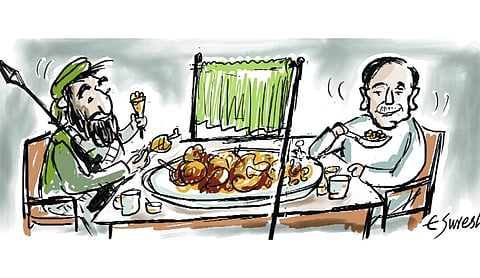

From Osama bin Laden's Abbottabad hideout to the protection allegedly afforded to anti-India terror chiefs, Pakistan's relationship with terrorism has been less an aberration than a recurring instrument of statecraft.
There is something remarkably predictable about Pakistan's response whenever a terrorist wanted by India or the international community is discovered on its soil. First comes denial, followed by indignation and, occasionally, an announcement of arrest or prosecution. The individual then disappears from public scrutiny, while the organisation he founded continues to operate.
The latest reports that Lashkar-e-Taiba (LeT) Chief Hafiz Saeed and Jaish-e-Mohammed (JeM) Chief Masood Azhar have been moved to heavily guarded safe houses in Pakistan offer another illustration of this pattern. Recently, credible intelligence sources claimed that Hafiz Saeed had been shifted to Rawalpindi, close to Pakistan Army headquarters, and Masood Azhar to Nawabshah in Sindh. While these reports remain independently unverified, their repeated pattern and implications deserve hard scrutiny.
Pakistan's use of militant organisations as instruments of strategic policy took institutional shape during General Zia-ul-Haq's rule in the 1980s. Jihadist networks were cultivated in Afghanistan and subsequently mobilised against India. This gradually became an entrenched security doctrine, i.e., distinguishing between terrorists who threatened Pakistan and those who advanced its strategic interests abroad. The infamous Pakistani spy agency ISI's (Inter-Services Intelligence) relationship with these groups has consequently remained central to understanding Pakistan's security establishment, where militant proxies have often been viewed as instruments of strategic leverage rather than liabilities to be eliminated.
Osama bin Laden's discovery in Abbottabad in May 2011 should have demolished Pakistan's credibility on this question. The world's most wanted terrorist was living in a fortified compound in a garrison town, barely a kilometre from Pakistan's premier military academy. He had reportedly occupied the said premises for years, until an American operation exposed his presence without Islamabad's knowledge.
Pakistan's own Abbottabad Commission described the episode as one of "culpable negligence and incompetence at almost all levels of government". The question remains: how could bin Laden live for years in the shadow of Pakistan's military establishment without its formidable intelligence apparatus knowing?
Then there is the age-old issue of Dawood Ibrahim, the alleged mastermind of the 1993 Mumbai serial bombings. India has consistently maintained that he resides in Pakistan, an allegation Islamabad denies. In August 2020, Pakistan issued sanctions notifications reproducing UN listings that included Dawood, before insisting that this did not constitute an admission of his presence on Pakistani territory.
Hafiz Saeed and Masood Azhar represent an even more consequential example. LeT's role in the November 2008 Mumbai attacks, which killed 166 people, is extensively documented. Despite Hafiz Saeed's designation as a UN terrorist, his public activities and organisational networks survived for years.
His eventual convictions in Pakistan concerned terror financing rather than a comprehensive prosecution for the atrocities attributed to his organisation.
Masood Azhar's JeM has been linked to the 2001 Parliament attack, the 2016 Pathankot airbase attack and the 2019 Pulwama bombing. The United Nations finally designated him a global terrorist in May 2019, after years of diplomatic obstruction, including repeated interventions by China at Pakistan's behest.
The pattern extends beyond India. Pakistan's longstanding relationship with the Afghan Taliban and the notorious Haqqani Network reflected its desire to retain strategic influence in Afghanistan and limit India's presence there. Today, Islamabad accuses the same Afghan Taliban of sheltering the Tehrik-e-Taliban Pakistan (TTP), whose attacks increasingly target Pakistani security forces.
The irony is unmistakable: a country that normalised militant proxies as instruments of foreign policy is now confronting the consequences of that doctrine. It is also a reminder that terror networks, once cultivated and empowered, acquire their own ambitions and are rarely content to remain instruments of somebody else's policy.
Washington recognised this contradiction years ago. The US State Department's 2019 Country Report on Terrorism described Pakistan as a "safe haven for certain regionally focused terrorist groups", including the Afghan Taliban, Haqqani Network, LeT and JeM. This was not an Indian accusation but an assessment by Pakistan's principal international security partner.
The problem is not simply the presence of individual terrorists but an institutional ecosystem that allows organisations to survive through changing names, front organisations and selective prosecutions. Banning an organisation is not dismantling it; arresting its leader is not necessarily bringing him to justice. Genuine counterterrorism requires dismantling recruitment networks, financial channels, training infrastructure and the political patronage that sustains them. Pakistan has repeatedly demonstrated a willingness to take cosmetic action without addressing this larger architecture.
Pakistan cannot demand international solidarity against terrorism while reserving the right to distinguish between good terrorists and bad terrorists. Nor can it invoke sovereignty when its territory becomes a launchpad for attacks against neighbours and plead victimhood when the violence eventually turns against itself.
If the latest reports about Hafiz Saeed and Masood Azhar are confirmed, they will reinforce a deeply entrenched pattern; i.e., the addresses may change, and the official explanations may evolve, but the underlying institutional instinct remains stubbornly intact. Until Pakistan dismantles the infrastructure of terrorism rather than merely rearranging its occupants, its assurances will remain promises without credibility and denials without conviction.
The writer is a former Lieutenant Governor of the Andaman and Nicobar Islands and Puducherry, and a military veteran