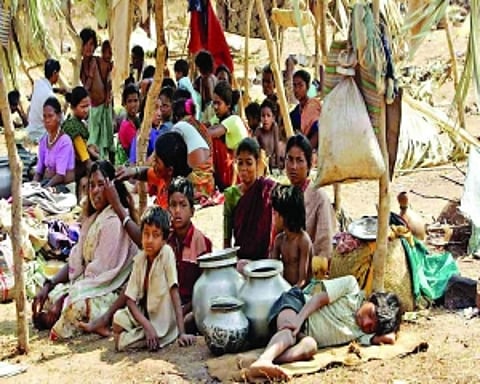

Focus should be on posting good, honest, pro-poor and pro-active officers in the right posts where antipoverty schemes are implemented and monitored
Poverty is still regarded as an anathema as it immobilises individual progress and a nation’s growth. A rigorous and sincere exercise is needed to identify its causes and address those for eradicating poverty. The tools to identify the poverty-stricken are many, starting with an imaginary line to gauge poverty. Dandekar and Rath have emphasised the concept of poverty line as an imaginary line fixing a value for income per day and people whose income comes below that mark are considered Below Poverty Line (BPL). The income so fixed has gone through many changes. Different poverty estimation panels in India, including the Alagh Committee (1979), Lakdowal Committee (1993), Tendulkar Committee (2005), NC Saxena Committee and Rangarajan Committee, all have given their assessment.
The Tendulkar Committee wanted to correct the spatial and temporal issues with the price adjustment procedure (with uniform recall period). Saxena Committee favoured revising the BPL status with systemic inclusion and exclusion. They stated that automatic BPL inclusion was for the homeless, bonded labourers and the destitute and automatic exclusion was for the income tax payers, any member drawing a salary of Rs 10,000 or having a mechanised farm and equipment.
The Rangarajan Committee in 2014 favoured a separate poverty line for rural and urban areas. They fixed the poverty line delineating Rs 972 per person per month for the rural poor and Rs 1,407 per person per month in urban areas, stating that 29.5 per cent of the population was BPL.
As it comes, the poverty line is associated with deprivation and fixed as per income/consumption level. The World Bank has clearly defined poverty as ‘deprivation in well-being’ and it comprises many dimensions including ‘low income and inability to acquire basic goods and services for survival with dignity’. Hence, confining poverty only to economic interpretation may be labelled as a one-sided concept. In a paradigm shift, Nobel laureate Amartya Sen recognised the multidimensional connotations of the concept and defined poverty as not having enough material possession/income to meet a person’s needs. Poverty should include social, economic and political factors in its reflection. Amartya Sen classified it as absolute (complete lack of means to meet basic needs) and relative poverty (where the household income is a certain percentage below median income). For example, the threshold for relative poverty could be set at 50 per cent of the median income.
Amartya Sen stressed that traditional poverty had been defined based on individual levels of income. But a better approach is to see poverty as deprivation of a person’s capability to live a valued life. So he stressed for a shift in perception from income, growth, utility to that of increase in emphasis on individual entitlements, capability and freedom of right for addressing poverty and related issues. Nobel laureate Abhijeet Banerjee and Duflow in their book, ‘Poor Economics — Rethinking poverty and the ways to end it’, wrote: “We have no longer guaranteed to eradicate poverty and once we accept that time is on our side, join hands with millions of well-intentioned people across the world — elected officials, bureaucrats, teachers, NGO workers, academicians and entrepreneurs — in the quest for many ideas, that will eventually lead the world where no one has to live on 99 cent a day.”
Before enunciating on how to deal with poverty, we may divide it into three categories (Primary poverty means insufficient income to meet basic needs; Secondary poverty means insufficient money to buy basic necessities; Persistent poverty denotes poverty all through, come what may). The million-dollar question is how to eradicate poverty with waxing on the living condition of the impecunious?
The pragmatic approach to end the predicament of the poverty-stricken is to ensure that benefits percolate to the target groups. Though many a Government scheme is good and ingenious but the benefits are not reaching the target groups. The remedy may be in posting good, honest, pro-poor and pro-active officers in the right posts where implementation and monitoring of the antipoverty schemes take place. Constant monitoring of poverty eradication programmes is to be done by a high-level committee headed by the Development Commissioner. Cases of corruption and malfeasance should be dealt with a heavy hand. Evaluation, monitoring and right implementation of the policies for benefiting the needy would ensure percolation of benefits to the poor to enhance their living standards.
Certain dilemmas and conundrum always confuse the planners about the right approach to emulate and decide as to which comes first — growth or equitable distribution? The sanguine approach should always be the middle path, that is to go for growth with equitable distribution, leaving behind the sophistry and diatribes. While all possible steps should be taken for the growth of the nation in terms of GDP and related parameters, it should be well ensured that equitable distribution goes hand in hand with it.
(This article is the second part of a series.)
(The author is a superannuated senior IAS officer. The views expressed are personal.)