
Nepal Prime Minister Balen Shah’s maiden foreign visit to India has opened a promising new chapter in bilateral relations, marked by a 10-pillar Joint Vision document. Yet, beneath the diplomatic warmth and impressive deliverables lie unresolved questions over the border dispute, the 1950 Treaty, the Agnipath recruitment scheme and Nepal’s sovereign concerns
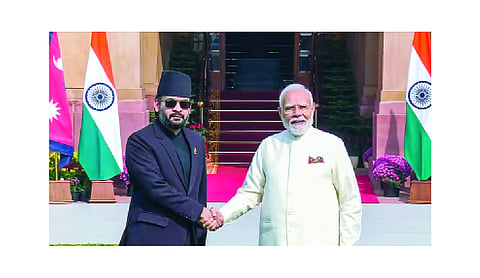
Prime Minister of Nepal, Balen Shah, arrived on his first foreign visit - traditionally first to India, not China - to a red carpet welcome. The Guard of Honour was led by 1/5 Gorkha Rifles (FF); most Gorkhas were Nepal-domiciled, whose recruitment is suspended as youth wait for the diplomatic de-freeze, which, expectedly, did not happen. Dressed in his distinctive all-black Nepali gear, with turned-up trousers and boots, Balen’s right hand moved across his heart while his left hand shuffled, buttoning and unbuttoning his jacket. PM Narendra Modi wore white, and both looked relaxed. Back in Nepal, people were glued to TV/social media, watching their beloved Balen cruise through his 25 hours in Delhi, but in a hurry. Kathmandu Post must be credited for reporting, since last Friday, the likely framework of the India-Nepal Joint Vision document and its ingredients with precision; exactly what appeared in the joint press statement on Monday, 23 November, which was the synopsis of the outcomes following delegation-level talks. These reflected Nepal as a key partner in India’s Neighbourhood First policy, and India as a trusted and reliable first responder.
What was conspicuously missing during the proceedings was mention of a special and/or Unique relationship, which did not diminish the outcome package. PM Shah, in his remarks at the joint press briefing, emphasised the need for ‘mutual respect for each and total trust between two countries’. It marked the beginning of rapport-building between the world’s youngest and one of the world’s oldest Prime Ministers. Their one-on-one conversation scheduled for 30 minutes went on for an hour and a half.
Though Nepalis were aware that India was likely to commit USD 1.5bn as against Nepal’s ask for USD 2 bn as assistance and development package, Nepali journalists attending the joint press briefing were looking out for Modi’s ‘surprise’ announcement, which turned out to be the Nepali currency Rs 24,000 crore package. In the package a grant assistance of NPR 5600 crore was for post-disaster reconstruction and rehabilitation of the Rasuwa-Bhote Kosi floods; the remainder NPR 18400 crore as line of credit for energy sector projects. NPR 160 is equivalent to INR 100. A substantial portion of the loan component of the $ 1b 2015 earthquake relief package remains unused as it could not be mobilised, Nepalis caution. This development package is one of the largest ever provided to Nepal. The two leaders adopted a Joint Vision 10-Pillar Document for a Prosperous Nepal and a Developed India, which will integrate all ongoing and future bilateral projects with targets, goals and priorities. For Nepal, the most attractive are road, rail and aviation connectivity projects. For 17 years, Nepal has sought the uni-directional B345 Kathmandu-Bhairahawa-Lucknow flight path to be made bi-directional, which has been agreed, but technical details remain to be settled. Direct flights to Pokhara from Delhi and additional intercity flights remain under discussion. Nepal has been allotted additional transit trade through Kandla and Paradip ports. Additional petroleum pipelines, integrated border check-posts and other infrastructure will boost connectivity. Further survey work on the Raxaul-Kathmandu electrified rail line and East West Railway in Nepal is being undertaken.
In the hydropower sector, both sides agreed to follow the Joint Vision for Power Sector Cooperation and Long Term Power Trade Agreement. The new 669 MW Lower Arun hydroelectric project was launched, while the long-delayed Pancheswor Multipurpose project is to be hastened. Other projects are: offshore IIT campus, additional cross-border transmission lines, startups, digital and financial connectivity. Eight MoUs were signed — forensic research; cooperation between Rashtriya Raksha University India and National Police Academy Nepal; good governance; ayurved and traditional medicine, satellite communication, sustainable urban development and livestock and fisheries. PM Shah’s constituency is Gen Z; so youth development projects are included.
The optics of the 24-point MoU and other agreements are good, though they are routine bilateral cooperation activities. What stands out, though, is the Nepali Rs 24,000 crore development package, which resembles the 2022 $4b Sri Lanka assistance package to rescue it from sovereign default and economic meltdown, which led to Gen Z protests in Colombo resulting in President Gotabaya Rajapaksa fleeing the country. National elections resurrected a Marxist party involved in civil war, rocketing from 2 seats in Parliament to a 2/3 majority.
The rescue package dramatically turned around bilateral relations to an unprecedented high. Delhi’s financial package is a political investment in PM Shah and the RSP, whose president, Rabi Lamichchane, was welcomed by India earlier. A stable RSP government is expected to last its full term in office.
The package of agreements and vision document caters to all sections of society, especially the youth and includes several deliverables. Legacy issues like borders, the 1950 Treaty of Peace and Friendship, revival of SAARC, and the trade deficit were not discussed, though the pathways to reviewing some of them are mentioned in the joint documents. In Kathmandu, the opposition is questioning Shah’s silence on outstanding issues, especially the border dispute, which he has been championing since he was Mayor of Kathmandu, when he wrote to then PM KP Oli, proceeding on a visit to China not to omit mentioning disputed Lipulekh during his talks in Beijing.
As PM, Shah raised the Limpiyadhura-Lipulekh-Kalapani dispute in Parliament and mentioned consulting UK, turning a bilateral issue trilateral, which kicked up a ruckus. His detractors will now target him for his failure to put across Nepal’s security concerns and defend national interest.
Kantipur TV, whose offices were ransacked during GenZ protests, is accusing Shah of omitting key issues during his talks with Modi. While lauding the breakthrough in securing the bi-directional routing for the Kathmandu-Bhairhawa-Lucknow flights, it bemoaned the status quo in denial of air access at other points to avoid congestion at Simra.
In a letter to the editor in response to an article on Nepal in the Indian Express on 23 November, K Chidananda Kumar from Bengaluru says that GenZ leaders seek ‘respect for their mandate and Nepal should be consulted before decision-making’.
India took a unilateral decision to change the recruitment system to the Agnipath scheme. Further, Nepal should be given its due sovereign space and equal status. Nepal’s balanced diplomacy of equidistance between India and China needs a reset, factoring in that its geography is entwined with the unique open border provided by India.
What was conspicuously missing during the proceedings was mention of a special and/or Unique relationship, which did not diminish the outcome package. PM Shah, in his remarks at the joint press briefing, emphasised the need for ‘mutual respect for each and total trust between two countries’.
The writer, a retired Major General, was Commander, IPKF South, Sri Lanka, and founder member of the Defence Planning Staff, currently the Integrated Defence Staff; Views presented are personal.
