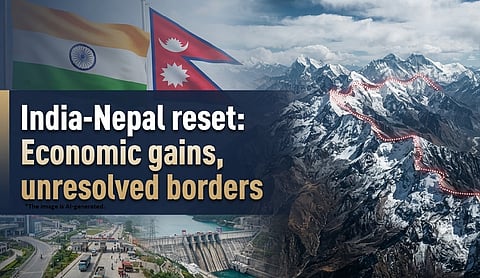

Balendra Shah’s first state visit to India signalled a diplomatic reset. But unresolved border disputes remain a test of the renewed bonhomie.
The maiden visit of Nepal Prime Minister Balendra Shah was long awaited and when he landed in Delhi, the optics were great. Even the enthusiasm on both sides was visible. This bonhomie did find place in various declarations and the bonding of the two leaders. However, when the real diplomacy played, many old issues cropped up which still need to be resolved before the two friendly neighbours can claim to be friends again.
A day later, Balendra Shah left with what Delhi calls its largest-ever package for Nepal, announced in the wake of August’s Rasuwa-Bhotekoshi floods: Rs 15,000 crore (NPR 24,000 crore), comprising Rs 3,500 crore in grants and an Rs 11,500 crore rupee line of credit for energy projects. The mood was warm and meticulously staged: a ceremonial welcome at Rashtrapati Bhavan, tributes at Rajghat, a luncheon hosted by Prime Minister Narendra Modi, and gifts of Gangajal and Pashupatinath rudraksh.
If the money was the headline, the image was the Sarayu-Kamala Express, flagged off between Ayodhya and Janakpur, which Shah linked to Ram and Janaki. Modi accepted an invitation to Nepal; Nepal’s foreign minister called the visit a milestone.
The agenda was resolutely economic. India opened Kandla’s Deendayal port to Nepal’s transit trade, with Paradip to follow; agreed to make the Kathmandu-Bhairahawa-Lucknow air route two-way; laid the foundation stone of the 669 MW Lower Arun hydropower project; promised an offshore IIT campus; and exchanged eight MoUs, from satellite communication to police training. Project reports for Pancheshwar, Saptakoshi and Sunkoshi are to be hastened. Shah, for his part, courted Indian investors, pressed for more direct flights and invited Indian pilgrims to Pashupatinath, Muktinath and the Janaki temple.
The joint release says only that foreign secretaries should “work on the outstanding boundary issues”; it is silent on Lipulekh, the 1950 treaty and the Eminent Persons Group report. Silence is not settlement. At home, a prime minister whose May remarks obstructed Parliament faces an opposition that will ask what he brought back on the border. Money brings its own tests. Under a quarter of the package is grant, against recovery needs Nepal puts at $4.7 billion. The credit’s terms and projects remain to be settled.
Power exports of about 1,200 MW are far from the 10,000 MW target. Pancheshwar, promised in the 1996 Mahakali treaty, still lacks a final project report, and air access beyond one route is pending. Three takeaways follow. First, Kathmandu has chosen pragmatism over grievance, for now, and Delhi has answered generously; both should publish a delivery scorecard and treat Modi’s Kathmandu visit as the deadline for visible results. Second, transmission lines, rebuilding grants, transit routes and project reports must move in months, not decades. Third, India should convene the foreign secretaries soon, let existing mechanisms work, and spare Kathmandu a choice between nationalism and neighbourliness.
