
On October 16, 1854, Abraham Lincoln, the towering sixteenth President of the United States, in his historic Address on the Repeal of the Missouri Compromise, in Peoria, Illinois, astutely observed, “Slavery is founded on the selfishness of man’s nature - opposition to it on his love of justice. These principles are in eternal antagonism; and when brought into collision so fiercely as slavery extension brings them, shocks and throes and convulsions must ceaselessly follow.”
Turning the pages of history, the heinous, abhorrent and reprehensible transatlantic slave trade was indisputably the central pillar of Great Britain’s economic, political and diplomatic power from the 17th century until the British Parliament passed the historic Slave Trade Act, 1807 on March 25, 1807 (Slave Act), which mandated the slave trade illegal throughout the length and breadth of the British Empire. The pioneering legislative effort was spearheaded by William Wilberforce, the redoubtable Yorkshireman independent Member of Parliament, reinforced by enlightened Anglican abolitionists like Thomas Clarkson, who fathered the Society for the Abolition of the Slave Trade (launched on May 22, 1787, to raise public awareness in order to lobby for a new law that would abolish the slave trade and enforce this law on the high seas across the British empire), and Granville Sharp, the renowned English scholar and philanthropist.
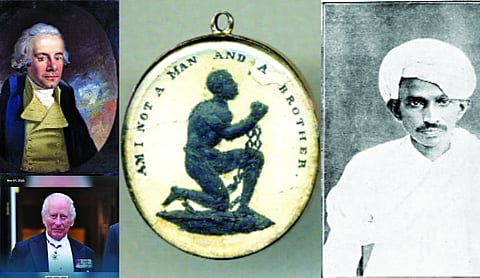
Wilberforce, in his pathbreaking Abolition speech, delivered in the House of Commons on May 12, 1789, said in ringing tones, “As soon as ever I had arrived thus far in my investigation of the slave trade, I confess to you sir, so enormous, so dreadful, so irremediable did its wickedness appear that my own mind was completely made up for the abolition. A trade founded in iniquity, and carried on as this was, must be abolished, let the policy be what it might, let the consequences be what they would, I from this time determined that I would never rest till I had affected its abolition.” Although Wilberforce’s first motion was dishonourably crushed in the face of stiff opposition from deep-seated vested commercial and property interests, the Slave Act did ultimately fortuitously see the light of day. One of the key protagonists of the Society was Josiah Wedgwood, the venerable potter and entrepreneur (the founder of the internationally acclaimed Wedgwood Company in 1759) who commissioned a bronze token and a ceramic medallion from the artist William Hackwood in 1787. Wedgwood’s slave tokens and medallions, picturing an African slave on one knee in shackles with the caption “Am I not a man and a brother?” became the most famous image of a black person in the annals of 18th-century art. Supported by like-minded allies like William Pitt the Younger, who became the youngest Prime Minister in British history at the age of 24 years and 205 days on December 19, 1783, Wilberforce’s dogged persistence culminated in the passage of the Slave Act.
Britain mercurially rose to become the world’s most dominant, dominating, and domineering transatlantic slave-trading power in the 17th century, far eclipsing in complexity and scale the participation of all other Northern European powers in the slave trade. Lamentably, British ports outfitted nearly one-third of all transatlantic slave voyages, facilitating the forced transportation of over 3.2 million Africans, mainly to British colonies in the Caribbean and North Africa like Jamaica and Barbados. The slave trade operated like a veritable protean monster, ever-enhancing the depth, dimension and direction of its mighty, far-flung tentacles. Behind the facade of each and every slaving voyage setting sail from London, Bristol, Liverpool, Lancaster, Glasgow, Plymouth, Exeter and Bridport, lay an intricate, sinister network of flourishing economic ties.
Ships were more often than not financed by a group of ready and willing investors who furtively struck business deals at places like the Jamaican Coffee House ensconced in St. Michael’s Cornhill, London. Goods loaded onto ships destined for West Africa were acquired, often on credit, from manufacturers and merchants in distant towns and regions. Indeed, the entire Atlantic economic system was lubricated by a well-knit, elaborate international system of credit, in which British investors and banking houses played a paramount role. Bills of credit became the means of financing this global system, necessitated by the huge time lags involved.
As slave ships were away from their home ports for over a year or more, planters dispatching sugar to London or tobacco to Glasgow had to wait prolonged periods for payments for their produce. Credit, financed from major banks and insurance companies, like the Bank of England, Barclays, HSBC and Llyod’s of London, for each ship (and for the African captives on board), demonstrated the heightened marketing complexities of the Atlantic economy of the time.
While the British did not subject millions of Indians to chattel slavery in the same manner as the transatlantic slave trade, they built up a staggering system of forced labour that effectively served as a legal circumvention to slavery. During the early rule of the East India Company (EIC), the British actively participated in the existing Indian Ocean slave trade. The EIC primarily focused on remunerative commodity trading rather than large-scale plantations in India. However, they did buy, sell, and transport hundreds and thousands of hapless Indians across the Indian Ocean. This was triggered by commercial famine and bondage - extreme poverty, high colonial taxes and devastating events like the Bengal Famine forcing starving peasants into “distress sales”, thereby selling themselves or their family members into perpetual bondage to survive.
The British Parliament eventually targeted domestic slavery, culminating in the Indian Slavery Act of 1843, passed on April 7, 1843, by Edward Law, 1st Earl of Ellenborough, the Governor-General of India in Council, which outlawed the economic transaction of slaves under the EIC rule. However, the Act did not abolish debt-bondage, allowing forced labour to continue under diverse cover-up labels, particularly in the tea plantations of Assam and Tamil Nadu. A 1996 Human Rights Watch report refers to the well-known Indian author Manjari Dingwaney’s book “Unredeemed Promises: The Law and Servitude”, and states, “Various forms of debt bondage co-existed with formal slavery, and while the British abolished slavery legislatively through the Anti-Slavery Act of 1843, large numbers of former slaves traded their status for that of perpetually bonded servitude.” Because returning to India was financially impracticable for most or carried severe risks of social ostracization, the vast majority of these labourers were perforce constrained to permanently settle in their new environs.
They constituted the very substratum of modern Indo-Caribbean, Indo-Mauritian and Indo-Fijian societies, preserving the essence of Bhojpuri and Hindi cultures and languages to this day. Growing resistance, international pressure and unwavering strikes led by political leaders like Mahatma Gandhi, who described indentured labour as “admittedly a remnant of slavery”, finally brought the British Government to its knees to officially outlaw the indenture system in 1917.
On November 3, 2026, King Charles III of the United Kingdom ceremonially opened the 28th Commonwealth Heads of Government Meeting, a summit of 56 Commonwealth member-state leaders, in Antigua and Barbuda, the independent twin-island country nestled in the heart of the eastern Caribbean Sea. Severely deprecating Britain’s dark legacy of the transatlantic slave trade, he candidly confessed, “As I have said before, that shameful chapter of history is one that fills my heart with horror and my soul with the most profound personal sorrow.” He stopped short of apologizing for Britain’s role in the slave trade, as well as refraining from any talk of reparations. Instead, he sombrely spoke of the need to look forward when addressing the “monstrous injustice” of the past to insure that “evil need not have the last word”.
The monarch said in all seriousness, “We cannot change the actions of those who came before us.. We can, however, learn from the past.” The British Prime Minister Andrew Murray “Andy” Burnham, also attending the summit, said, “The transatlantic trade in enslaved persons still casts a shadow over these islands and other members of our Commonwealth”. He further said that he was open to Britain issuing a formal apology but ruled out any financial reparations. Earlier, in an opinion piece published in The Guardian on October 30, 2026, Burnham wrote that his government was open to a structured conversation with countries affected by the trans-Atlantic slave trade, which he called “a brutal and barbaric violation”.
He, however, rejected calls for reparations, saying that the British people should not be “held liable for historical wrongs, however heinous, that happened in a different age under different laws and in which they played no personal part.” The King’s open expression of royal remorse and Burnham’s perceptible shift in the government’s longstanding position on a formal apology for slavery were part of a concerted effort by both leaders to restrain the Commonwealth from imploding, amid growing demands that Britain face up to and exculpate its sordid history.
The author is an internationally reputed senior lawyer practising in the Supreme Court of India and various High Courts and Tribunals in India. He is an avid debater, public speaker, writer, broadcaster, telecaster, artist, painter, sculptor, music critic and filmmaker; Views presented are personal.