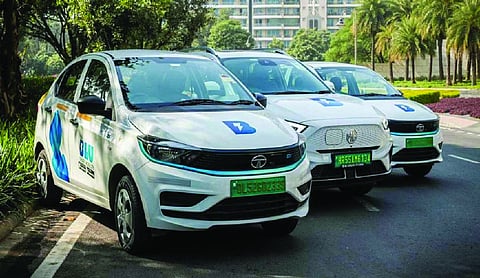

India’s battle against air pollution cannot be won through seasonal restrictions or private electric car adoption alone. Electrifying two-wheelers, three-wheelers, taxis and commercial vehicles could cut urban emissions, reduce dependence on imported oil and make clean mobility economically viable.
Every November, like clockwork, Northern India disappears behind a toxic, grey curtain. From Gurugram to Ghaziabad, the air turns metallic, schools shut down, and policymakers scramble for silver-bullet fixes. In the annual blame game over crop stubble and firecrackers, we routinely overlook the one pollutant we control 365 days a year: tailpipe exhaust.
Over the past few years, India's electric passenger car market has gained undeniable momentum. Electric Vehicles are inching towards ten per cent of overall passenger vehicle sales, and not just for altruistic reasons about the environment. Sure, vehicles from manufacturers like Mahindra and Tata are loaded to the gills with technology, but as a practical escape from the annual regulatory whiplash of the Graded Response Action Plan (GRAP). With winter anti-pollution rules frequently banning older BS-III petrol and BS-IV diesel cars across Delhi-NCR, owning a zero-emission EV with a green number plate to bypass all Delhi Police checks offers private car owners peace of mind and uninterrupted mobility.
Private EV buyers are undeniably an important part of the puzzle; their early adoption helps build ecosystem confidence, drives investments in the charging ecosystem, and pushes automakers to innovate. Yet, because personal cars spend 90 per cent of their lives parked, they represent only one piece of a much larger equation. If India wants to dramatically clear its winter skies and insulate its economy from geopolitical shocks, the heavy lifting must come from the vehicles that never stop moving: two-wheelers, three-wheelers, ride-hailing taxis, and commercial light vehicles.
The Geopolitics of the Fuel Tank
Before looking at the tailpipe, look at the map. India imports over 85 per cent of its crude oil, and a massive share of that supply transits through the Strait of Hormuz-one of the world's most volatile geopolitical chokepoints. Every flare-up in West Asia sends tremors through Kartavya Bhawan and the Prime Minister's Office, threatening India's current account deficit and stoking domestic inflation.
In this context, electrifying high-mileage transport isn't merely an environmental goal; it is a national security imperative. While a private EV saves a few litres of fuel on a daily office commute, switching a delivery scooter, an auto-rickshaw, or a light commercial van from petrol or diesel to electricity severs a massive, continuous dependency on imported crude.
The Margin Math of the Working Wheel
Unlike private car buyers who weigh upfront price against long-term convenience and regulatory certainty, commercial operators live and die by one metric: daily margins.
Ride-hailing taxi drivers, gig-economy delivery riders, and last-mile logistics operators work on razor-thin economics, where fluctuating fuel prices directly eat into take-home pay. Here, electricity offers unbeatable unit economics. Running an electric two- or three-wheeler costs a fraction of a rupee per kilometre, compared to several rupees for petrol or CNG.
This organic economic shift is already transforming Indian metros. E-commerce giants and quick-commerce fleets are rapidly transitioning to electric two- and three-wheelers because the math works on its own; you rarely see a delivery boy or girl on an internal combustion engine vehicle these days. Technology from companies such as Bengaluru-based start-up Exponent Energy, which both converts old three-wheelers to electric vehicles and also offers 'rapid charging' solutions through their proprietary technology, is also an indication of the tremendous innovation and deep technology development in this sphere pioneered by the likes of Ather.
Similarly, all-electric taxi fleets such as those from Vietnamese operator SM Green are proving that high-utilisation vehicles-clocking 150 to 250 kilometres a day-recover their higher upfront battery costs rapidly through fuel savings, directly widening driver margins. In fact, SM Green is now spreading beyond the NCR and Hyderabad to many more Indian cities. Even the police play a role here; Kolkata Police, for example, has inducted over a hundred new electric motorcycles from Bengaluru-based startup Ultraviolette.
The Commercial Light Vehicle Opportunity
The next major frontier is the commercial light vehicle (LCV) segment-the diesel-guzzling mini-trucks and vans that ferry goods into dense urban markets every morning.
In Delhi and the wider Indo-Gangetic Plain, meteorological inversions trap heavy, ground-level diesel particulates right where people breathe. Replacing ageing, smoke-belching diesel LCVs with electric alternatives removes huge volumes of PM2.5 and nitrogen oxides; this is true even of older CNG vehicles, directly from congested neighbourhoods.
Even better, commercial vans and city buses follow predictable, fixed routes. Rather than waiting years for a ubiquitous highway charging network, operators can rely on centralised overnight depot charging, sidestepping the exact grid and infrastructure bottlenecks that still make some private buyers hesitate on long highway drives.
Completing the Puzzle
To accelerate this transition, policy must support both ends of the market smartly. For private buyers, clear, consistent long-term EV policies will keep showroom momentum strong. For the commercial sector, where steep upfront financing and vehicle downtime remain real hurdles, targeted support is essential: low-interest green loans for commercial drivers, standardised battery-swapping networks for two- and three-wheelers, and reliable power at commercial charging hubs.
The Indian financial sector is strong and is capable of innovation, as the rapid digitisation of our personal finances has shown, and this will play a major role in driving electric vehicle adoption. There are companies that are innovating here as well, allowing buyers of auto-rickshaws to make daily micropayments towards their electric vehicles as well as for charging, leading to lower delinquencies among small commercial vehicle operators.
India's automotive sector is the bedrock of its manufacturing GDP, and our domestic automakers already lead the world in two- and three-wheeler engineering. By pairing steady private car adoption with an aggressive push into commercial and light electric mobility, India can achieve a rare triple win: protecting the livelihoods of working drivers, insulating the rupee from turbulence in the Strait of Hormuz, and finally giving Northern India a winter where breathing isn't a health hazard.
The Indian financial sector is strong and is capable of innovation, as the rapid digitisation of our personal finances has shown, and this will play a major role in driving electric vehicle adoption
The writer is Printer and Publisher, The Pioneer; Views presented are personal.