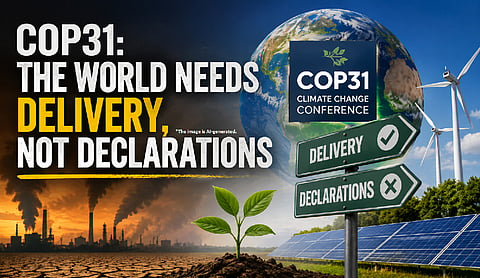

The challenge is no longer setting ambitious targets but delivering finance, accelerating a just energy transition and turning promises into measurable action.
When COP31 began on November 9 at the Antalya Expo Centre in Türkiye, without much hype. It was more of a routine conference than a meaningful meeting of minds where some substantial, tangible decisions would be made. It has been more than ten years since the Paris Agreement, yet the planet keeps warming up every year at an ever-higher rate. The 31st United Nations Climate Change Conference (COP31) will conclude on November 20, 2026.
The conference has to deal with the issues of record-breaking global temperatures and accelerating climate extremes. Its mandate, though simple, is difficult to achieve — making available funding to reset the planet so we can cool our planet. Indeed, COP has done its bit in setting targets but has failed to deliver on the changes that can retard global warming by curbing carbon emissions. At the present rate, we are warming roughly at 2.8°C, far beyond the 1.5°C contemplated in Paris.
And it is not made up, as some world leaders of developed countries would have us believe. Heatwaves, floods and failing monsoons are far more aggressive and frequent than they were earlier. However, the impact and disaster is more in developing countries so it is not on the priority list of the developed countries.
In India, where hundreds of millions depend on rain-fed farming, every fraction of a degree means lost harvests, lost wages and, too often, lost lives. Arnab cyclone was the latest to join the club.
The problem, or the big issue, is money to mitigate this crisis, which developed countries are unwilling to give, though they happen to be the worst polluters. The $300 billion a year by 2035 was pledged at Baku, which is a fraction of the $1.3 trillion developing nations need.
Moreover, much of it is in the form of loans that deepen debt. The second is fossil fuels, but it is not even a formal agenda item in Antalya. The third is credibility at the top. Both stewards of this summit, host Türkiye and Australia, which chairs the negotiations, lean heavily on coal, oil and gas.
Trump’s retreat from the Paris Agreement and multilateralism made the goal even further away. The way forward lies less in fresh pledges than in a sustainable mechanism supported by real money.
Antalya must launch the Climate Finance Work Programme with firm timelines, set a credible path to triple adaptation finance, and properly fund the loss and damage fund if a real change is to be seen in the coming years.
Besides, multilateral development banks must lend more, at low interest rates and in local currencies. India has done its bit for sure; it has walked its talk.
Its record speaks for itself: non-fossil sources already exceed half of installed power capacity, meeting 2030 target five years early. The world must follow.