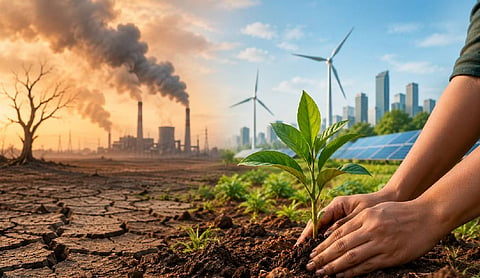

There is no dearth of pledges when it comes to lowering carbon emissions and bringing down or at least holding global warming. But, unfortunately, those pledges are seldom backed by genuine commitment to finance and execute programmes that would enable it. The world is running out of time to hold on to 1.5°C levels without crossing them. That is the message of the UN Environment Programme’s Emissions Gap Report 2026, released yesterday.
The best remaining option is to overshoot as little as possible and bring temperatures back down by 2100. That demands global emissions fall 18 per cent by 2030 and 45 per cent by 2035 from 2025 levels, close to 6 per cent every year.
But that is a far cry from what present national pledges deliver: barely 11 to 15 per cent by 2035, while current policies point towards 2.8°C. Climate diplomacy cannot remain a cycle of ambitious declarations followed by inadequate implementation.
Rising temperatures do not care about your intentions; they react only to steps executed to bring them down. India’s stake is existential. Heatwaves, erratic monsoons and flooded cities are already its daily weather. Yet India has delivered more than most: it met its 2030 target of half its installed power capacity from non-fossil sources early, and its new 2035 pledge promises a 47 per cent cut in emissions intensity and a 60 per cent non-fossil share.
But capacity is not generation. Non-fossil sources make up about 52 per cent of installed capacity yet produce only a quarter of the electricity. Coal, the main culprit, is what we rely most on for our energy needs.
The way forward runs on three tracks. First, turn capacity into generation. That means storage, transmission, a flexible grid and financially healthy distribution companies, so that solar and wind actually displace coal instead of being curtailed.
Second, we must build resilient cities. Growth and risk are concentrated in urban India. Heat action plans, drainage that works, cool roofs, building efficiency codes and municipal budgets that match municipal responsibility are not optional extras.
Third, we have to make a genuine effort to make finance and technology available for smart energy choices. India’s own plan says its commitments depend on both, and roughly 85 per cent of renewable investment is already domestic. But the reality is that the $300 billion a year promised by 2035 falls far short of the $1.3 trillion developing countries asked for.
It is high time that, at COP31 and from its BRICS chair, India pressed for grant-heavy concessional money, cheaper capital for Indian borrowers who pay one to three percentage points more than their rich-world peers, technology transfer in storage, electrolysers and grid equipment, a working just-transition mechanism, and scrutiny of unilateral carbon border taxes.
This can make a radical change, and that is perhaps the only sensible thing to do now. UNEP’s chief says the point of return begins now, not later. For India, that means asking loudly abroad and delivering visibly at home. The two are not alternatives. They are part of the whole solution.