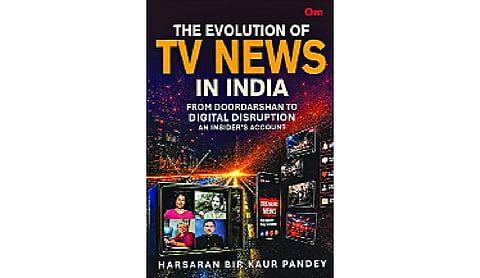

Putting together a live bulletin in the 1970s, writes Harsaran Bir Kaur Pandey, felt like leaping from a plane without a parachute and landing cleanly every night. That image anchors The Evolution of TV News in India: From Doordarshan to Digital Disruption (Om Books International), part institutional history, part media critique, part eyewitness testimony. Pandey is no mere chronicler; she helped write the medium’s grammar.
Inventing it as they went
Indian television news began not in glossy studios but in the draughty corridors of Akashvani Bhawan, on stubbornness and nerve.
Pandey joined Doordarshan in 1972 as one of its first two women news producers, and the only one in the Delhi newsroom. She likens the chaos to M\*A\*S\*H crossed with Catch-22. The lift’s operator, a Class IV employee barred from an official late-night ride home, left at 5.30 pm, and the lift went dead with him.
So Pandey and her team sprinted across a 200-metre compound and up five flights with freshly spliced 16mm reels, reaching the control room with seconds to spare. The “Rukavat ke liye khed hai” slide, she notes, was almost never needed on her watch. Improvisation defined her. When Indira Gandhi announced the Pokhran test in May 1974, a failing camera battery knocked the middle of her address out of sync.
Pandey raced to the Photo Division, shot stills of the event on 16mm with slow zooms, and cut them against the salvaged sound. Viewers assumed a polished multi-camera production.
When John Lennon was shot in 1980 and the library had closed, her husband brought their Beatles LPs to the studio; close-ups of the sleeves, cut to “Imagine,” made an obituary that rivalled Western networks.
Putting reporters on camera
In 1974, Pandey was among eight broadcasters sent to the BBC’s White City studios under Ivor Yorke. Back home, she helped standardise the piece-to-camera, moving correspondents from disembodied voice-overs to the scene itself. The technique remains the cornerstone of Indian field reporting, and her mentorship shaped a generation of broadcasters.
Conscience under pressure
A state broadcaster under the Information and Broadcasting Ministry meant walking a tightrope between conscience and power. Early producers resisted propaganda through magazines like Roving Eye and Panorama, and Pandey’s undercover report on cattle-subsidy embezzlement in Chakrata was among Doordarshan’s first on-air exposés of official corruption.
The 1984 chapters are the book’s moral core. Flown into curfew-bound Amritsar after Operation Blue Star, Pandey documented the damaged Golden Temple and its shattered marble parikrama.
As she interviewed Head Granthi Giani Kirpal Singh, military officers intervened on camera, urging him to temper his remarks on the Akal Takht’s destruction to avert riots. For years, she was asked whether she had held a gun to his head. After Indira Gandhi’s assassination on 31 October, organised mobs roamed Delhi with voter lists, targeting Sikh homes. Pandey, a Sikh married to a Hindu, faced grave danger, yet bargained with Doordarshan’s leadership: she would produce the live nightly bulletins if her days were free for relief work in the trans-Yamuna camps. In her battered Fiat she carried clothes and turbans to survivors who had watched families burn.
Broadcasts by night, relief by day.
The final chapters shift from memoir to diagnosis. After fifteen years at Doordarshan, Pandey spent over two decades at UNICEF and WHO, leading risk communication in South-East Asia. That dual vantage shapes her reading of the deregulation that followed the Supreme Court’s 1995 airwaves judgment: the end of the state monopoly opened the skies, but commodified news dismantled standards. TRP chasing turned studios into gladiatorial arenas and viewers into consumers. Invoking Wag the Dog, she describes newsrooms staging spectacle to deflect scrutiny from institutional failure, and shows how sensational visuals and premature victory laps undermined health communication during the COVID-19 infodemic. Citing Aunindyo Chakravarty, she warns that democracy rests on informed choices, which rest on accurate news.
The enduring word
Written with elegance, humour and clarity, the book rescues Mandi House’s technicians, producers and newsreaders from obscurity. In an age of screaming anchors and algorithmic echo chambers, it recalls what television news once was and must become again: curious, principled, courageous and deeply human.
Essential reading for every journalist, media student and citizen who believes truth belongs on the screen.