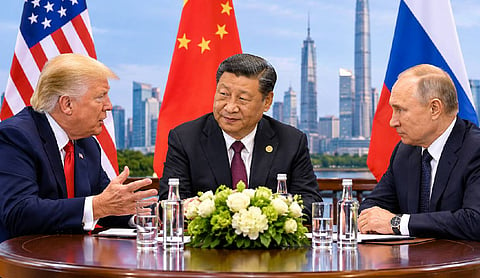

After China has confirmed that the three world leaders — Donald Trump, Xi Jinping and Vladimir Putin — will meet in Shenzhen China to discuss world affairs, the experts are contemplating the agenda and the outcome of this rarest Summit to happen for the first time in the history . Though they have met each other separately, they have never met together to discuss world affairs. The meeting is to be held on the sidelines of the APEC summit. Whether it proves a landmark or merely a photo op will be clear after the summit, but that such a meeting is taking place is a big event.
It shows that, despite their differences, which are huge, they are willing to discuss things and that there is a possibility of common ground which could mitigate the chances of a world war or a nuclear war.In fact, this was in the air for some time after Russia mulled over such a summit. The Kremlin floated the idea in September, after Putin and Xi met at the Shanghai Cooperation Organisation summit, and Putin talked to Trump in October to settle Ukraine. Behind the meeting lies over a year of a series of bilateral meetings — Trump and Putin in Alaska, Trump and Xi in Busan, Beijing and Washington, and Putin and Xi at least three times this year. It is interesting to note why the three must have agreed to such a meeting.
At this point, Russia is quite drained after a prolonged war in Ukraine, and the US has burnt its fingers in the Iran war, while China, though not involved in a direct conflict, is finding it tough in Taiwan, Hong Kong and the South China Sea. The Belt and Road initiative is also finding resistance in several countries, impeding its imperial designs.Neither war belongs to one power alone: Russia fights in Ukraine while Washington presses Kyiv toward a deal; America is at war with Iran, whose partners in Moscow and Beijing work the diplomacy.
The agenda, as Washington describes it, is narrow. Trump wants to discuss nuclear arsenals and Iran. Ukraine, officials say, belongs to a separate track. US officials call the trilateral an initial conversation and expect no concrete agreement.
Moscow, which wanted Ukraine on the table, may raise it anyway, though Xi reportedly made it clear it would not be discussed. Beijing has yet to outline an agenda and has repeatedly declined trilateral nuclear talks, pointing to the far smaller size of its arsenal. Will it define world politics? May be, may be not. These three disagree on Ukraine, Taiwan, Iran, technology and trade, and Kremlin spokesman Dmitry Peskov himself says nothing agreed in Shenzhen can be enforced on others.
Yet a great-power summit on wars fought on other people's soil will definitely work to understand the imperatives and each other’s compulsions. Three tests will decide whether the Shenzhen summit becomes a way forward: a nuclear risk-reduction channel; a declaration on the war, at least in principle; and a Gulf de-escalation plan and any hint for smoothing world trade.
Middle powers such as India, whose strategic autonomy depends on rules rather than clubs, should press for exactly that. The summit may not herald a new era, but the willingness of world leaders to engage in dialogue is certainly a welcome development.