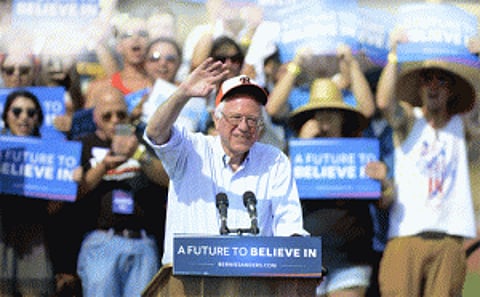

The movement against the Vietnam War, which had turned a large section in the US, particularly the youth, against the country's political establishment, subsided after the conflict ended. Most of the participating young men and women returned to conformist mainstream life. Would the same thing happen with Sanders' youthful supporters, and the radicalism they display prove transientIJ
It is hazardous to make predictions. Nevertheless, unlike the issue of the Vietnam War which was over with the conflict, the ones that Sanders has raised will remain after the election whoever the Democratic candidate and whoever wins. The disparities would continue, as would the privileges of corporate America and its power to intervene in politics; nor will it be easy to enforce accountability in the economic sphere, particularly in the areas of banking, high finance and real estate business, sharp and illegal practices in which caused the crisis that began unfolding in the US from 2008 and eventually engulfed almost the whole world.
Sanders will have to take on the dominant section of the US's political and economic establishment to achieve his political and economic goals. This in turn will require a long and hard struggle along multiple fronts ranging from political mobilisation to legislative and judicial action. Reverses will inevitably be many; at times the goals will seem unattainable. Even the controls, whose lifting enabled the perfidies that led to the 2008 crisis, will not be easy to reimpose. The question is: Will Sanders' supporters persist with their movement in the teeth of all thisIJ
The answer will depend on a significant extent on developments on the economic front. The urge to transform the US may erode in many who find jobs and get involved in quotidian businesses like raising families. While this seems logical, the logical does not always happen. Besides, the continuing surge of support for Sanders is not unrelated to the growing anger against the dispensers of the US's economic destiny, increasingly manifest since the unfolding of the crisis since 2008 in the form of movements like the one for occupying Wall Street. Those participating in it were dispersed by force but they are unlikely to give up wanting to bring the perpetrators of the crisis to justice, especially since most of the latter seem to have escaped scot free.
Much would depend on whether Donald Trump becomes President and the policies he follows if he does. Equally, what would his supporters do in case he is defeatedIJ Would his actions as President further arouse opposition and expand the movement supporting SandersIJ Contrarily, will his defeat demoralise his supporters who would become quiescentIJ
As I said earlier, it is hazardous to make predictions. Sanders' advance reflects a growing sense of disillusionment and anger among a large section of Americans with their country's economics and politics. One would need to fix precise goals and targets and draw up a credible plan of action to achieve these, for the movement to continue and grow. This has to be done in keeping with the US's values and democratic ethos in mind so as to be acceptable to a large section. Sanders and his supporters have their work cut out.