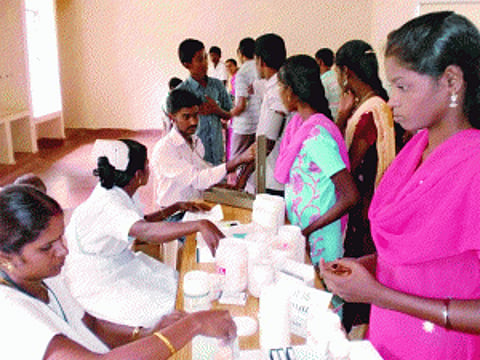

Much is desired to be done by the Government to provide its citizens accessible and affordable healthcare, as reflected in the BJP manifesto. This should have been made part of the Swachch Bharat Abhiyan and the larger cleanliness drive linked to overall health
The BJP in its manifesto for the 2014 lok Sabha election, had promised big ticket reforms in the health sector. It promised a comprehensive health care policy and to set up a National Health Assurance Mission with a clear mandate to provide accessible and affordable healthcare. The Government had taken one positive step in the field of medical education by breaking the blood-sucking stranglehold of private medical colleges on the admission procedures by adopting a uniform entrance test based on merit all over the country.
The Modi Government also improved the Supreme Court ruling on medical admission and to a large extent curtailed the corruption in Indian Medical and Dental Councils. The previous UPA Government launched the National Health Mission during its second tenure but the noble scheme witnessed corruption of gigantic proportions.
Much is desired to be done by the Government to provide its citizens accessible and affordable healthcare, as reflected in its manifesto. In fact, this should have been made part of the Swachch Bharat Abhiyan and the larger cleanliness drive linked to the overall health of the people especially children, women and the elderly. Integration of health and environment is an imperative for a growing economy of India’s population size. There is no mechanism in the country to check the way private hospitals are functioning purely on commercial basis, especially those who were given land and other facilities. Many of these entities treat the poor patient as a guinea pig.
The Central Government Health Scheme, better known as CGHS, also ails from several deficiencies ranging from red-tapism to over-bureaucratisation and had been plagued with scams in the past. The CGHS is definitely a unique welfare concept for the 36 lakh beneficiaries of the Union Government employees and pensioners, including Members of Parliament. This scheme, however, is very shabbily governed and poorly executed and has become a nightmare for the 11 lakh pensioner beneficiaries and also for Government employees outside the National Capital Region. Even in NCR, the conditions of patient satisfaction are miserable. This writer had written in an article on this scheme in January 2016 and offered some suggestions for improvement and also wrote to the Minister for Health, but no attention was paid to the suggestions; conditions remain deplorable.
Now, this writer has assessed the condition of CGHS scheme being implemented in Dehradun, where more than 24,000 CGHS beneficiaries are registered in two dispensaries being run in cramped locations. One hopes the Minister reads this article and takes remedial measures. There are two dispensaries having only six physicians on duty and the patients, mostly elderly pensioners, come from distant places like Roorkee(72km from Dehradun), Haridwar (65km) and Rishikesh (45km).
The online system of writing the medicines closes at two in the afternoon and is centrally controlled from Delhi. On an average, 500 to 600 patients visit these two dispensaries, and the conditions of elderly patients in their seventies and eighties is horrible. Many of them have to return if their turn does not come.
As if this agony is not enough, people begin lining up from five in the morning. This writer met one Raizada who retired from the Border Roads Organisation, and was waiting since morning to collect his insulin and wondering how he would take it to Roorkee in the scorching sun, and that too provided his turn of getting the medicine came. A few days ago, an elderly lady of 70 years told this writer that she was hoping to become third-time lucky and finally get the chance to meet the doctor. On top of this, the staff, operating at reduced capacity in the two dispensaries, is under severe stress to meet the aspirations of the tension-gripped patients. Squabbles with edgy patients are routine. The elderly patients are tolerating this harassment as they have nowhere to go, but the regular employees get a full half-day off from their duties. If medicines are to be indented, then it takes another couple of days.
The CGHS in Dehradun is thus being run just for the sake of it without assessing first the requirements of the infrastructure. There is no application of mind to ensure that the centre runs effectively. The misgovernance of the CGHS system is glaringly seen when we see the six CGHS doctors in the Survey of India catering to less than 2,000 beneficiaries, compared to 24,000 beneficiaries being seen by six doctors in these two CGHS dispensaries.
At least four doctors of the Survey of India could have been deployed in these two dispensaries to share the burden of 24,000 beneficiaries as both the dispensaries are being manned by the same CGHS cadre and looked after administratively by the same organisation. What is ridiculous is the fact that those who retire from the Survey of India are shifting to these two dispensaries and increasing the work load every year.
The CGHS facilities were created in Dehradun in 2004. More than a decade has gone by and by this time the mandarins sitting in the Directorate General of Health Services office and the Ministry of Health and Family Welfare should have created necessary infrastructure like land, buildings, laboratories, and posted sufficient doctors and support staff to meet the needs of the beneficiaries. The way the CGHS is working in Dehradun city, it is a shame and glaring example of gross negligence by those who are entrusted to oversee its management at the top level.
The example of the Dehradun CGHS and other such dispensaries, which too are in shambles, gives an opportunity to the Union Government to reform the CGHS. Already, the 7th Pay Commission had argued for reforms. The Union Health Minister needs to review the scheme as, a lot of money is being spent but still the satisfaction level is very poor.
One of the reasons for the CGHS’ poor show is the red-tapism and over bureaucratisation it symbolises. The first thing that needs to be done is to either form simple guidelines to allow the empanelled hospitals to check the patients on the lines of public sector undertakings, with stringent provisions for malpractices; else, create facilities with proper assessment of the staff and physicians and post them accordingly, along with other necessary infrastructure facilities.
In fact the Ministry of Health and Family Welfare must assign the work to a study unit of the Central Secretariat to study the expenditure on CGHS dispensaries vis-à-vis public sector undertakings’ healthcare system. If this is proved profitable, the huge staff presently posted in the CGHS can be deployed in other Government hospitals gainfully. Here is a quote from Winston Churchill, who said about healthcare: “I never ‘worry’ about action, but only about inaction.”
(The writer is former Principal Secretary, Government of Tripura, and chairman of Foundation for Integrated Resources Management)