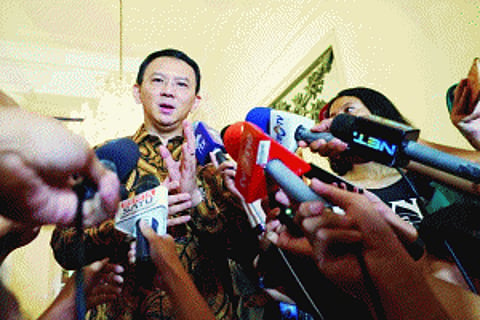

Jakarta Governor Basuki ‘Ahok’ Tjahaja Purnama, a minority, is facing ‘blasphemy trial’. Ahok’s persecution is only the tip of the iceberg. The Islamist rage reflects a simmering divide between the majority Muslims and the minorities, particularly the Chinese-Indonesians
Jakarta, the capital city of Indonesia, is agog with reports about the upcoming gubernatorial election on February 15. But what is making it more interesting in the country and across the globe is the candidature of the incumbent Governor of the city, Basuki “Ahok” Tjahaja Purnama. He is contesting the poll for the second time. Interestingly, he has neither completed a full term, nor was elected to the post. What exactly happened was that Joko Widodo, popularly known as Jokowi, who was the Governor of Jakarta in 2014, became the President of Indonesia that very year. Then Deputy Governor Ahok automatically succeeded him as the Governor in November 2014. However, now he is implicated in a blasphemy case for one of his speeches delivered in the Thousand Islands of Indonesia in September, 2016.
What did Ahok exactly doIJ Is the whole campaign against him politically motivatedIJ Are common people raising the banner of protest against him because he uprooted people from the Jakarta suburbsIJ Or is it that the majority Muslims are fast developing hatred against the minorities like the Chinese-Indonesians, who are just one per cent of the country’s 250 million people, but having an extremely high stake on the economyIJ Finally, is it a new forceful radical challenge blowing towards Indonesia against its non-Muslim minoritiesIJ Time for Indonesia has come to search for adequate explanations to all these questions today.
Ahok is the first non-Muslim, first ethnic Chinese and the second Christian Governor of Jakarta. While on a campaign tour to the Thousands Islands, he said that there was nothing in the Holy Book that proscribed Muslims from choosing a non-Muslim leader by citing the “Al Maidah 51” verse. Also he said that this verse of the Quran has been used to deceive voters and justify the assertion that Muslims should not be led by the non-Muslims. This angered the country’s majority Muslim community and lakhs marched to the streets, demanding his immediate trial, jail terms and, by some, his hanging. Many international observers say that it was a massive protest that, probably, created a sort of history in the Island nation. But, the Governor straightway denied that he tried to insult the Quran in his much talked about trial in the city.
To Ahok, the entire campaign launched by the Islamists against him is purely motivated by political actors. If he would have not contested for the gubernatorial poll, there would have been no such attention paid to him. Though he apologised for his comments, saying it was not his intention to cause any offence, it did not work. Indonesia saw an unrelenting vengefulness against the Governor. Ahok’s Al-Maidah commentary forced lakhs of protesters to descend in Jakarta, shouting slogans like “Kafir” (infidel) against him. Indonesia’s Ulema Council, the top Muslim clerical body, announced that a non-Muslim should not become a leader of the capital of the world’s largest Muslim majority nation. But the question is what was it doing when Ahok was taking over from Jokowi in 2014IJ It should have prevented him from taking gubernatorial post. Probably, all were waiting for an opportunity to come to hound the popular Governor of Jakarta.
Beyond this, the rage reflects a simmering divide between the majority Muslims and the minorities, particularly the Chinese-Indonesians. Why is it soIJ With Ahok, an anti-Chinese wave has been unleashed throughout the country. Even in a rally organised in December, one Islamic activist was filmed telling the crowd that Ahok was “Mata sipit” (slitty-eyed), “Perut buncit” (pot-bellied) and “Babi sudah” (a pig). So, the hatred towards the Chinese community has gone to a point of no return. However, more troubling is the fact that the whole protest movement against Ahok has been hijacked by the radicals to fan “Sinophobia” among the Muslims there. His status as a double minority — Chinese and Christian — is adding fuel to the fire to the anti-Ahok campaign. Again, the status of the Chinese-Indonesians are very dominant in the country. In a survey conducted by the East Asia Analytical Unit of Australia’s Department of Foreign Affairs and Trade estimated in 1995 that the Chinese-Indonesians owned 68 per cent of the top 300 conglomerates in Indonesia. Their disproportionate share in the economy has contributed to the angst and in some cases resentment against them. During President Suharto’s rule from 1966-1988, this phenomenon of resentment against the minority Chinese was termed as “social envy” by the locals. Also, as majority of them either follow Buddhism or Christianity, they have always been seen as outsiders by the Muslims. Given this background, it has been observed that Ahok’s statement is just an accident, but the frustration of the Muslims have been growing for decades. Knowing fully well that the biggest slice of the economy is eluding them, the Muslims, backed by the hardliners, are now out on the streets to warn the Chinese. The emergence of the “bhumiputras” is not an exception in Indonesia, as it has been a phenomenon across the world, for wresting power, resources and status by the indigenous people from the outsiders. But what worries Indonesia is the ugly turn the movement is taking with the growing presence of the Islamists. That is why the Muslim “Pribumi” (Indigenous Indonesian) groups are scaling their attempts in the recent past to enter the economy and making efforts to counter the growing Chinese influence in Indonesia. For instance, small start-ups by the locals are coming up fast across Indonesia. The city of Magelang in Central Java saw the installation of several hoardings on the roads, urging Muslims to boycott groceries produced or brought by the “Asing” (foreign) or “Aseng” (pejorative term referring to the Chinese-Indonesians) and instead buy from the “Pribumi” producers or suppliers.
But fairly speaking, there is no reason to believe that Chinese-Indonesians are forcefully making inroads into the economic sector. During the 32-year rule of Suharto, the Chinese-Indonesians were highly discouraged to take up any role or service in the public domain. The social envy was at its height, mainly targeted to the Chinese. Therefore, they had no option left except moving towards business and trade. Therefore, naturally, the community has made its mark in this sector and, over time, has become dominant.
leaving aside all these trends, the current blasphemy trial of Ahok reflects gaps as observed by international experts. First of all, despite President Jokowi’s assurances that the trial will be conducted in a free and fair manner, the media is largely barred from covering it. Shockingly, the chairman of the Indonesian Ulema Council (MUI) who had given his testimony on January 31 in the Ahok blasphemy trial told the jury that “he did not watch the video that contained Ahok’s blasphemous statement”. Thus, it seems that the MUI is giving into the public pressure built up by the hardliners in the name of the majority community.
The latest welcome flagged by the fisher folk to Ahok and his campaigning team in the Pramuka Islands of the Thousands Islands is springing surprises to all, including the poll pundits of the nation. This was the place where he made the so-called controversial speech, but today its residents are displaying a new spirit for their Governor. He was greeted with a “Marawis”, the traditional percussion ensemble which is typically offered for welcoming important guests. The residents gathered, applauded and cheered him. They shouted slogans, saying, “long live Ahok” and “long live Candidate Number 2”, as the way his name appears in the gubernatorial election.
What does all these mean for him and for the rest of the Chinese-Indonesians of the countryIJ He may win the hearts of the people, but sceptics say that he will not certainly be in the right side of the conservatives. When the announcement came from National Police Chief Detective Ari Dono Sukmanto that police have decided to declare Basuki Tjahaja Purnama a suspect and bar him from travelling abroad in November last year, the Government’s intentions were more than clear. Even the Human Rights Watch feared that it would not be simply a trial for Ahok, he is very likely to end up in jail soon. Therefore, Andreas Harsono of the Human Rights Watch commented, “I have studied more than 200 blasphemy cases in Indonesia since it (law) was written by President Sukarno in 1965. Over the 50 year period, I think there was only one case where the suspect was acquitted. I don’t think Ahok can survive this prosecution, he is very likely to end up in jail.” If this really happens, he will be in jail for five years as per this law. Fortunately, only a newspaper editor was acquitted of charges of blasphemy way back in 1968 after three years of coming of this draconian law.
Still, Ahok believes in Indonesia’s multi-religious and multi-cultural fabric long established by its founding fathers. Thus he emphatically echoes, “Islam in Indonesia wants to bring prosperity and grace to all creatures. If you are Muslim, Christian or Hindu, you will still be an Indonesian. I am convinced that the majority in this country are still on track with our ideology. After this case happened, it is actually getting stronger. We are more aware that we can’t stay quiet. We are a country based on Pancasila. A tolerant nation.” On his part, he is optimistic about the secular future of his nation. But his detractors say it is time to rein in those who try to vilify Islam.
Whatsoever it may be, Indonesia should remain a secular nation. It must celebrate its multi-ethnic identity. Rather than giving into the diktats of the radicals, Jokowi must respond to the crisis as early as possible. As the world over, people are witnessing the rise of jehadis, and Indonesia is no exception to it, Jokowi’s time has just come to talk straight. Ahok is only the tip of the iceberg, as the Islamists are likely to hound more like him. And, this anger is fuelled by a global raze, conditioned by local atmosphere.
(The writer is Senior Editor, The Pioneer)