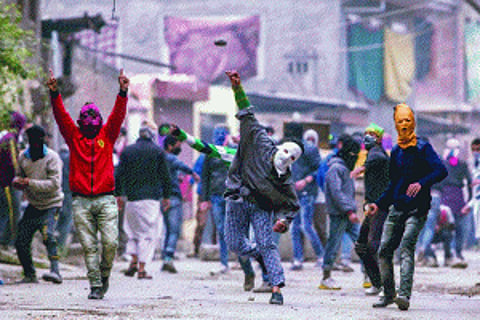

Even as security agencies, with backing from the political establishment, are on a major offensive to quell the uprising in the valley, there has been a lack of political engagement. Kashmir requires interventions which go beyond the traditional management methodology
Kashmir witnessed a difficult period in recent history during the peak summer season. Autumn is fast paving way for winter to set in, but the situation on the ground remains consistently inconvenient for the common people.
The separatists, who spearheaded a campaign of shutdowns, anti-India rallies and protests since mid-July, when spontaneous protests erupted in the wake of killing of Hizbul Mujahideen leader Burhan Wani, have not shown any sign of retreat or re-think. Security agencies, fully backed by the political establishment, are on a major offensive to quell the uprising. Initially, the unbridled use of force lead to the killing of more than 90 persons, most of them youngsters, and injured over 10,000 others.
However, a systematic method is now underway to bring the rebellious population to submission. A dozen of Government employees were dismissed for participation in protests, massive crackdowns have been conducted in the countryside to arrest the organisers of the protests and alleged stone-pelters. An English daily, Kashmir Reader, was banned and this had a huge impact on local coverage of the happenings, both in English and vernacular Press.
Hundreds of protesters have been booked under the Public Safety Act — a law that allows authorities to detain any suspect for a year without any trial in court. Most of the detainees have been lodged in jails outside the Kashmir valley. On the other hand, a large population is either engaged in attending their injured kith and kin or are engaged with the hectic processes to bail out of their detained relatives.
Jammu & Kashmir Chief Minister Mehbooba Mufti, her Cabinet colleagues and top bureaucrats, packed up from Srinagar last week of October. Under the biennial shifting of the State offices, the Government will now operate from ‘peaceful’ Jammu for the next six months. Interestingly, the winter secretariat, a contact office of the Government, often attended by a Minister, was not established for the upcoming harsh months, a deliberate deviation from the past practice.
When Mehbooba Mufti started operating from the winter capital on November 7, she had already completed seven months in office, as the continuation of the unpopular PDP-BJP alliance that her father Mufti Muhammad Sayeed forged in March 2015. To her misfortune, these months are replete with haunting memories for the common people in Kashmir.
Just like former Jammu & Kashmir Chief Minister Omar Abdullah received full backing of the Center in the tumultuous summer of 2010 that saved his shaky chair, the Narendra Modi-led BJP Government ensured stability for the Mufti Government in the aftermath of killing of Burhan Wani.
The additional deployment of over 1,00,000 paramilitary personnel and two brigades of Army was one of the effective measures to ensure stability to the precarious Government. The authorities have no intent to dislodge these forces for several months. No matter how much these methods go against the basic politics of her party, Mehbooba Mufti is emboldened enough to justify them.
In a meeting with a group of local editors in Srinagar, she justified the methods her Government employed to “restore public order”, which includes scores of killings, except a few incidents she counts on her fingers.
Home Minister Rajnath Singh did not visit Kashmir after September 5, apparently due to the failure of an all-party delegation he had led to find a way out to the Kashmir crisis. He had linked his earlier frequent visits to the sincerity and seriousness of the Union Government. The separatists’ rebuff to a detachment of the parliamentary delegation became one of the major reasons for the Center’s hardened stance. This led to the harshest ever crack down on the separatist leaders and workers.
In reaction, the separatists remained unrelenting and continued the shutdown which has now entered its fifth month. On November 8, three separatist leaders, Syed Ali Shah Geelani, Mirwaiz Umar Farooq and Yasin Malik, held a day-long meeting with businessmen and other stakeholders in Srinagar. The meeting did not terminate the shutdown schedule but a fresh weekly calendar of protests was issued.
The Government is continuing its efforts to rupture the separatists’ sway on the ground. The main focus is on re-opening of educational institutions which have been closed since July 1. Despite resentment from a section of students and teachers, the Government is conducting annual examinations for classes X and XII. Examinations are being held amid a mysterious spree of burning of schools that compelled the authorities to detail the teachers on night duty for ensuring safety.
The police, the civil administration and the education department have been coordinating to ensure the conduct of examinations. This is a high-risk method the Government has adopted to break the perpetual shutdown.
If one goes by the police spokesman’s ritualistic daily statement, the situation in Kashmir is normal. For quite some time, there have been no killings, street protests have ebbed, vehicles have been plying on roads, vendors have been trading merchandise on the roadside and the common people have been urged to return to normal life.
However, this does not reflect the entire ground situation. The semblance of peace is due to round-the-clock presence of security forces in every nook and corner of the valley and the methods adopted by them to keep a check on common man’s movements. The Friday congregational prayers have not been held in Jamia Masjid in old Srinagar since July 15, a major cause of resentment in the volatile city.
In October, former Foreign Minister Yashwant Sinha arrived in Srinagar alongwith four influential citizens to engage with the separatists. They did not receive a cold shoulder. Their report talked about some interventions the Union and State Governments could do to reach out to the people. One month down the line, there are no takers to their recommendations.
The security situation is grimmer. The number of militants has swelled to 300 in the past four months with fresh recruitments in south Kashmir and several incidents of weapon snatching from police. After the September 29 ‘surgical strike’, the borders have become more active. Almost every day, a soldier is hit along the line of Control (loC) and a large chunk of border population has been evacuated in the Jammu region due to heavy Pakistani shelling. This state of affairs highlights the essence of political engagement, internally as well as externally. The lack of it is continuously taking a heavy toll on the common people in Jammu & Kashmir.
The demonetisation of currency notes may have deflected the attention at the national level, but the fact is that Kashmir remains on the edge and it requires interventions which go beyond the traditional management methodology.
(The writer is a Jammu & Kashmir-based correspondent, The Pioneer)