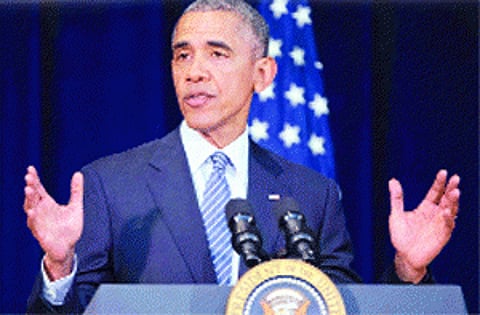

Obama's foreign policy has been minimalist on Cold War era concerns. But he has been an activist in his pivot to Asia, resetting ties with Cuba and on climate change
If the US Congress had not imposed a two-term limit on the presidency in 1947 after Franklin D Roosevelt's record four electoral victories, US President Barack Obama would be a safe bet for a third term next November. He inherited the worst recession since the Great Depression, and now the US has the healthiest economy of all the major powers, with unemployment back down to 5.5 per cent.
But Obama can't run for President again, so the time has come for the pundits to start delivering their assessments on the success or failure of his policies. First up is Jeffrey Goldberg, national correspondent for The Atlantic magazine, with a lengthy article called ‘The Obama Doctrine’ on the man's conduct of American foreign policy over the past seven and a half years.
As you would expect when discussing a man whose basic rule is ‘don't do stupid shit’, Goldberg's piece is mostly an examination of what Obama didn't do, not what he did. He didn't go to war with the Assad regime in Syria. He didn't get into a new Cold War with Russia over Ukraine. He didn't bomb Iran, instead making a political deal to block its nuclear weapons ambitions. He didn't attack North Korea even when it did test nuclear weapons.
But in the Washington, DC, foreign policy establishment, where every conflict on the planet tends to be re-defined as an American problem and almost unlimited military force is available to attack the problem, Obama's approach was heretical.
Democrats were just as opposed to his heresy as Republicans. Indeed, despite the wreckage of former US President George W Bush's invasions of Afghanistan and Iraq that Obama's administration inherited when it took office in early 2009, his own first Secretary of State, Hillary Clinton, was a classic interventionist.
After she left office in 2013, Clinton told Goldberg that “the failure to build up a credible fighting force of the people who were the originators of the protests against Assad...left a big vacuum, which the jihadists have now filled.” But Hillary Clinton actually got her way on Syria. The real failure of American policy on Syria in 2011 was the tolerance extended to Turkish, Qatari and Saudi Arabian shipments of arms and money that were intended to subvert the faltering non-violent revolution and replace it with an armed revolt whose goal was a Sunni Islamic State, not a secular democracy.
Most Syrians would now agree that it would have been better to accept the failure of the non-violent movement and the continued rule of the execrable Assad regime than to see their country virtually destroyed. I suspect that Obama sees Clinton's Syrian policy, in hindsight, as the greatest mistake of his time in office — but he did partially redeem himself by refusing to bomb Syria during the “poison gas” episode of 2014.
His fundamental insight — and his greatest break with the orthodoxy of the American foreign policy establishment — has been to understand that very little that happens or could happen in West Asia is a threat to America's vital interests. Even Israel's well-being is only a sentimental consideration for the United States, not a strategic one, although like all American politicians he is obliged to pretend otherwise.
His foreign policy has been minimalist only with regard to the traditional ‘strategic’ concerns inherited from the Cold War and America's long, deep and mostly futile engagement with the Middle East. In his ‘pivot’ to Asia, in re-establishing ties with Cuba, above all on the issue of climate change (which he rightly sees as the crucial issue for the next generation and beyond), he has been an activist in his foreign policy — and a largely successful one. Neither Hillary Clinton nor Donald Trump, the two main contenders for the succession, will be a patch on him.