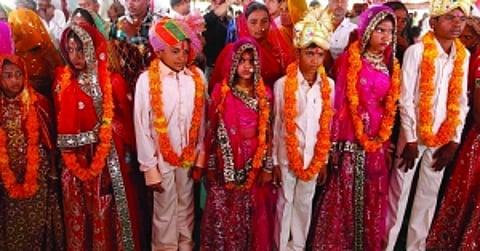

The apex court’s criminalisation of sex with an underage wife is laudable. But there’s a long way before the country criminalises marital rape
The Supreme Court, in a landmark judgement in the case of Independent Thought vs Union of India, criminalised sex between a man and his minor wife. The court was hearing a petition filed by an NGO, Independent Thought.
The legal issue up for adjudication before the apex court was the law contained under Exception 2 of Section 375 of the Indian Penal Code (IPC). Section 375 of the code defines rape. Exception 2 provides that if the parties are married and the age of the woman is more than 15 years, then sexual intercourse between the parties, consensual or otherwise, will not be considered rape.
This created a legal anomaly at various levels. The Indian law considers 18 years as the age of majority for all purposes. The Prohibition of Child Marriages Act, 2006, (PCMA) defines a child as a male under 21 years of age and a female under 18 years of age. A more recent legislation, the Protection of Children from Sexual Offences Act, 2012 (POCSO) also defines a child as a person below 18 years of age.
Also, the IPC itself under Section 354, provides for punishment for anyone who outrages the modesty of a woman. Hence, it is also applicable to a man who is a husband of a woman aged between 15 and 18 years, but poignantly, he can’t be booked for a graver offence, that being rape.
The petitioner challenged the constitutional validity of Exception 2 in light of this incongruity. The Supreme Court accordingly read down the provision. Reading down here means that the wording of the provision will have a different meaning, which will be in compliance with the Constitution of India.
The court said that age under Exception 2 will be read as 18 years from now on. This effectively means that the offence of rape will be made out even if the perpetrator is the husband of the victim, considering the victim is less than 18 years of age. It is pertinent to highlight that a complete strike down of Exception 2 would have resulted in recognition of marital rape, also applicable to adults under the Indian law.
The problem of incongruity is also complicated by the PCMA. This Act makes child marriages only ‘voidable’ and not ‘void’. Voidable means that the marriage can be made void or illegal at the option of one of the parties to the marriage if they so choose to do, but it is not illegal by itself. Ironically, the Act, though makes child marriage only voidable, prescribes punishment for such a marriage. The IPC at the same time allowed sexual intercourse without it being considered rape in child marriages, where the woman was between 15 and 18 years of age.
The POCSO, which is the latest legislation, however, provides, as also mentioned in the judgement that "any sexual activity engaged in by any person (husband or otherwise) with a girl child is unlawful and is a punishable offence”. It also provides for a more severe category of offences termed as “aggravated sexual assault”, which occurs when the perpetrator is related to the victim. The husband too is obviously related to the victim. There is, therefore, a direct conflict between the operation of the IPC and that of the POCSO and the PCMA.
The court here held that since POCSO is a new law and has a non-obstante clause (a provision which provides for overruling of all other laws), it shall prevail over the IPC. It also held that since POCSO was framed in pursuance of Article 15(3) of the Constitution, it naturally will have prominence. Article 15(3) empowers the Government to make special laws to the advantage of women and children.
The judgement also referred to Karnataka State’s amendment to PCMA, which has now made child marriage void ab initio (void from its inception), instead it being merely voidable, as is the case for the rest of India. The said amendment received the President’s assent on April 20. This also means that at some level, even the Union Government was on the same page.
The court stressed that if such an amendment was made at the national level, Exception 2 would have already been futile. It is so because in such a situation, like in Karnataka, marriage with a minor will not be considered a marriage at all in the eyes of law, hence, Exception 2 can’t kick into operation.
While reading down the provision, Justice Deepak Gupta referred to the famous quote from Charles Dicken’s famous novel Oliver Twist, that ‘law is an ass’, but added that even then it can’t be arbitrary or discriminatory. Thereby it held Exception 2 to be both arbitrary and discriminatory.
The court, on several occasions in the judgement stressed on the fact that it is abstaining from making any observations on marital rape in general. The instant case was very specific in dealing with the issue of marital rape of a minor. The petitioner also did not demand any remedy with respect to marital rape for adults in its petition. This is probably due to the fact that the larger issue of recognition of marital rape as an offence under the Indian law is being currently heard by the Delhi High Court in another case.
This verdict has, therefore, certainly laid down the ground for two important further developments in this regard. One being making child marriages void ab initio in the entire country, and not only in Karnataka. The other being a possible recognition of marital rape as an offence for adults too. The latter may actually happen soon if it is so desired by the Delhi High Court in the matter which is pending before it.
This decision of the court, nevertheless, needs to be appreciated in light of the progressive point of view it has espoused, which is in consonance with the modern democratic values, but certainly, more needs to be done.
(The writer is Research Fellow with the Department of Humanities and Social Sciences, IIT Bombay, Mumbai)