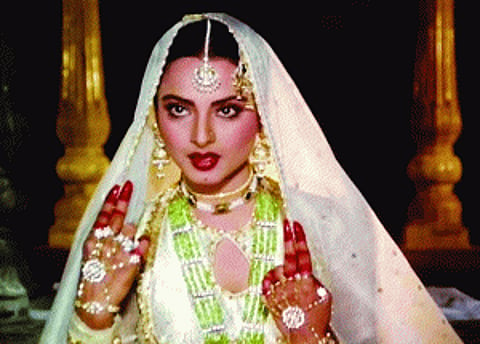

Tawaifs and kothas did not have negative connotations in the centuries they flourished, especially during the Mughal rule. They were repositories of high quality art and music. Now, though, like today's women dance performers, they are seen as ‘characterless'
One of the most dangerous occupational hazards female performers face, whether at weddings or at private functions, is to be presumed as ‘available’ for the ‘right sum’ or even by force. A few times, as it happened in the Bhatinda case, where a drunk man allegedly shot a dancer at a wedding after she refused to dance with him, performers become victims of hooliganism by unruly elements.
In Mumbai, dance bars were shut down by a State Government order because the regime believed the dance girls were engaged in “immoral activities”, that went beyond dancing. There is no saying for sure that some of these are not so engaged or ‘available’, but the unfairness lies in painting the entire profession with the same brush. A ‘dance girl’, therefore, has become synonymous with one having a ‘dubious’ character.
But this is not the only or the primary misconception. History is replete with terms that have acquired meanings very different from what they initially were. Take, for instance, the term ‘hector’. Originally, the term symbolised a person who could exercise restraint, one had a noble character, and one who was courageous. It owed its origin to prince Hector in Greek mythology who fought the Trojan war against Achilles for the peace of Troy, but eventually lost. Hector went into folklore as a strong, intrepid and noble man, who commanded respect not only of his own people but also those who were against him. He remained one of the greatest warriors of Troy. Hence, the term Hector signified ‘masculinity’ and one who would hold respect. later, the term’s meaning degenerated. It is now used for bossy people, a bully.
Similarly, the term ‘maverick’ always had a rebellious connotation. It owes its popularity to Samuel Maverick, an American cattleman, who was known for not branding his cattle. To avoid disputes over ownership of cattle, cattleman used to brand their cattle by stamping the name of their ranch into the animal’s skin with a hot iron. Samuel Maverick never approved of branding cattle as, according to him, it was a cruel practice. Instead, he allowed his cattle to move freely. Hence, the term ‘maverick’ signified a person who was independent — a free thinker who stood apart from others. Gradually, from being synonymous to a person who exhibited courage of conviction, the term now is often applied to destructive rebels as well.
Similar is the case in the Indian context. Take the words, ‘tawaif’ and ‘kotha’.Tawaif did not have any negative connotation in the 18th century, unlike what it has assumed now. From being referred to as women entertainers, tawaifs have gained an occupationally-driven identity. The tawaifs, during the Mughal era, commanded respect and were referred to as female entertainers and repositories in art, poetry, music, dancing, singing et al. Not only this, they had the authority on etiquette — so much that young nawabs were sent to tawaifs to learn learn tameez, tehzeeb and lihaz. Thetawaifs taught nawabs the difference between the ‘good’ and the ‘bad’. They were, in fact, preservers of centuries-old north Indian culture.
Sadly, with modernity, there were new linkages to tawaifs. They are now too often referred to as sex-workers. From holding literary positions, they have been branded and stigmatised as hereditary bar dancers and worse. They are no longer part of the original community but have been reduced to an unwanted and shunned category. Owing to the negative image, many performers have ceased to perform. Perhaps post-19th century, the number of such women who would dance publically, has seen a downfall, and is almost negligent now.
Similarly, kotha, from being referred to as a place where the tawaifs resided, is now referred to as brothels. Since, in modern times, for many people, tawaifs mean nothing more than sex-workers, the kothas have become a place where sex-workers live and work. In fact, many red-light buildings harbouring sex-workers and their activities are now called kothas.
The degeneration in description reminds one of the Geishas of Japan, who can be equated to thetawaifs in India. Geishas were elegant figures who were well-dressed — they wore kimonos, painted their face white, had red lips and elaborate hairstyle — and trained in performing arts such as classical music, dance, games and conversation, mainly to entertain not only male customers but also a female audience . In fact, ‘Geisha’ means artists. They were regarded as an extended family member, treated with regard and often publicly recognised. But today the Geishas too are referred to pejoratively.
So, why have distortions taken placeIJ First, the new generation is unaware of the rich tradition and roles the tawaifs and the kothas played.Tawaifs are seen as tools to be used and discarded.
Second, the manner in which such issues are displayed in contemporary films, has promoted wrong impressions. Thetawaif’s dance attracts the audience when it’s obscene. In Ram Teri Ganga Maili, the kotha where Ganga, the central character of the film, was taken after being abandoned, was actually a brothel. She is portrayed as a mistress and is eventually shown as being sold off to a politician.
Third, many among the generation of today are not even aware of, let alone having seen, films of the genre, such as Pakeezah and Umrao Jaan. In Pakeezah, which revolves around the world of tawaifs, Nargis and Sahibjaan (character names) are shown as dancers, but their performance is shown as both empowering and artistic. Both the characters (played by Meena Kumari) are judged by different attitudes. The film shows how Sahibjaan, daughter of Nargis, a courtesan, struggles to re-establish her mother’s dishonoured name. The denouement of the film stands out as Nargis, who was branded as a prostitute owing to her mother’s profession, is integrated back into society, though at the cost of giving up her love for dance.
The film, Umrao Jaan, which is an adaptation of Mirza Hadi Ruswa’s book, Umrao Jaan Ada, revolves around the life of courtesans from lucknow. It shows how a young Umrao is abducted and sold off to a kotha where she is educated in dance and music and subsequently she attracts the attention of influential people. Eventually, Umrao remains an outsider, excluded from her family and her male lovers (or just admirersIJ).
Fourth, society is increasingly becoming voyeuristic and less appreciative of cultural sensitivities. And finally, the distorted image fits in with the patriarchal mindset that views women’s independence with suspicion, or engages in female foeticide.
In light of all this, it is refreshing to learn that Member of Parliament and actor Hema Malini has appealed to the Uttar Pradesh Government to revive thekotha culture of Oudh, to not only promote art and music in the State but also check exploitation of female performers. It’s time for some positive maverickism.
(The writer is Assistant Editor, The Pioneer)