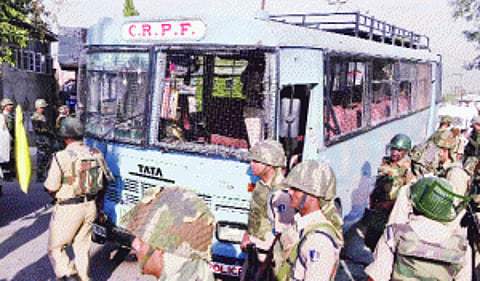

An initial probe has found security lapses leading up to the Pampore attack. We must ask why local police and the CRPF displayed such complacency and how complicit was their chain of command at the highest levels in permitting such a command failure to occur
I wish, the Special Director General of the Central Reserve Police Force (CRPF), K Durga Prasad, had given his take to the media on the tragic ambush near Pampore in Kashmir, after seeing the amateur video that went viral on social media. That attack led to eight CRPF jawans being martyred and 22 others being wounded, including two critically. He would then, have avoided the embarrassment of being confronted with visual evidence of facts being completely contrary to what he would have us believe.
This is neither about whether the ambush could have been prevented nor why such large number of casualties occurred. Those issues will be analysed at length by the team that has been set up by the Ministry of Home Affairs to probe the issue. One can only hope that it includes members with actual ground experience in such matters as otherwise its value and efficacy is questionable.
For some reason, our political leaders believe that seniority is directly proportional to domain knowledge, and so, we never learn lessons from the disasters that strike because the lessons tend to be just academic exercises with little practical outcomes.
As anybody who has served in low intensity conflict situations understands, success or failure in any engagement is as much a matter of chance and luck as professional abilities, knowledge, motivation and training. In operations over an extended period of time, you win some and you lose some, though off course, the attempt is to keep the win ratio as high as possible.
To use a cricketing analogy, a batsman of the calibre of Sachin Tendulkar getting out for a duck occasionally does happen. But like in cricket or any other sport, that is not to suggest that professional skill and its related aspects do not have primacy of place.
Far from it, they are of paramount importance, and enough jawans have paid the ultimate price to prove the truism correct that the most dangerous enemy that security forces have to combat is not the terrorists they face but complacency and boredom. This ambush is just such an example.
It is a well-accepted norm that counter-insurgency operations are about effective junior leadership at the squad, platoon and company level and the skillful use of small-unit tactics. This is because all aspects of counter-insurgency operations, be it acquiring
actionable intelligence, domination of the battle space, neutralisation of insurgents and terrorists or winning hearts and minds of the local population require boots on the ground to do the tough bit and deliver. This does not mean that commanders up the chain of command are redundant or only just as useful as post offices. They have the greater responsibility to ensure that their command is suitably equipped, trained, oriented and motivated for the task at hand.
Even more importantly they have to be able to comprehend the big picture and provide strategic direction that will ensure that the insurgency is reduced to such a level that political initiatives can be instituted to defeat it completely.
All of this is only feasible if these higher commanders have intimate and practical working knowledge of counter-insurgency operations. No amount of academic knowledge or simulated training can make up for practical experience in undertaking a cordon and search, carrying out road opening drills, laying an ambush or carrying out a forced entry into a house in a live insurgency environment.
Without this experience, commanders are hampered as they hostage to their subordinates for understanding the prevailing situation and in no position to give directions based on their own abilities or knowledge. In the present instance, neither the Director General nor the Inspector General of the CRPF inspires even a modicum of confidence, if one were to go by their statements.
It verges on the preposterous for Nalin Prabhat, the Inspector General CRPF in the sector, to even suggest that by shaving their beards, the militants had clearly indicated that they Fedayeen fighters intent on carrying out a suicide attack. That actually should have been obvious from whether they attempted to escape or not after springing the ambush.
As a matter of fact this issue is of little importance in any case. Not content with imparting this piece of knowledge, he further went on to state that by looking at the dead militants it was obvious that they were Pakistanis and members of the lashkar-e-Tayyeba. One cannot be quite sure whether the militants were carrying identification to this effect, which under the circumstances would be unlikely, but certainly, dissemination of his deduction techniques can be of great help to our intelligence agencies in the future.
Not to be left behind the Director General, supposedly experienced in counter-insurgency operations, having headed Andhra Pradesh’s Greyhound Force and for a time the CRPF’s Commando Battalion for Resolute Action Force, suddenly realised that buses are vulnerable to terror attacks and needed some kind of bullet proofing to make them less vulnerable.
While the Army may have done this in some of their own transport, it seemed to have escaped him that security forces have been using buses to transport their men into the Kashmir valley ever since the insurgency started with only a mere handful of attacks having been launched against them.
This was possible because all movement was in convoys with escort elements in light vehicles accompanying them and with proper road opening parties (ROPs) deployed all along the route before the convoy moved through. For the uninitiated, ROP’s physically occupy potential ambush sites and also carry out spot checks for improvised explosive devices and snipers hiding in buildings along the route.
In addition to all this, nominated personnel in the buses would be required to react tactically in the event of the bus coming under fire. In the eventuality the convoy has to proceed through areas where ROP’s have not been deployed, which is quite common off the national highway, the convoy moves in a manner that it is organised to defend and fight itself.
In this instance, as the video clearly shows, there was only one bus in which the jawans were travelling with no escort vehicles or ROP’s visible in the area. The bus was stopped at a bend highlights this, as does the fact that the terrorists are seen standing in front of the bus and firing short bursts into it with absolutely no response from inside. This action goes on for over two minutes and one terrorist can even be seen changing his magazine. Which element or unit finally responded and neutralised the terrorist and who was responsible for the ROP fiasco is now a matter of an unseemly controversy and best ignored.
Despite the DG CRPF’s statement to the contrary, the probe team does not need to look for lapses in the following of SOPs or whether the SOPs themselves need amendment, because occurrence of lapses are undeniable. What is of greater importance is why the local police and the CRPF displayed such utter complacency and as to how complicit was their chain of command at the highest levels in permitting such a command failure to occurIJ Accountability must be pin-pointed and dealt with accordingly, if we are to avoid a repetition.
(The writer is a military veteran and a consultant with the Observer Research Foundation)