
Jamia’s founders dared to envision and made their dreams come true with their sweat and blood, and never compromised with their ideals for short-term gains. Such is the inspirational story of Jamia and its principal architects
Even at 96, Jamia Millia Islamia continues to be, just as its founding fathers envisioned, a home for all. In post-Partition, Jamia came to be regarded as the most dependable refuge of both Muslims and Hindus — more Hindus than Muslims by most accounts.
Jatinder Peter Anand — born in Pakistan’s North West Frontier Province (NWFP) on May 16, 1936 — now based in Canada, was eleven when he found himself in a refugee camp at Jamia.
“There’s no Hindu or Muslim in Jamia. There’s no Partition here,” said Anand, who stayed on the campus from 1949 to 1966. And as that tradition continues, incumbent Vice Chancellor Prof Talat Ahmad termed the varsity as a confluence of modern and aged-old values of brotherhood and mutual coexistence.
Reams have been written on Jamia’s historic contribution to India’s freedom movement; and on how Father of our nation Mohandas Karamchand Gandhi himself repeatedly came to its rescue when its survival was threatened.
There are innumerable stories of people whose dedication, sagacity and brilliance made Jamia count globally as a unique institution. Among them was Dr Zakir Hussain, India’s third President, and a host of other luminaries who were part and parcel of the freedom struggle.
What is remarkable is that this spirit has continued to define Jamia in the 96th years of its existence.
Jamia went through some exceptionally trying times, but the unshakeable resolve of its founding fathers saved the day for it at every critical juncture. One of them, Hakim Ajmal Khan, spent all of his personal savings to keep the idea of Jamia alive right till the day he
breathed his last. like all great and
abiding relationships, Jamia was built brick by brick.
FANS OF JAMIA
As its fame grew scores of other dignitaries too came calling. Post Independence, Jamia has seen a steady flow of dignitaries, including Marshal Josip Broz Tito of Yuoglavia (1954). Other notable visits were by King Zahir Shah of Afghanistan (1955); Crown Prince Faisal of Saudi Arabia; King Reza Shah Pehlavi of Iran (1956); and Prince Mukarram Jah (1960); Nobel laureates Dalai lama and Amritya Sen among others.
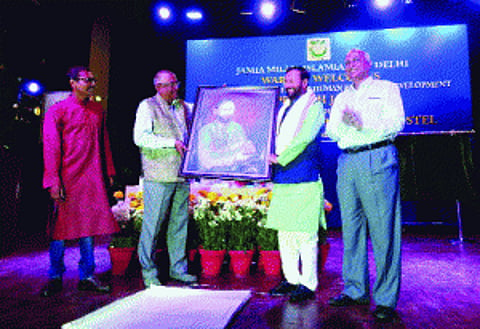
A few days ago, US Ambassador to India Richard Verma visited Jamia, hailing it as one of the finest embodiments of India. During his recent visit to Jamia, Union Human Resource Development Minister Prakash Javadekar lauded the contribution of the university, which will turn 100 in 2020 .
THE FOUNDATION
The founders of Jamia will be remembered as much for their love of the country as their probity and vision. When the foundations of Jamia were laid in Aligarh (then in the United Provinces) it was with a twin objective: the university would be equally a centre of learning as an active participant in the freedom struggle. The year was 1920.
For these nationalist-minded Muslim leaders founding and nurturing Jamia was like raising a family which, albeit highly distinguished.
Today its legion of luminaries includes personalities like Shah Rukh Khan and Virender Sehwag — both youth icons in their very different ways. And there are scores of others whose details are recorded.
MINORITY INSTITUTION
In 1980, by an act of Parliament, Jamia was accorded the status of a Central university. And ever since, it has seen rapid expansion. New buildings have come up, new courses have been launched and each department is digitally powered.
Besides, all the faculties are connected with a nodal centre from which both past and present information can instantly be accessed 24x7. In 2001, the National Commission for Minority Educational Institutions (NCMEI) granted Jamia
permission to reserve 50 per cent seats
for Muslims.
Under the leadership of Professor Ahmad, the varsity has secured prestigious research projects, including the Centres with Potential for Excellence in Particular Areas (CPEPA) Award and the Visitor’s Award for Research in Cosmology and Astrophysics.
FREEDOM STRUGGlE
During the height of the freedom struggle hundreds of Jamia volunteers courted arrest and were locked up in jails. But when in 1922 Gandhi called off his non-cooperation movement — and Kamal Ataturk his Khilafat stir — Jamia was plunged into a fresh crisis. For the funding, meager as it was, stopped abruptly.
All this led to widespread disenchantment in Jamia’s the rank and file, and its imminent collapse suddenly loomed large. Its troubles were compounded by an equally sudden exodus of many illustrious people who felt that Jamia was losing its original moorings.
ONWARD SOlDIER
Hope surged when, in 1925 — encouraged by Gandhi’s assurance — three Jamia stalwarts took the step to shift base to Karol Bagh in Delhi. Yet while Gandhi’s influence and efforts did manage to win Jamia a reprieve, many former well wishers balked at the idea of lending their name to a Congress-backed institution. Indeed, it got to be so that Hakim Ajmal Khan had to shell out his own savings to prevent Jamia from collapsing. At the same time a few stalwarts travelled extensively, telling people why Jamia mattered and deserved to be bailed out.
THE SECOND RESURGENCE
Under the stewardship of Hakim Ajmal Khan — one of the founders of the Jamia , who became its first chancellor remaining in office until his death in 1927 — Jamia experienced more financial hiccups. It was then, the reins were handed over to Dr Zakir Hussain.
As he stepped into the saddle, a dedicated band of his admirers pledged along with him to work for the next 20 years on a monthly salary of just Rs 150. The trail blazed by this group — venerated as life Members of Jamia — inspired another generation of teachers in 1942 to walk in their footsteps.
THE NEW CAMPUS AND AFTER
In 1935 Okhla was nothing but a cluster of mud-and-thatch structures. It was in one vacant space there that the Jamia management chose to have its new base. A year later the building was ready and, barring the Jamia Press, the Maktaba, and the library, all other departments moved into it. This was also the year when Dr M A Ansari breathed his last.
A teachers’ college, Utstadon Ka Madrasa, was established to locate and create new teaching models and innovative strategies. The innovation school came up which drew a host of foreign dignitaries. Among them were Husein Raouf Bey (1933), Dr Behadjet Wahbi of Cairo (1934), and Halide Edib of Turkey (1936), and several others. One of them, a German woman named Gerda Philipsborn, and fondly called Aapa Jaan, lived and worked in Jamia till the end or her life, and is buried on the campus.
But while the rest of Jamia’s campus, in Gandhi’s words, continued to serve as “an oasis of peace in the Sahara of communal violence,” the Maktaba had no such luck. The arsonists went on a mad spree, burning and destroying books.
Such is the inspirational story of Jamia and its principal architects. They dared to dream and made their dreams come true with their sweat and blood — but never compromised with their ideals for short-term gains.
(The writer has penned first-of-its kind book profiling lives of fifty Jamia alumni, including youth icons)