Zardari’s minority claims: A far cry from reality
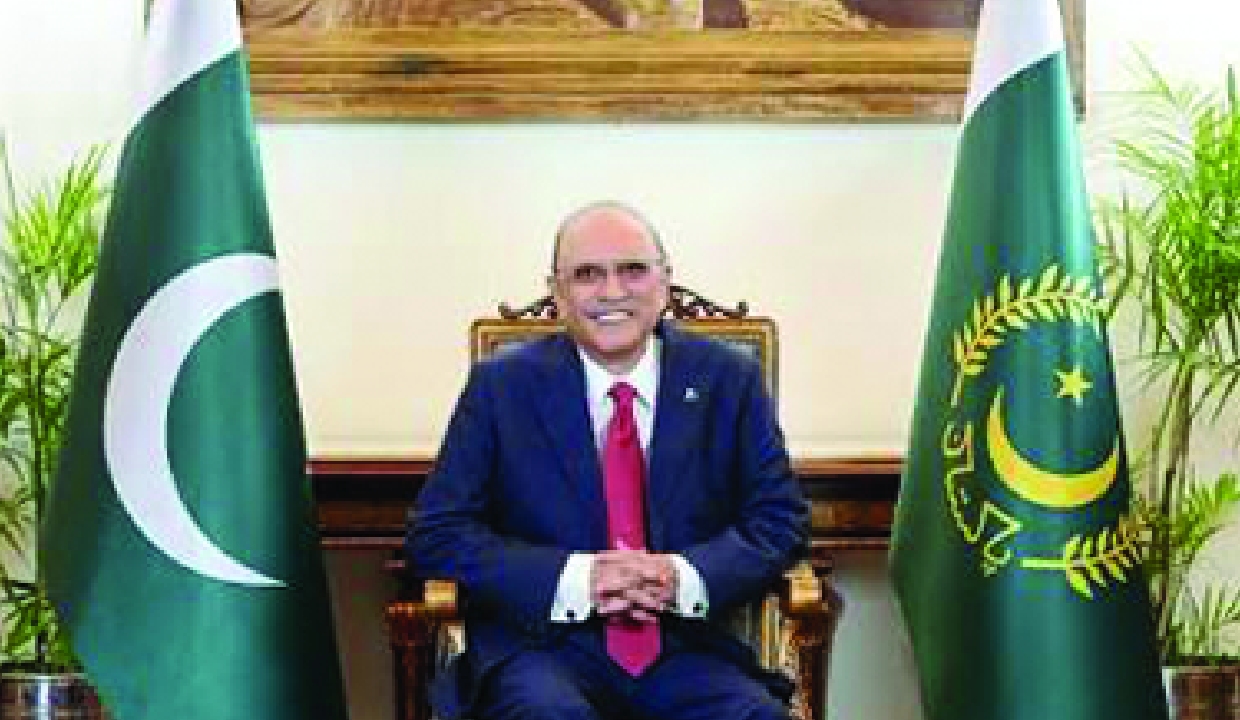
Pakistan’s President Asif Ali Zardari generated a new wave of controversy by stating that, “The Indians believe in Akhand Bharat. But we are Muslims of the mindset that tolerates. We have a 4 per cent Hindu population in Pakistan. They are free as anywhere else. They would rather be with us than India.” At first look, this position of Zardari seems benevolent and secular. But the reality is something different.
Official Pakistani census records tell an entirely different story regarding demographic trends. The Hindu share of the population in territories that became Pakistan has dropped sharply, from roughly 15 per centin the 1941 census to 2.17 per cent (5.2 million) in the 2023 census, depending on the categories and regions counted. According to the Pakistan Hindu Council, the actual number of Hindus is between 8 to 10 million, arguing that many Hindus are missed or deliberately uncounted in the 2023 official census. As per the 2023 census, 49 lakh Hindus live in Sindh, making up almost 9 per centof the overall population of the province. Punjab has 2.5 lakh, Balochistan 59,107, Khyber-Pakhtunkhwa 6,104 and Islamabad Capital Territory 839.
Before Partition (1947), in today’s Pakistan-occupied Kashmir, particularly as per the 1941 British India census, 15 per cent Hindus and Sikhs were residing. During the tragedy of Partition, they were killed and those left over were compelled to embark on compulsory migration to India. As per the 2023 census, almost zero Hindus live in Pakistan-occupied Kashmir. Although the 1973 Bhutto Constitution of Pakistan provides equal rights to all citizens and is not supposed to discriminate on the basis of caste, creed or religion.
Pakistan came into being on the philosophy that Hindus and Muslims were two different faiths and could not live together. By 1940, Mohammed Ali Jinnah became the sole spokesperson for the Muslims of undivided Bharat. In the historic Lahore Resolution, the ‘Two-Nation Theory’ was moved by a Bengali Muslim, AK Fazal Huq, and passed by the Jinnah-led Muslim League in March 1940. Muhammad Ali Jinnah argued during the Lahore Resolution in his presidential address that ‘Hindus and Muslims were distinct nations that could not coexist in a single Indian framework’. In the larger context, the Lahore Resolution became the philosophical ground for the Partition of India and the creation of Pakistan. Perhaps in any corner of the globe, within the ambit of seven years (1940-1947), a nation has been created. The new nation came into being as Pakistan. However, later Jinnah modified his stance and argued for an inclusive Pakistan in his address to the Constituent Assembly of Pakistan. Khawaja Nizamuddin, the 2nd Prime Minister of Pakistan, stated in the Constituent Assembly of Pakistan: “I do not agree that religion is a private affair of the individual nor do I agree that in an Islamic state every citizen has identical rights, no matter what his caste, creed or faith be.”
Article 41 (2) of the Constitution of the Islamic State of Pakistan explicitly states that a person is not qualified for election as President (head of the state) unless he is a Muslim. This provision exclusively debars Hindus from becoming President of Pakistan, which is otherwise not possible due to their miniscule population and the prominence of ‘Political Islam’. Pakistan’s Constitution’s Article 51 (2A) provides 10 reserved seats for non-Muslims in the National Assembly, 23 reserved seats for non-Muslims in four provincial assemblies under Article 106, and four seats for non-Muslims in the Senate of Pakistan. Conventionally, Hindus were allocated 4-5 seats in the Pakistani Parliament. The number of National Assembly seats has today gone from 207 in 1997 to 336 in the 2024 election, but seats for minorities have not been increased in this proportion due to opposition from the forces known as harbingers of ‘Political Islam’. Hindus are not duly represented in diverse walks of life and face multiple forms of discrimination, including forced conversion, rape of their women and many such others. In education, they are also deprived because of the structure of the syllabus.
In contrast, Muslims in India were 9.8 per centas per the 1951 census and increased up to 14.2 per centas per the 2011 census. Muslims in India became President three times; Union Cabinet ministers, Governors and many became Chief Ministers in Hindu-majority provinces like Bihar and Maharashtra. Muslims and other Indian minorities are duly represented in all walks of life. Hindi cinema has been unprecedentedly led by Muslim artists. Parsis are a minuscule minority in India, but they are leading the Indian economy.
Swami Vivekananda stated in his famous 1893 Chicago address that, since ages, India has accommodated all shades of minorities. We believe in accommodation, not toleration, Zardari. We do not need to be lectured by President Asif Ali Zardari about the rights of minorities. Our Constitution treats each citizen on the basis of equality. After 80 years of our democratic experience, we have proved the ‘Two-Nation Theory’ wrong. After Indonesia, the largest number of Muslims are living in India with dignity and a sense of belongingness. Pakistan must learn from India on many fronts, including the fair treatment of its minorities.