Youth must power India’s rise: PM
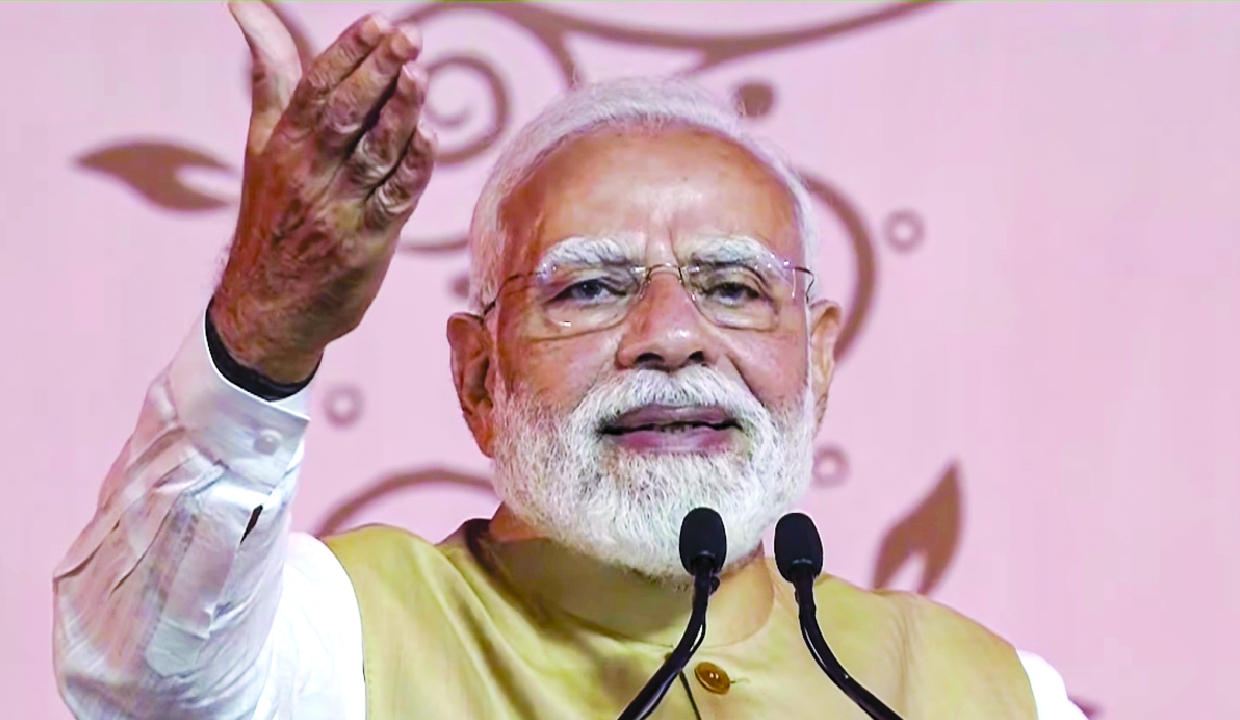
Prime Minister Narendra Modi on Saturday called on India’s youth to support nation-building through service, innovation, education, and discipline, emphasising that the current generation is responsible for fulfilling Swami Vivekananda’s vision for the country.
After inaugurating the Swami Vivekananda Cultural Youth Centre (Viveka Smaraka) at Sri Ramakrishna Ashram, Modi said the memorial should inspire youth to prioritise the nation and uphold Vivekananda’s ideals of service and sacrifice. The Centre expands the Ramakrishna Mission’s activities.
He noted that while India’s youth were once restricted under colonial rule, they are now contributing to global development.
“Today, India is the world’s fastest-growing major economy. Who has made this possible? The capability of India’s youth. Youth of India are giving impetus to the development of the world,” Modi underlined. He credited young Indians for India’s position as the world’s fastest-growing major economy, the third-largest startup ecosystem, the second-largest mobile phone manufacturer, and for progress in semiconductors, Artificial Intelligence (AI), deep technology, and space technology.
Modi cited the recent launch of a privately developed Indian rocket as evidence of the growing capabilities of young innovators. He stated that realising Swami Vivekananda’s vision is the responsibility of today’s generation and expressed confidence that Viveka Smaraka will inspire and energise this mission.
Recalling his association with the Ramakrishna Mission, the Prime Minister said the organisation played a significant role in shaping his life and expressed gratitude for the opportunity to interact again with the order’s monks.
He described Mysuru as a centre of India’s enduring cultural consciousness. Swami Vivekananda’s association with the city and the support extended to him by the then Maharaja of Mysuru had played a key role in the swami’s journey to the West. Quoting the principle “Shiva Jnane Jiva Seva” (serving humanity is serving God), he said the Viveka Smaraka should inspire youth to place the welfare of the poor and the nation above personal interests.
He stated that initiatives such as Atmanirbhar Bharat and Make in India are advancing because of the contributions of India’s youth. He emphasised the need to provide opportunities, guidance, and support for young people, and called for a strong commitment to cleanliness, conservation of natural resources, and water preservation. “We have to work in mission mode to conserve water,” he said.
Listing achievements, Modi highlighted progress in education, including the establishment of over 650 universities, nearly 14,000 colleges, more than 4,000 ITIs, nine IIMs, seven IITs, and 13 AIIMS in the past 12 years. He noted that MBBS seats have increased to about 140,000 and the number of medical colleges has reached 823.
PM further mentioned that over 14,000 PM SHRI Schools and more than 10,000 Atal Tinkering Labs are fostering innovation and scientific thinking. He said that girls are now joining institutions like the National Defence Academy, and students can pursue medical and engineering education in their mother tongues, reducing language barriers.
The Prime Minister stated that programs such as Khelo India, Youth Games, University Games, Para Games, and Winter Games, along with expanded sports infrastructure, are helping to identify talent from rural areas and enhance India’s performance in international competitions. The younger generation is being encouraged to engage with Kannada literature and support local artisans by choosing Mysuru’s handicrafts, sandalwood products, and traditional crafts.
An official statement said the Viveka Smaraka commemorates Swami Vivekananda’s visit to Mysuru in November 1892. During his stay, Vivekananda delivered discourses, interacted with scholars and devotees, and received the patronage of Maharaja Sri Chamarajendra Wadiyar X, whose support enabled his journey to the Parliament of Religions in Chicago in 1893, it said.
The Viveka Smaraka, located at the historic Niranjana Math, covers over 81,000 square feet and includes a main building and an annex block. Facilities include an experience centre, exhibition hall, amphitheatre with seating for about 700, classrooms, conference rooms, library, reading room, meditation and yoga hall, and a book stall. The centre also provides dedicated facilities for students preparing for competitive examinations, according to the statement.