Why India’s Uzbekistan upgrade matters
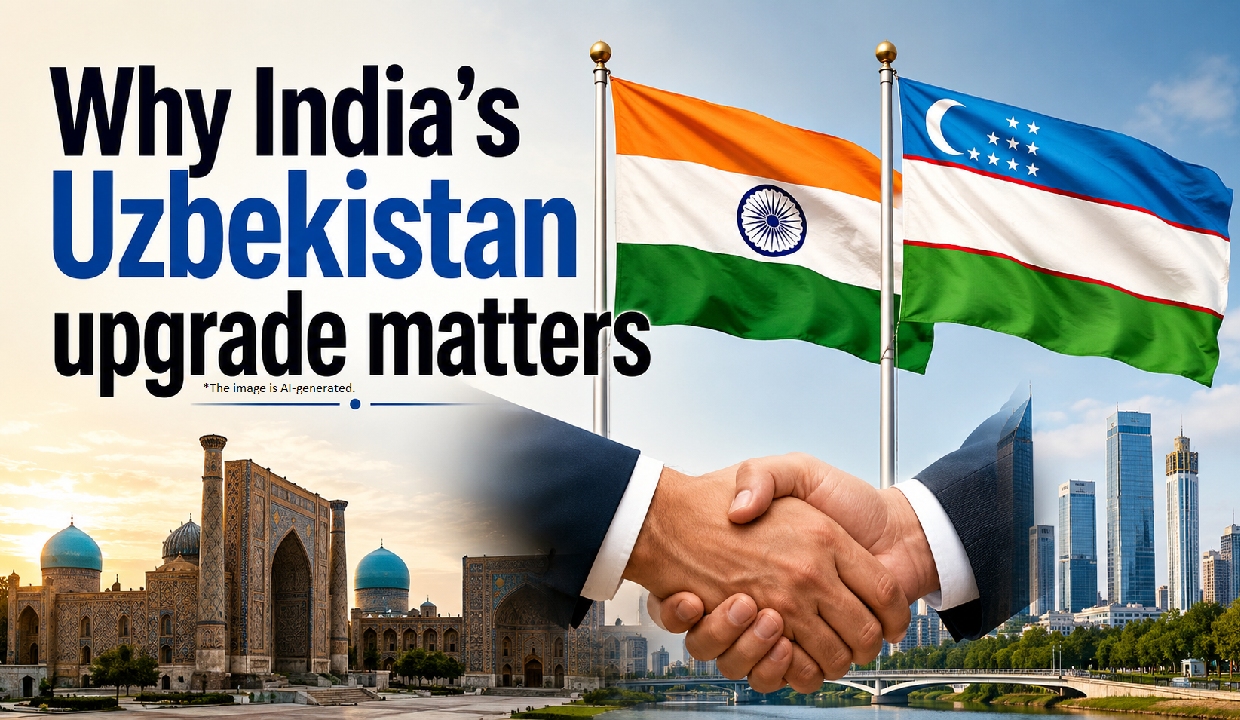
The Comprehensive Strategic Partnership takes bilateral ties beyond diplomacy, encompassing energy, defence, trade and regional connectivity
Prime Minister Narendra Modi’s two-day state visit to Uzbekistan on August 29-30 — his fourth to the country — produced more than ceremony. At Tashkent’s Kuksaroy Presidential Palace, Modi and President Shavkat Mirziyoyev agreed to elevate the 15-year-old India-Uzbekistan Strategic Partnership to a Comprehensive Strategic Partnership, timed with Uzbekistan’s 35th Independence Day. Modi was also conferred the ‘Oliy Darajali Do’stlik’ Order, Uzbekistan’s highest honour for a foreign leader and his 36th international award. Beyond symbolism, the visit yielded substance: sixteen outcomes, by official count.
A Coordination Council at foreign-minister level will steer the relationship, and the Joint Commission moves from secretary- to ministerial-level. The two sides agreed on a long-term uranium-supply framework for India’s civil nuclear programme, growing defence cooperation spanning the industrial domain and the ‘Dustlik’ joint military exercise, and a trade target of $5 billion by 2030 - nearly four times the $1.3 billion in bilateral trade recorded in 2025, itself up a third over the previous year.
Why Uzbekistan? It is Central Asia’s demographic and geographic anchor — home to nearly 38 million people, close to half the region’s population, bordering all four Central Asian neighbours plus Afghanistan. Under Mirziyoyev, it has pursued sustained economic liberalisation and plays a leading role in the Central Asia-India summit format the two leaders reaffirmed at the level of heads of state. Civilisational memory, from Babur’s Ferghana roots to the Silk Road threads binding Samarkand and Bukhara to the subcontinent, gives this relationship a resonance rare in India’s extended neighbourhood.
The stakes extend well beyond bilateral ties. India shares no land border with Central Asia, and Pakistan blocks the direct route — a single fact of geography that explains the enduring importance of Iran’s Chabahar port and the International North-South Transport Corridor as alternative arteries into a region India cannot otherwise reach. It also explains why uranium and critical minerals matter here: Central Asia offers India resource diversification independent of traditional suppliers. Add counter-terrorism cooperation, given the region’s proximity to Afghanistan, and the logic sharpens further — a stable, partnered Uzbekistan is a hedge against instability spilling southwards.
There is a great-power dimension too: Russia remains Central Asia’s historic security partner, China its largest trading partner and infrastructure financier through the Belt and Road Initiative. India can offer something distinct — a non-hegemonic partner with civilisational ties, pharmaceutical and technology capacity, and no territorial designs. The test, as ever, lies in execution: whether the $5 billion trade target survives the connectivity bottleneck, and whether ministerial mechanisms translate into completed projects rather than communiqués.