
I recently moderated a conversation with a friend about his book On Angels’ Wings. He was only seventeen when he lost his entire family in the bombing of Air India Flight 182, Kanishka. The book is a moving account of the tragedy and the long quest of the families for justice.
The aircraft went down off the coast of Ireland. As we spoke about the events that followed, one aspect stayed with me-the compassion shown by the local people towards the families who had travelled there after losing their loved ones. They were complete strangers, arriving in another country in circumstances nobody should ever have to face. Yet people opened not merely their doors but also their hearts to them. Their grief somehow became a shared grief.
A few weeks later, I was watching a series about another aviation tragedy-the bombing of Pan Am Flight 103 over Lockerbie in Scotland in 1988. Debris was scattered over a vast area, with Lockerbie itself suffering deaths on the ground. And once again, what struck me was the response of ordinary people. The residents of Lockerbie reached out to families they had never met. They offered comfort and companionship of a kind that official systems, however well-intentioned, could seldom provide.
These accounts reminded me of experiences from my own years in the Railways. Railway accidents sometimes occurred in remote locations accessible only through narrow village roads. By the time railway teams could reach the site, the nearby villagers were invariably already there. Many had very little to spare themselves. Yet that seldom seemed to matter. They helped the injured, brought whatever food and water they could arrange, and stayed around to assist those involved in rescue and restoration. I remember being deeply moved by such gestures. Nobody had instructed them to help. Someone was in distress, and helping seemed the most natural thing to do.
Years later, I find myself wondering about the apparent contradiction in human behaviour.
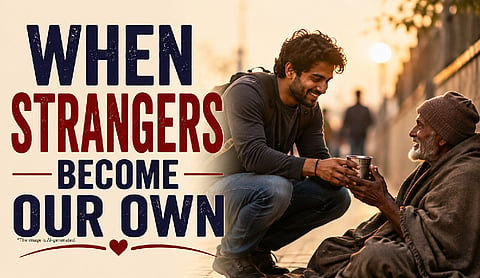
The same human beings who can display extraordinary compassion towards complete strangers can also become divided over matters that, viewed from a distance, sometimes appear insignificant. Communities that come together during an accident, flood or other tragedy can, at another time, find themselves confronting one another over differences of identity, belief or ideology. Why? Perhaps suffering does something that ordinary life does not. When we encounter someone who has lost a child, a parent or an entire family, the labels with which we normally identify people temporarily disappear. We do not first see nationality, religion, language, social standing or political belief. We see another human being in pain. A stranger ceases, for that moment, to be a stranger.
Our everyday lives are different. We have the time and space to notice what distinguishes us from others. Differences get emphasised, grievances acquire histories and opinions gradually become positions we feel compelled to defend.
Yet the responses I have witnessed in times of tragedy make me believe that compassion lies closer to our natural instincts than many of those divisions. Perhaps tragedy does not suddenly make people kinder. It merely strips away, for a while, the layers that prevent that kindness from expressing itself.
The question that remains with me is a simple one. If we can so easily recognise our shared humanity when confronted with another person’s suffering, why must we wait for tragedy to remind us that strangers can also be our own?
The writer is a founder of Kala - Krazy About Literature And Arts, is an author, speaker, coach, arbitrator, and strategy consultant; Views presented are personal.