What happens inside AI before it answers?
Every day, millions of people rely on AI assistants such as ChatGPT, Gemini and Claude. A recent landmark study by Anthropic now offers a glimpse into what happens inside these systems before they produce an answer.
Millions of people around the world use these AI assistants daily to seek answers to countless questions. Students seek help with homework, housewives request for diet plans, professionals prepare reports, doctors summarise medical research and travellers plan holidays. AI has quietly become a part of everyday life. Yet one question has continued to puzzle even the AI experts who built these systems: ‘What actually happens inside AI after we ask a question and before it produces an answer?’
The AI black box
Researchers could see the information going into these systems (the ‘AI Black Boxes’) and the responses coming out, but what happened in between remained hidden. As AI becomes part of healthcare, education, banking, business and Government, understanding how it reaches its conclusions is becoming increasingly important. People are unlikely to trust AI completely unless they have some idea how it arrives at its answers.
A recent research paper by Anthropic (‘Verbalizable Representations Form a Global Workspace in Language Models,’ published on July 6, 2026) has attracted worldwide attention. The study provides the clearest evidence yet that advanced AI appears to organise information before producing a response. Until now, we believed that AI simply ‘predicted the next word’ without any organised internal thinking.
Anthropic’s paper suggests that modern AI may have a more structured way of processing information than we previously understood. To understand this, think about how we answer a question ourselves. Suppose someone asks, ‘Which is the largest planet in our solar system?’
Most of us do not immediately say ‘Jupiter’. Our brain silently searches through memories of the planets, identifies the correct answer and only then do we speak. The entire process takes barely a fraction of a second, yet it is an essential part of human reasoning.
A peek inside the AI black box
Until now, people believed AI worked very differently. Anthropic’s researchers have opened a small window into the inner workings of modern AI. They suggest that advanced AI systems appear to create a temporary internal workspace where the key ideas needed to answer a question briefly come together before the response is generated.
Imagine a large company. Finance, Marketing, Operations and Human Resources each perform specialised tasks. But when an important decision has to be made, the heads of these departments meet to exchange information and decide the best course of action.
How AI answers questions
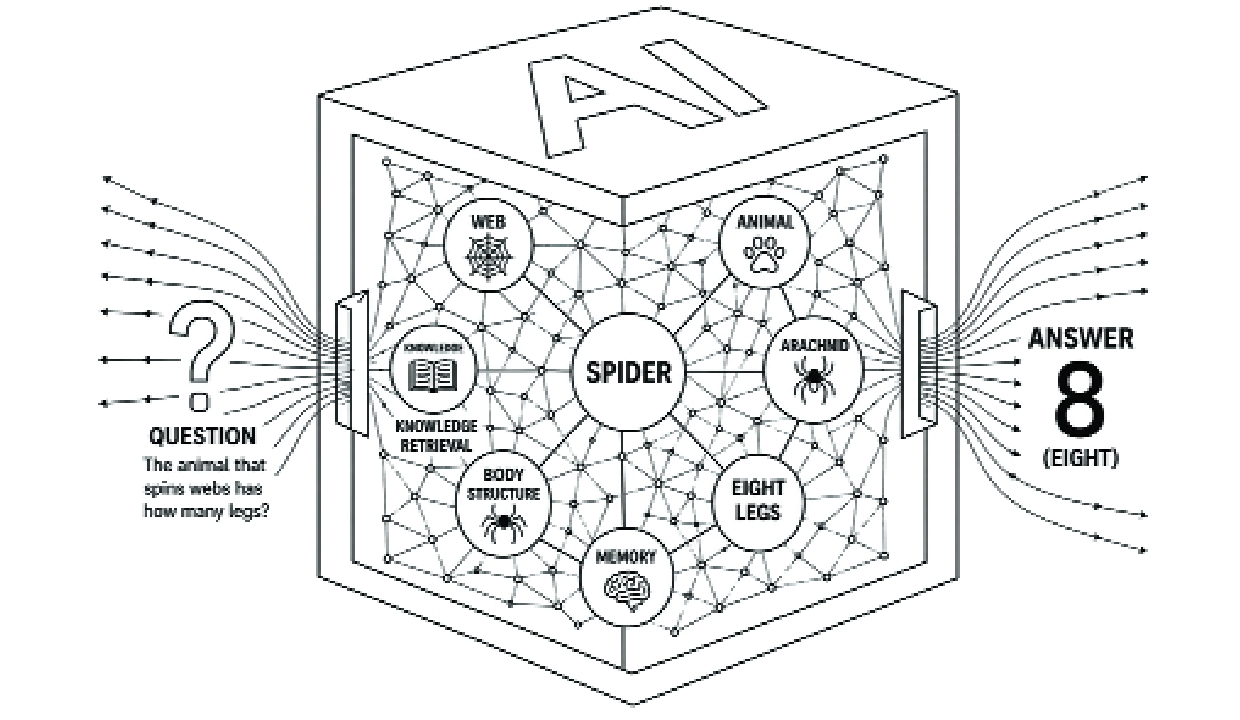
Anthropic believes something similar happens inside modern AI. Before producing an answer, the AI appears to bring together the most relevant ideas in an internal workspace where they influence one another. To ascertain if this hidden workspace genuinely helps the AI to reason, the researchers designed a series of experiments. One of the simplest involved the question: ‘The animal that spins webs has how many legs?’ ChatGPT’s answer is ‘The animal that spins webs is a spider and has 8 legs.’
The question did not contain the word ‘spider’. Yet AI activated the idea of a spider internally before answering, connecting ‘web’ with ‘spider’ and then with ‘eight legs’. Humans think in a similar way, forming ideas before expressing them in words. The experiments suggested that advanced AI may also organise concepts internally before deciding what to say. This insight has important implications for understanding AI and for making it more reliable.
Why the anthropic study is important
The researchers also wanted to find out whether the internal workspace actually influenced AI’s answers.
Imagine a student solving a mathematics problem. If you quietly changed one of the numbers in the student’s rough work, the final answer would almost certainly change, showing that the rough work was an essential part of the thinking process.
Anthropic’s researchers carried out a similar experiment. By carefully altering some of the concepts active inside the AI while it was working on a problem, they found that the final answer changed as well. The internal ideas were not merely passing through the system but were actively shaping its reasoning.
The researchers observed similar patterns when the AI solved arithmetic problems, translated languages and tackled more complex tasks, suggesting that advanced AI is doing considerably more than simply ‘predicting the next word’: it appears to organise information before responding.
Interestingly, this internal reasoning process was not needed for every task. Simple jobs such as correcting spelling mistakes or recalling straightforward facts continued to work reasonably well even when this workspace was disturbed. That observation mirrors human behaviour. Reading a familiar word requires almost no effort. Solving a crossword, planning a holiday or making an important financial decision requires far more careful thought. Advanced AI appears to make a similar distinction between routine processing and complex reasoning.
Towards more trustworthy AI
The significance of this research extends far beyond scientific curiosity. One of the biggest challenges facing AI today is trust. If an AI recommends a medical treatment, helps approve a bank loan or assists a Government department in making decisions, people naturally want to know why it reached that conclusion. Until now, AI has often resembled a brilliant student who always gives the right answer but never shows the steps used to reach it. Anthropic’s work begins to change that.
If researchers can better understand how AI organises its reasoning, they may eventually be able to detect faulty logic, hidden bias or uncertainty before the system presents its final answer. That could make future AI systems more reliable, easier to improve and more transparent. Till now, the emphasis has been on building larger models using more data and more compute. Anthropic’s work indicates that the next major breakthrough may come not from making AI bigger, but from understanding it better.
What the anthropic study does not claim
The study does not claim that AI is conscious and does not suggest that machines have emotions, self-awareness or feelings. The researchers simply argue that advanced AI appears to organise information internally before producing an answer. That tells us something about how these systems process information. It tells us nothing about consciousness.
Why the study is relevant for India
India is rapidly embracing AI. Universities are introducing AI into their curricula. Businesses are embedding it in products and services. Governments are exploring its use in healthcare, agriculture, education and public administration. Millions of Indians now interact with AI assistants daily. As this transformation gathers pace, trust will become as important as capability. People will increasingly ask whether these systems are reliable, whether their decisions can be explained and whether mistakes can be identified before they cause harm.
Anthropic’s research does not answer all these questions. Much remains to be discovered. However, scientific breakthroughs are often remembered not because they solved every problem, but because they opened an entirely new way of thinking. This study may prove to be one such milestone.
It does not tell us that machines think like humans. Instead, it gives us the first clear glimpse of how one of humanity’s most powerful inventions appears to organise information before producing an answer. The long-term success of AI will depend not only on how intelligent it becomes, but also on how well we understand it. Anthropic’s study has not completely opened AI’s black box. But it has lifted the lid just enough to reveal something that was previously hidden. That small glimpse may one day be remembered as an important step towards building AI that is not only powerful, but also transparent, trustworthy and worthy of the confidence society increasingly places in it.
The author is an alumnus of IIM Ahmedabad and Professor of Practice at IILM University, Gurugram, with an interest in AI, Technology and Strategy; Views presented are personal.