
- HOME
- INDIA
- WORLD
- BUSINESS
- STATES
- LAW & JUSTICE
- ENTERTAINMENT
- SPORTS
- VIEWPOINT
- LIFESTYLE
- TECH
Union Minister of External Affairs S Jaishankar has warned that the continuing conflict in West Asia is disrupting energy and trade flows, putting pressure on household expenses, employment and livelihoods as global prices of fuel, food and fertilisers rise.
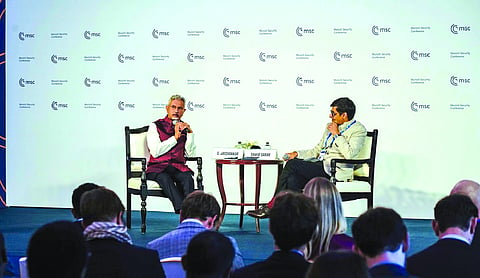
Addressing the 62nd Munich Security Conference, Jaishankar said the immediate challenge for India was the disruption to energy supplies and international trade caused by the conflict. He noted that energy markets had become highly volatile, creating wider economic consequences for countries dependent on imports.
For India, the impact is particularly significant because of its reliance on supplies from the wider West Asian region. Jaishankar said New Delhi wanted the uninterrupted movement of energy, goods and people to be restored, stressing that countries far removed from the conflict were also bearing its economic costs.
The minister also expressed hope that any eventual outcome would remain consistent with international law. The conflict, which began on February 28 with US and Israeli attacks on Iran, has contributed to heightened pressure in global energy markets. Disruptions around the Strait of Hormuz and continuing instability affecting shipping through the Red Sea have added to concerns over supply chains and transportation costs.
India has responded by expanding its sourcing options and diversifying energy supplies. The country has been procuring crude and other resources from multiple suppliers, including the US and Venezuela, in an effort to reduce exposure to disruptions from any single region.
India’s purchases of Russian energy have also risen substantially since the Russia-Ukraine war began in 2022.
Bilateral trade is now estimated at around $67 billion, with energy accounting for a significant share of India’s imports from Russia. The surge in imports, however, has also contributed to a widening trade deficit for India.
On the Russia-Ukraine conflict, Jaishankar described the situation as unfortunate and reiterated India’s longstanding call for an end to the fighting through dialogue and diplomacy.
He said India had moved beyond simply advocating negotiations and had become more actively involved in discussions with both Moscow and Kyiv. India’s engagement initially included efforts concerning the safety of shipping in the Black Sea and has since expanded to issues such as grain and energy exports and possible arrangements to prevent attacks.