Warsaw climate talks at risk of delivering nothing
At an informal stock-taking plenary of the UNFCCC’s Conference of Parties, convened late evening on Thursday 21 November, China warned that the Warsaw climate talks were on the verge of delivering virtually nothing.
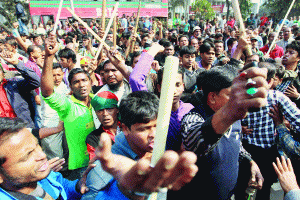
It expressed solidarity with over 800 representatives of leading non-governmental organisations and social movements who on Thursday walked out of the Warsaw Stadium, the venue of the climate talks, saying that the talks were on track to deliver virtually nothing.
“While still cherishing the last hope to make Warsaw a successful climate Conference,” China’s lead negotiator Suwei said he fully understood why there was a walkout. He said “the Warsaw talks which should have been an important step forward in the implementation of the Convention and the Kyoto Protocol, is now on the verge of delivering virtually nothing”.
On the sidelines of the talks, India’s Minister for Environment and Forests JayanthiNatarajan said that she had heard that a large number of NGOs have walked out protesting against the inaction of the developed countries in combatting climate change and blocking progress in many important areas in the ongoing Conference of Parties in Warsaw.
Ms Natarajan expressed India’s “deep concern that there has be absolutely no progress in any of the issues of interest to developing countries in this COP. Discussions on crucial issues of direct importance to developing countries like finance, technology and loss and damage have remained deadlocked due to lack of will by developed country Parties. This comes in the backdrop of some developed countries actually reneging on their commitments or decreasing them. I fully share the sentiments of the NGOs and call on developed countries to show their determination to implement commitments and increase their ambition to address the mitigation gap and provide enhanced means of implementation and ensure that the negotiations reach a meaningful conclusion in the COP."
At the informal stock-taking sessionon Thursday, the COP President, Poland’s recently sacked Environment Minister Marcin Korolec gave an update on several outstanding issues and also invited Ministers who were facilitating the consultations on loss and damage as well as the Co-chairs of the Ad Hoc Working Group on Durban Platform for Enhanced Action to provide information on the progress of the negotiations.
On the issue of loss and Damage, two Ministers, Edna Molewa (South Africa) and lena Margareta Ek (Sweden) conducted several ministerial bilaterals throughout the day. Ms Molewa said consultations were still going on and “progress was made to close the gap in divergences” and added that the issue would need more time to conclude.
On long-term Finance, the COP President informed Parties that he will convene an open-ended ministerial consultationon Friday morning (November 22) to present the results. “If we manage to complete the issue of finance, we have major success in Warsaw,” said Mr Korolec.
At the informal stock-take on Thursday, the European Union said this was a very important issue for them and more work was needed to finalize an outcome. The rules to establish the assigned amounts are essential so that the CP2 can be ratified.
Another critical issue that remains unresolved is the UNFCCC Secretariat’s programme budget for 2014-2015. The COP President said that the co-facilitators on this issue reported that intense discussions were still on-going.
On the work of the ADP, Co-Chair Arthur Runge-Metzger (EU) reported that Parties were busy providing suggestions to improve the decision text and conclusions for the ADP. (The Co-chairs had issued a second draft text on November 20 which saw substantial and intense discussions. A revised text is expected this morning for further feedback). The ADP was supposed to close on Thursday, November 21, but that will now happenon Friday.
At the conclusion of the informal stock-take yesterday,Fiji on behalf of G77 and Chinareiterated the importance of transparency and efficiency in the process and did not want a revisit or reopening of decisions already agreed to in the subsidiary bodies and working groups.
The fight over the revival of the market mechanism issue for a possible decision at the level of the COP, after its lack of agreement at the SBSTA, was one of the highlights of the Wednesday 20 November) stock-take plenary.
With many critical issues remaining contentious and awaiting resolution, it is unclear if the talks will end on time or will spill over to the following day, as has been the experience at past COP meetings.