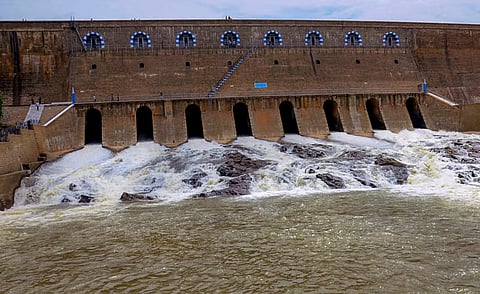

Tamil Nadu Chief Minister C Joseph Vijay on Tuesday opened the sluice gates of the Stanley Reservoir at Mettur, releasing Cauvery water for Samba cultivation and drinking needs across the delta, in his first Mettur water-release ceremony since taking office.
The gates were opened when the reservoir stood at 91.56 feet, against its full level of 120 feet. The storage was 54.452 tmcft, with an inflow of 10,857 cusecs.
The water will be released for 45 days from Tuesday to support Samba cultivation and meet drinking water requirements in the Cauvery delta.
The release came nearly three months later than the customary June 12 schedule. The delay was linked to weak rainfall in the Cauvery catchment and poor inflows into the reservoir.
For farmers in the delta, the opening of the gates sets the course for the Samba season. The timing of the release has also often become a political issue, particularly when water levels remain low.
The Mettur project took shape during the Madras Presidency, with construction beginning in 1925 under the Public Works Department. British engineer Col W M E Vincent Hart oversaw the work, which employed around 17,000 workers. Several villages, including Nayambadi, were relocated for the project.
The dam was completed and inaugurated on August 21, 1934, by Sir George Stanley, after whom the reservoir was named.
Over the decades, Mettur became a key point in regulating water for the Cauvery delta. The reservoir feeds the canal system connected to the Grand Anicut and supports irrigation across several districts.
June 12 became the customary date for opening the dam's gates for kuruvai cultivation, although the schedule has increasingly depended on rainfall and reservoir levels.
In 2011, the gates were opened early on June 6. In 2024, the release was delayed until July 28.
In June 2025, the reservoir touched its full level of 120 feet in June for only the second time since the dam was built, and the first time since 1957.
This year, the gates opened on September 1, nearly three months after the customary date.
Mettur was built at a time when large-scale irrigation projects were changing the way water was managed across the region. Stretching nearly 1,700 metres across the Cauvery gorge, the dam was a major engineering undertaking when it was completed in 1934.
Its significance also comes from its connection with the much older irrigation system of the delta. The Grand Anicut, built across the Cauvery more than 1,800 years ago, had already been diverting river water for agriculture. Mettur added a large storage reservoir to that system and gave the state greater control over when water could be released downstream.
The reservoir's water supports agriculture in the Cauvery delta, including parts of Thanjavur, Tiruvarur, Nagapattinam, Pudukkottai, Tiruchirappalli and Karur.
That has made the annual opening of the gates an important event for the region. Farmers closely watch the reservoir level and the government's decision on the release, as the timing can determine when cultivation begins.
The dam has also remained closely tied to the long-running Cauvery water dispute between Tamil Nadu and Karnataka. In years when inflows are poor, the question of when Mettur can be opened becomes particularly important for farmers waiting for water.
This year's September 1 release therefore comes after a long wait for the delta, with the reservoir opening nearly three months later than the traditional June 12 date.