Twice rebuilt, twice champions: Spain scripts football’s greatest reinvention story
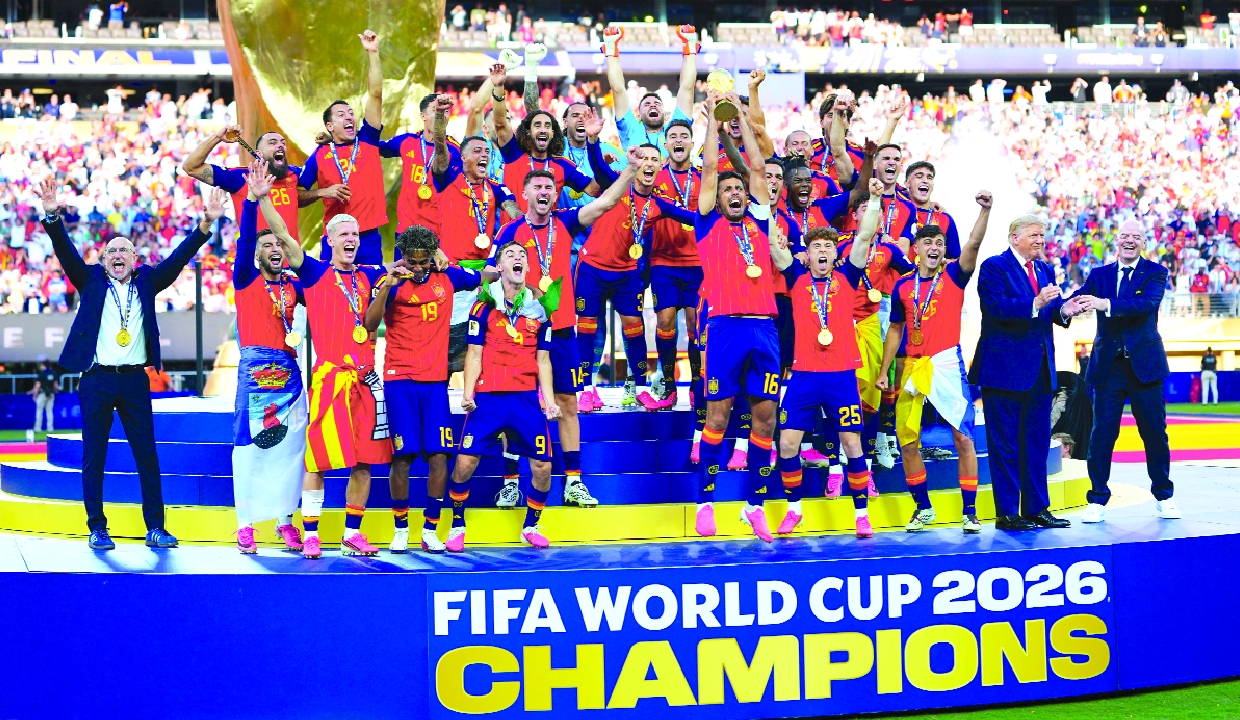
Spain are world champions once again after beating Argentina in the final.
An extra-time goal from Ferran Torres helped Spain add the FIFA World Cup to their UEFA Euro 2024 title. They have now won two World Cups and three European Championships in the last 18 years, establishing themselves as one of the greatest national teams in football history. In a little under two decades, Spain have built a record that few countries can match in an era when global competition has made sustained dominance harder than ever.
Yet this latest triumph is not simply the continuation of the team that conquered football between 2008 and 2012. It is the story of a nation that has reinvented itself twice.
For much of the twentieth century, Spain were international football’s great underachievers. Before 2008, they had reached the last four of the World Cup only once in 1950, while their only European Championship title came in 1964, when the tournament featured just four teams. Despite producing generations of technically gifted footballers and possessing one of Europe’s strongest domestic leagues, Spain repeatedly fell short on the biggest stage.
Despite possessing two of world football’s biggest clubs, Barcelona and Real Madrid, Spain often struggled to forge a cohesive national side. Club and regional rivalries were often cited as one factor behind that difficulty. Real Madrid traditionally represented Spain’s capital, while Barcelona became closely associated with Catalonia, and those club and regional identities occasionally carried over into the national team environment.
The arrival of Luis Aragonés after Spain’s first round exit in the 2004 European Championships changed things. He built a team around a clear footballing identity rather than reputation, before Vicente del Bosque carried that culture forward. The result was one of international football’s greatest teams, winning Euro 2008, the 2010 World Cup and Euro 2012 with a possession-based style that transformed the game. Like every great team, however, that cycle eventually came to an end.
Between 2014 and 2022, Spain often looked like a nation trying to recreate the past. They still dominated possession but struggled to create chances with the speed and unpredictability that had once made them irresistible. Round of 16 exits at the 2018 and 2022 World Cups to lower-ranked opposition, both after penalty shootouts, highlighted a side that controlled matches without consistently deciding them.
The response after Qatar was not another attempt to revive the old formula. Instead, Spain chose reinvention.
Former Athletic Bilbao defender Luis de la Fuente, who had spent nearly a decade within the Spanish Football Federation guiding youth sides to European titles and an Olympic silver medal, was appointed to the top job.
He already knew the country’s next generation, with many of the players who now form the backbone of the senior side having already won trophies under him as well as an Olympic silver medal in 2021.
One of the key factors at the heart of Spain’s successful reinvention under De la Fuente has been selection of players.
Rather than revolving around Barcelona and Real Madrid, today’s Spain are drawn from across the country’s football landscape.
Unai Simón, Aymeric Laporte, Fabián Ruiz and Mikel Oyarzabal have become leaders without having ever represented Spain’s traditional superclubs. Remarkably, Spain’s World Cup-winning squad did not include a single Real Madrid player, despite the club’s long-standing influence on the national team.
De la Fuente has also trusted youth with unusual conviction. Lamine Yamal became a starter before turning 18, while Pau Cubarsí was integrated into the senior side despite still being a teenager.
The regional balance is equally significant. Catalonia remains central to Spain’s footballing identity, but so too does the Basque Country, where players including Oyarzabal, Laporte and Simón, as well as De la Fuente himself, are closely associated. That broader representation, along with contributions from clubs across the country, has helped create one of the most cohesive outfits amongst modern national teams in recent times.
The first Spanish team proved the country could fulfil its immense potential. The second has shown the first was no accident. From Luis Aragonés to Vicente del Bosque and now Luis de la Fuente, Spain’s defining strength has not simply been a style of play, but the ability to build a collective identity that transcends club and regional loyalties while adapting to football’s changing demands.
This latest World Cup is therefore more than another trophy. It is evidence that Spain have evolved from a golden generation into a footballing institution. Teams are difficult to build. Rebuilding one may be even harder. Spain have now done both.
It completes one of international football’s most remarkable journeys: from decades of frustration to one of the greatest teams of the 21st century, through decline and reinvention, and back to the summit once again.
History will remember the medals and the silverware. But Spain’s greatest accomplishment may be something less tangible: the ability to repeatedly unite players from different footballing backgrounds around a shared identity.
The author is a sports management consultant with over a decade of experience in sports promotion and development; Views presented are personal.