Thought-provoking journey of Indus Cities to Harsha’s Empire
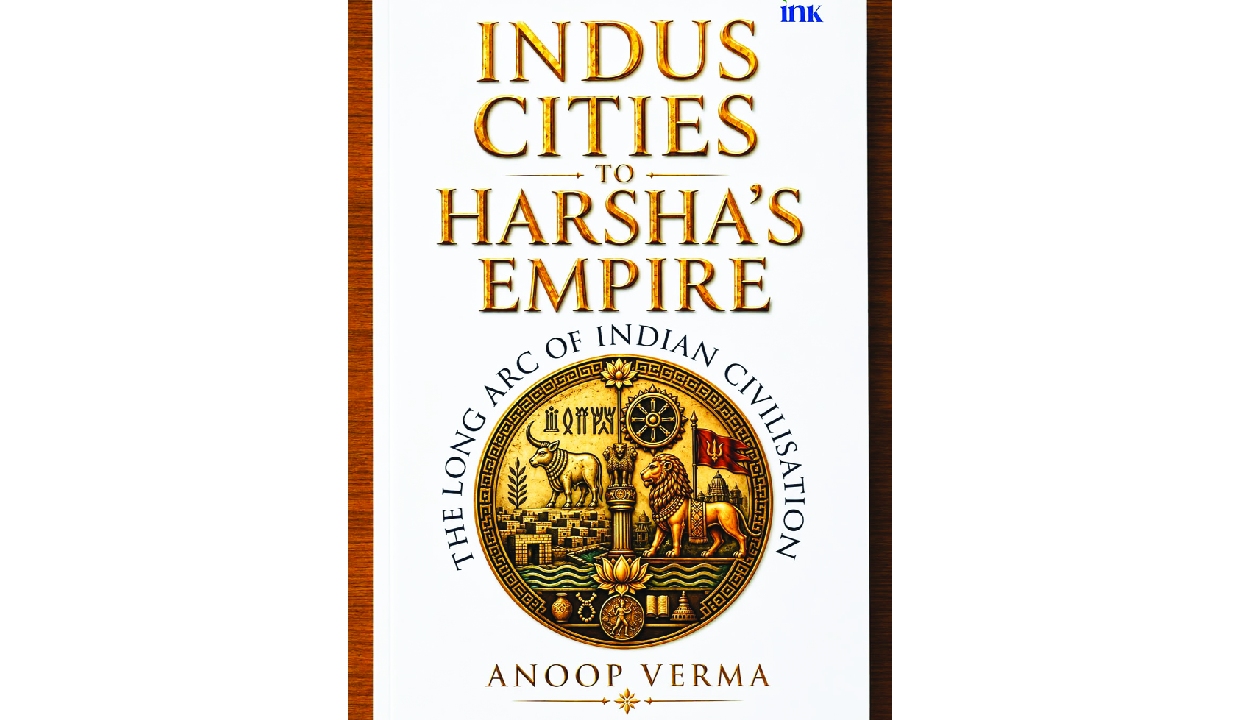
Civilisations rarely develop in straight lines. They evolve through encounters, conflicts, intellectual debates and institutional change.
In Indus Cities to Harsha’s Empire: The Long Arc of Indian Civilisation, Anoop Verma explores ancient India through this expansive lens, tracing nearly three millennia from the Indus Valley Civilisation to the age of Emperor Harsha.
Across almost 500 pages, Verma moves beyond a conventional chronology of dynasties and battles to examine what he sees as the evolution of the Indian civilisational mind.
The Vedic corpus, Upanishadic thought, Buddhism and Jainism, the epics, the Mauryan and Gupta periods, and the rise of regional powers are presented as interconnected stages in a continuing intellectual and cultural process.
A major strength of the book is its interdisciplinary approach. Archaeology, scripture, philosophy, literature and political history are brought together to examine enduring questions about authority, morality, social order and the relationship between the individual and the cosmos.
The transition to the Vedic world, the philosophical transformation represented by the Upanishads, and the emergence of Buddhism and Jainism demonstrate that ancient Indian thought developed through debate rather than simple continuity.
Similarly, the Ramayana and Mahabharata are treated as repositories of ethical and political dilemmas rather than merely literary or religious texts.
The Mauryan section effectively contrasts the pragmatic statecraft of the Arthashastra with Ashoka’s emphasis on dhamma and public welfare.
The Gupta period, meanwhile, is presented less as an isolated “golden age” than as a period of cultural and intellectual synthesis.