The Western Ghats: A decade of delay
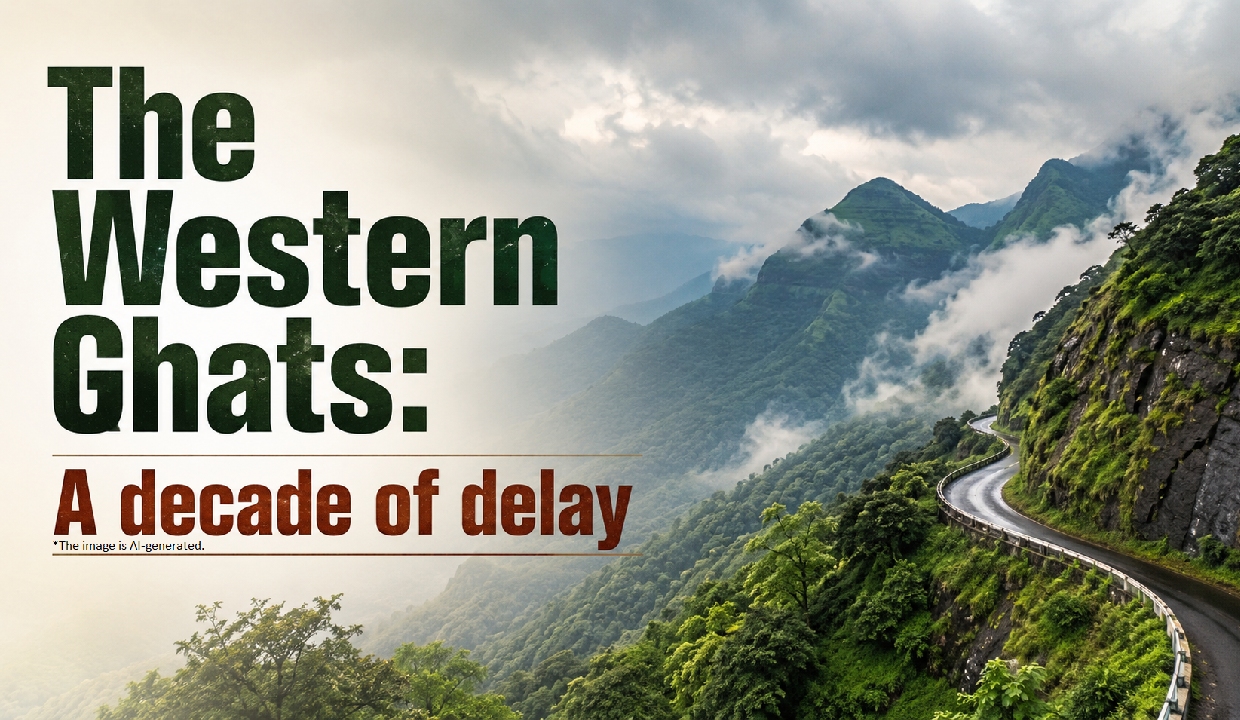
The Western Ghats have been mapped and studied for over a decade, yet there is no consensus on how much of this landscape must be protected, and at what cost?
On July 27, the Union Environment Ministry issued its seventh attempt since 2014 to notify Ecologically Sensitive Areas in the Western Ghats — proposing 56,825 square kilometres across six states where mining, quarrying, thermal power plants and large-scale construction would be restricted or banned. That it has taken seven drafts tells its own story: a policy first proposed in 2011 remains, in 2026, still unresolved.
The stakes are not abstract. The Ghats are one of the world’s eight richest biodiversity hotspots, home to more than 7,000 species, and the source of the Godavari, Krishna and Kaveri River systems that sustain peninsular India’s agriculture. They also shape the monsoon, and their degradation can cost lives.
Research shows the range’s evergreen forest cover shrank from 16 per cent in 1985 to barely 11 per cent by 2018, even as construction and farmland crept upward — a trajectory that makes disasters like Wayanad more likely, not less.
Yet Kerala, Karnataka and Goa remain unpersuaded, even as Maharashtra, Gujarat and Tamil Nadu now have accepted it. Karnataka, which carries the largest share at 20,668 sq km, objects less to conservation itself than to the absence of compensation: the Kasturirangan committee had recommended states be paid for economic activity forgone, a promise never kept. Kerala wants roughly 1,200 sq km excluded, arguing the notification threatens tourism livelihoods in Wayanad and Idukki, where critics say even a modest resort risks being classed a polluting industry.
Goa fears it will halt the conversion of farmland into real estate, and wants iron-rich Sattari taluka excluded altogether. These are not frivolous objections — mining revenue, plantation economies built on coffee, tea and spices, and tourism receipts are real livelihoods, not abstractions. But the framing of ecology versus economy is largely false. Studies find villages near intact forest report double the agricultural yield of those without; and the ecosystem services the Ghats provide — flood control, water security, carbon storage — dwarf in value what a shrinking pool of quarries and townships could generate, while benefiting a population far larger than the six Ghats states alone.
The way forward does not require choosing between the two. It requires the Centre to finally operationalise the compensation mechanism it has promised for over a decade, through payment-for-ecosystem-services rather than platitudes. It requires precise, ground-truthed, village-level mapping to end boundary disputes fed as much by misinformation as by fact. And it requires distinguishing, as experts have long urged, between genuinely destructive activity — mining, quarrying, unregulated construction — and the sustainable agriculture and eco-tourism that can coexist with protection. The Sanjay Kumar committee now has until 2027 to settle this.
Another missed deadline will not be neutral: given what fragmentation is already doing to this landscape, it will be a decision dressed up as indecision. India has weighed the Western Ghats’ fate for fifteen years. It cannot afford fifteen more.