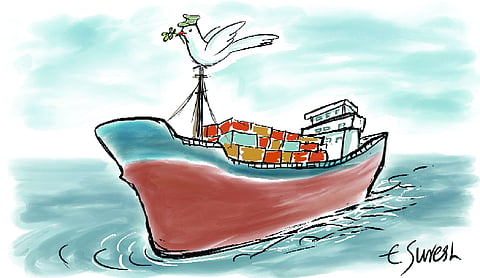

The Gulf crisis highlights the need for a stronger rules-based maritime order, with the United Nations Convention on the Law of the Sea (UNCLOS) at its core. For a maritime power like the United States, which follows many UNCLOS principles but has never ratified the convention, the debate carries significance far beyond its own shores
US Coast Guard Day, observed on August 4, comes at a time when the world’s attention is again focused on the Persian Gulf and the Strait of Hormuz. Rising tensions in the region have once again shown how closely maritime security is connected with energy, trade and global peace.
The US Coast Guard has a long history of protecting American waters, rescuing people at sea, preventing smuggling and helping ships in distress. Its role also reflects a larger reality of the modern world: the oceans are too important to be governed solely by naval power. They need common rules accepted by countries.
The most important international framework for this purpose is the United Nations Convention on the Law of the Sea, or UNCLOS. It is widely regarded as the basic legal framework for the world’s oceans. It covers navigation, territorial waters, maritime boundaries, fishing, seabed resources, marine pollution and the rights of coastal countries.
The United States signed UNCLOS in 1982 but has not ratified it. The US Senate has never approved the Convention. American objections have included the original provisions dealing with deep-seabed mining, international dispute settlement, military activities at sea and concerns about national sovereignty. The deep-seabed provisions were later revised through the 1994 Agreement.
America’s position remains unusual. Although it is not a party to UNCLOS, the United States accepts many of its basic navigation rules as customary international law. Washington strongly supports freedom of navigation and regularly challenges maritime claims it considers excessive.
The continuing tension in the Persian Gulf makes this issue especially important. The Gulf is a narrow and crowded maritime region surrounded by several countries. It contains some of the world’s most important oil and gas resources. The Strait of Hormuz connects the Gulf with the Arabian Sea and the wider Indian Ocean. It is one of the world’s most important energy routes.
Any disruption in the Strait can affect oil supplies, shipping costs, energy prices and economies far beyond West Asia. The impact can reach India, China, Japan, Europe and many other parts of the world.
UNCLOS provides a basic system for managing maritime spaces. A coastal country can claim a territorial sea of up to 12 nautical miles from its baselines. It exercises sovereignty in this area, subject to international law and the right of innocent passage for foreign ships.
Beyond the territorial sea lies the Exclusive Economic Zone (EEZ), which can extend up to 200 nautical miles. The EEZ is not an extension of national territory. A coastal country has special rights over natural resources such as fish, oil and gas, while other countries retain important freedoms of navigation and overflight.
This distinction is particularly important in crowded maritime regions. A country cannot treat its entire 200-nautical-mile EEZ as territorial waters. International law balances the economic rights of coastal states with the navigation rights of other countries.
UNCLOS also provides rules for international straits, continental shelves, fisheries, marine environmental protection, scientific research and the peaceful settlement of maritime disputes. It has helped bring a degree of order to an ocean covering most of the planet.
India is a party to UNCLOS and has a strong interest in maintaining this rules-based maritime order. India’s long coastline, island territories and vast EEZ make the law of the sea central to its national interests.
India’s economic future is closely connected with the ocean. A large part of India’s international trade moves by sea. Energy supplies from the Persian Gulf are particularly important. Millions of Indians live and work in Gulf countries, making stability in the region important not only for India’s economy but also for millions of families.
The Strait of Hormuz, therefore, has a direct connection with India. Any prolonged disturbance in the Strait can increase energy costs, affect shipping and put pressure on the Indian economy.
The issue also has a wider strategic dimension. The United States is one of the world’s most powerful maritime countries. Its Navy protects important sea lanes, while its Coast Guard performs vital functions related to maritime law enforcement, rescue and security. American participation in the international law of the sea system would add greater weight to the rules that govern global maritime activity.
The United States is not alone among countries that have not ratified UNCLOS. Turkey, Israel, Colombia and Venezuela are also outside the Convention, for different reasons. The American case attracts greater attention because of the country’s enormous economic, naval and global maritime influence.
The present Gulf tensions show the importance of a predictable maritime order. Ships carrying oil, food and other essential goods cannot depend solely on the goodwill of competing powers. They need internationally recognised rules.
The sea connects economies even when politics divides countries. A conflict in the Persian Gulf can affect fuel prices in India, shipping companies in Asia and consumers across the world.
US Coast Guard Day, therefore, carries significance beyond America’s maritime service. It is also an opportunity to recognise the importance of safe seas, freedom of navigation and international maritime law.
The future of the oceans cannot be secured by warships alone. It requires countries to respect maritime law, protect freedom of navigation and settle disputes peacefully.
A peaceful sea keeps the global economy moving. A lawless sea can bring the whole world to a standstill.
The Strait of Hormuz, therefore, has a direct connection with India. Any prolonged disturbance in the Strait can increase energy costs, affect shipping and put pressure on the Indian economy
The writer is a Professor at the Centre for South Asian Studies, School of International Studies and Social Sciences, Pondicherry Central University; Views presented are personal.